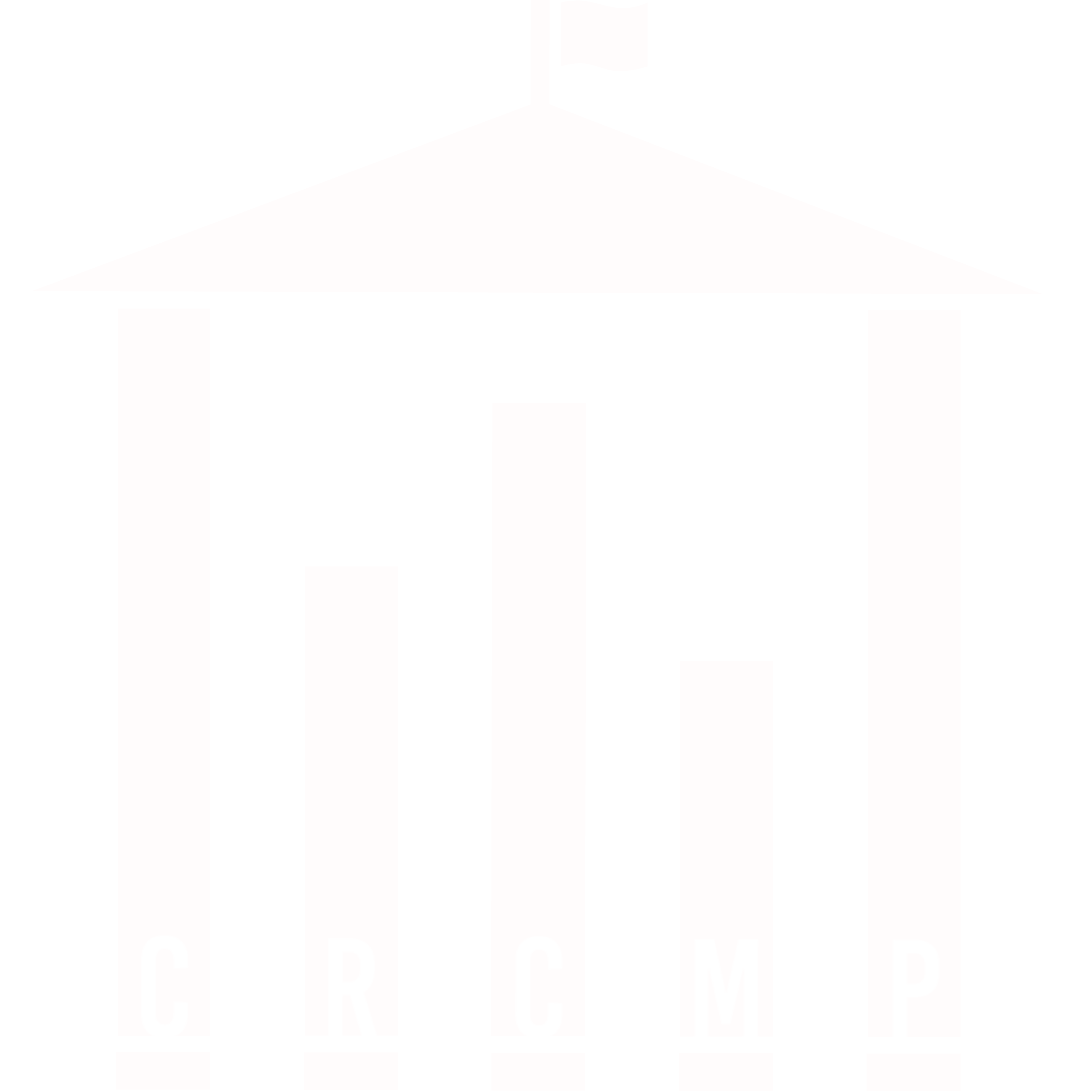

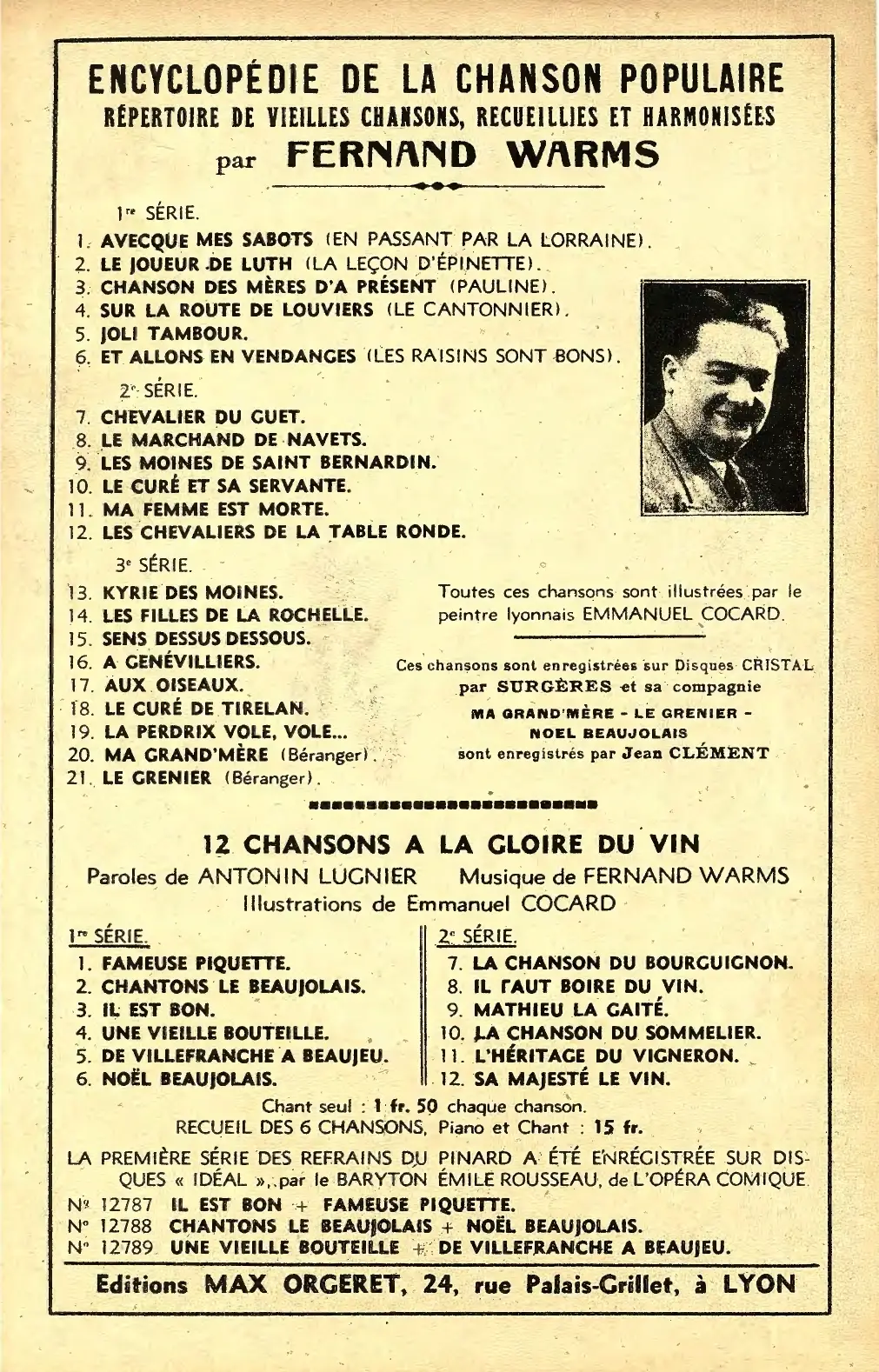
Le joueur de luth (Pour apprendre à jouer de l’épinette...), chanson de tradition orale recueillie et harmonisée par Fernand Warms, partition pour chant et piano, Lyon, Max Orgeret, 1936.


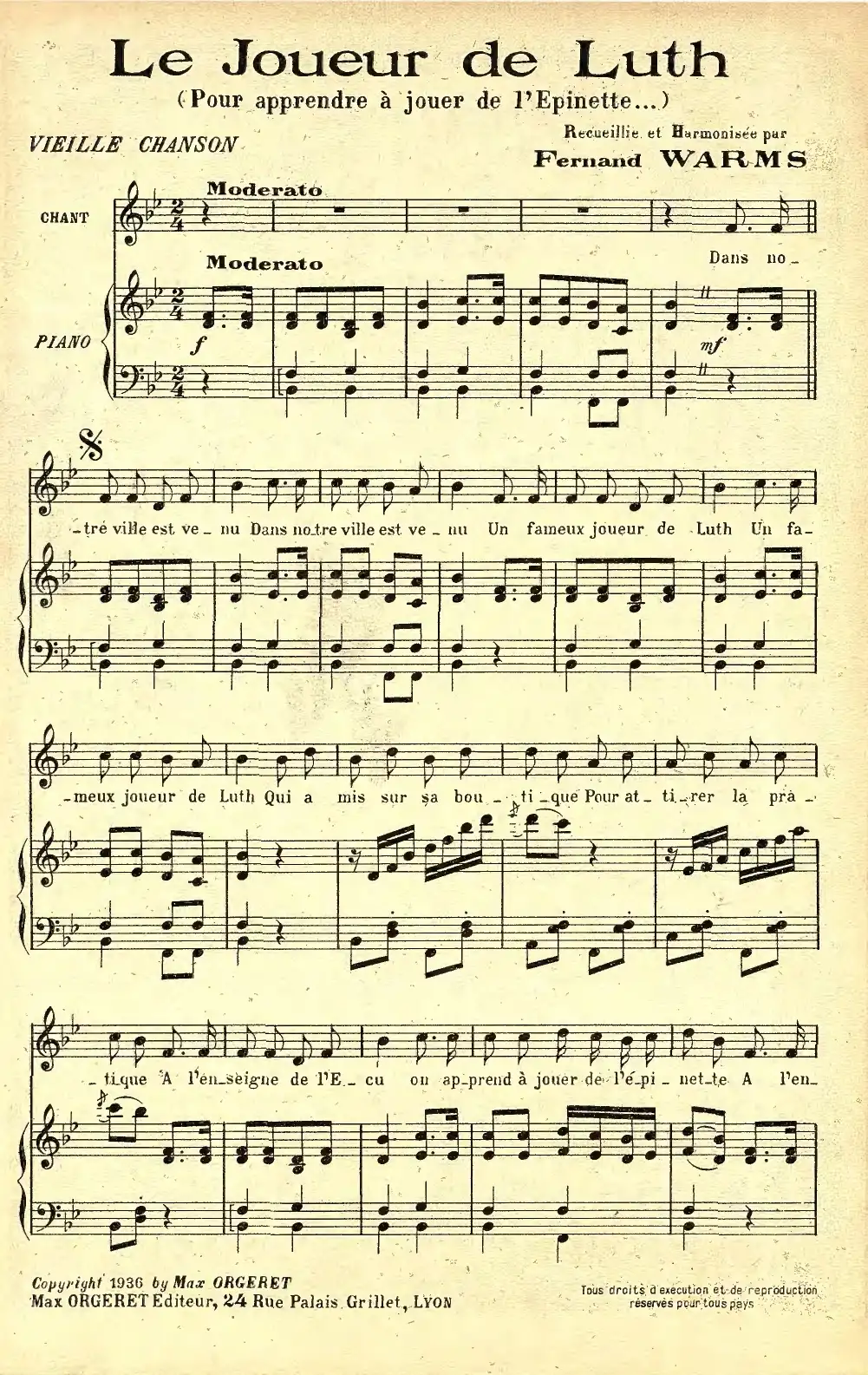
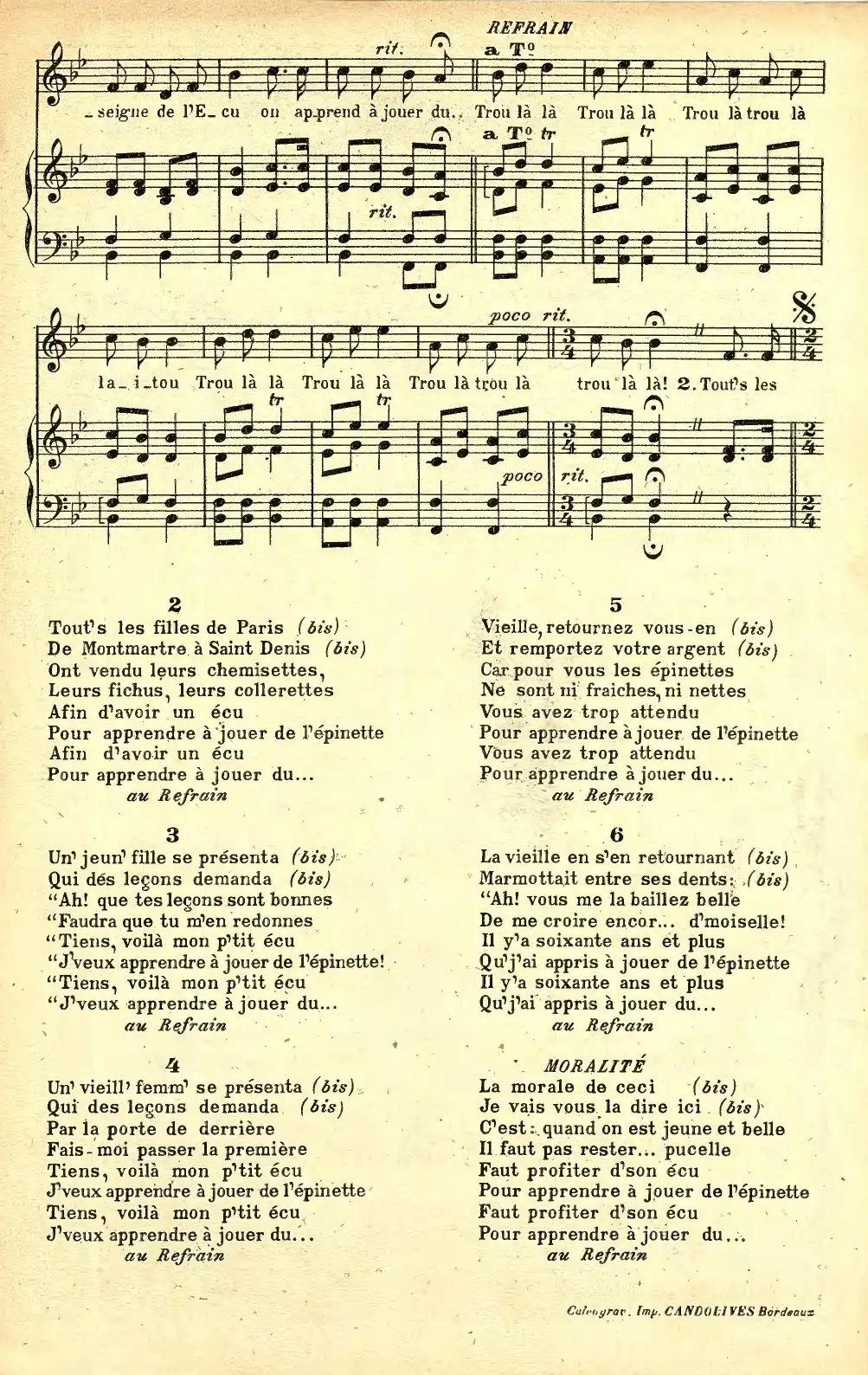
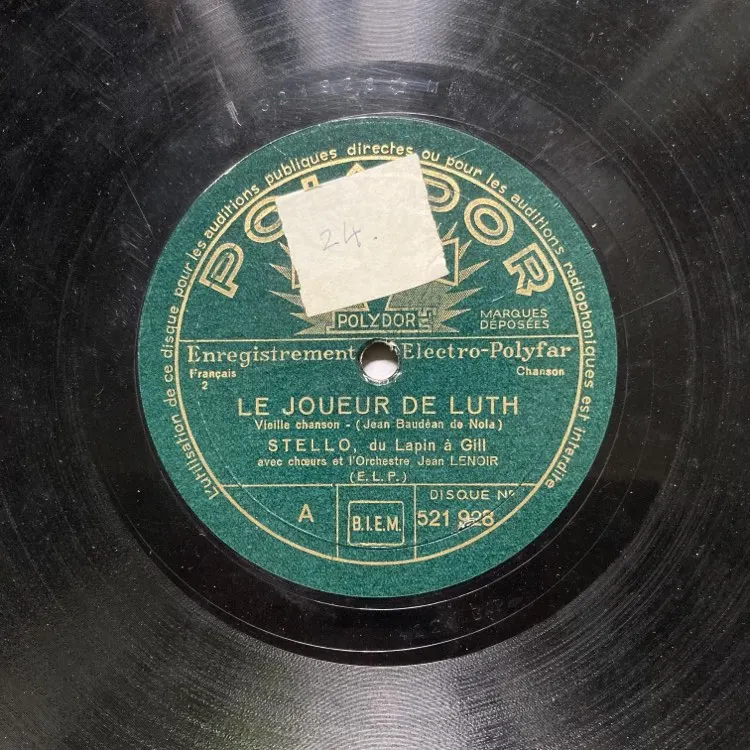
Le joueur de luth, Stello (chant), chœurs et orchestre Jean Lenoir, 1 disque 78 tours, Polydor, 521.928, v. 1931
1940-1941, Cherche-Midi prison
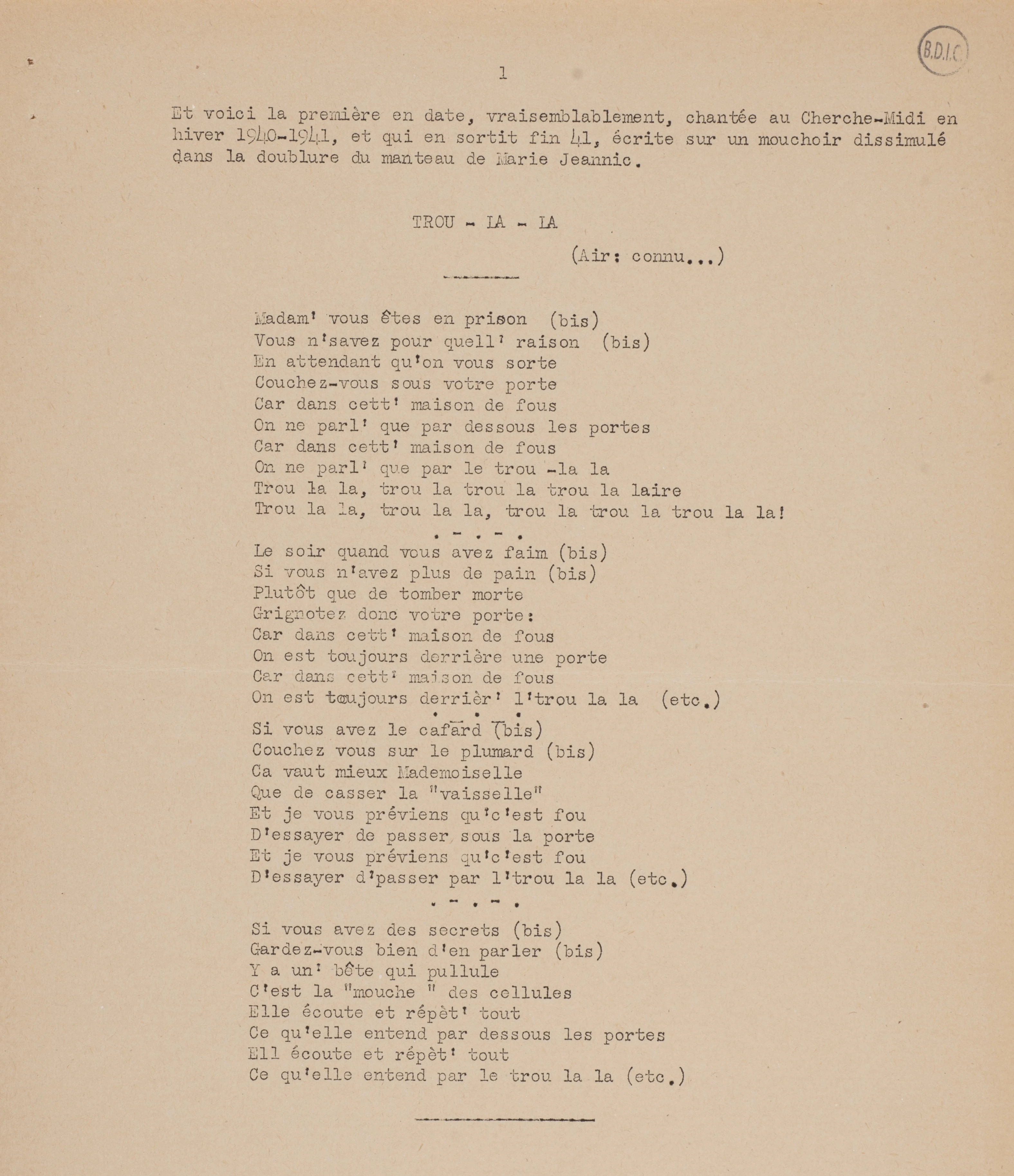
The first tune transcribed by Oddon takes its melody from the song Le joueur de luth (also known as Pour apprendre à jouer de l’épinette [Learning to play the spinet] and À l’auberge de l’écu [At the Buck Inn]), a bawdy song already considered old in the 1930s. Its lyrics are credited to Georges Denola (1865-1944) and its music, to Jean Baudéan (the pseudonym of Marie Baudéan, 1859-1921).
Le joueur de luth tells the story of the eponymous lute player arriving in town and offering young girls lessons on an instrument best left to the imagination, but heavily implied by the refrain, which insists on the importance of a “hole de rol” (a twist on “fol de rol”; the original French is a twist on “tra-la-la” that also uses “hole” [trou] in its wordplay). In the transformed version by Oddon and her companions, the “hole de rol” in question no longer refers to an orifice in the human body but to the lock on the cell door, serving as a metonymic reference to the reality of incarceration. While the original has six stanzas with the addition of a seventh to serve as the “moral” (an ironic one, of course), the modified version only adapts four stanzas while staying true to the original prosody. According to Oddon, it is the oldest of the prison songs and was written “in late ’41, on a handkerchief hidden in the lining of Marie Jeannic’s coat”. This fellow detainee at the Cherche-Midi, who belonged to Honoré d’Estienne d’Orves’ Resistance network, had been arrested, like Oddon, in February 1941; acquitted at the end of her trial, she likely managed to take the text of Hole-de-rol away with her when she was released.
The recording presented here of the original song was made in 1931 featuring the Montmartre singer Stello (the stage name of Paul-Édouard Fichter, 1882–1945). As one of the emcees at the cabaret Au Lapin Agile, Stello had a fondness for singing there accompanied by a chorus, a practice that is evident in his rendition of Le joueur de luth.
[Sources: references 7, 26, 33, 49, 55, 80, 129 in the bibliography]
Le joueur de luth
The Lute Player
(oral tradition)
Dans notre ville est venu (bis)
To our town did come (bis)
Un fameux joueur de Luth (bis)
A famous lute player (bis)
Qui a mis sur sa boutique
Who offered in his store
Pour attirer la pratique
To draw in customers
À l’enseigne de l’Écu
At the sign of a “buck”
On apprend à jouer de l’épinette,
Learn to play the spinet,
À l’enseigne de l’Écu
At the sign of a “buck”
On apprend à jouer du… Trou là là
Learn to play the… Hole de rol
Trou là là, Trou là trou là, la-i-tou
Hole de rol, Hole de, rol-hey-ho
Trou là là, Trou là là, Trou là, Trou là Trou là là!
Hole de rol, Hole de rol, Hole de, Hole de, Hole de rol!
2
Tout’s les filles de Paris (bis)
All the girls of Paris (bis)
De Montmartre à Saint Denis (bis)
From Montmartre to Saint Denis (bis)
Ont vendu leurs chemisettes,
Sold their camisoles,
Leurs fichus, leurs collerettes
their muffs, their ruffles
Afin d’avoir un écu
All to get a buck
Pour apprendre à jouer de l’épinette
To learn to play the spinet
Afin d’avoir un écu
All to get a buck
Pour apprendre à jouer du… au Refrain
To learn to play the… to Refrain
3
Un’ jeune fille se présenta (bis)
A young girl did come ’round (bis)
Qui des leçons demanda (bis)
Lessons she desired (bis)
« Ah! que tes leçons sont bonnes
“Oh! Your lessons are good fun
« Faudra que tu m’en redonnes
“You must give me another one
« Tiens, voilà mon p’tit écu
“Here’s my little buck
« J’veux apprendre à jouer de l’épinette!
“I want to learn the spinet!
« Tiens, voilà mon p’tit écu
“Here’s my little buck
« J’veux apprendre à jouer du… au Refrain
“I want to learn the… to Refrain
4
Un’ vieill’ femm’ se présenta (bis)
An old woman did come ’round (bis)
Qui des leçons demanda (bis)
Lessons she desired (bis)
Par la porte de derrière
In through the back door
Fais-moi passer la première
I’d like to go before
Tiens, voilà mon p’tit écu
“Here’s my little buck
J’veux apprendre à jouer de l’épinette
“I want to learn the spinet!
Tiens, voilà mon p’tit écu
“Here’s my little buck
J’veux apprendre à jouer du… au Refrain
“I want to learn the… to Refrain
5
Vieille, retournez[-]vous-en (bis)
Old woman, go away (bis)
Et remportez votre argent (bis)
Take back your money (bis)
Car pour vous les épinettes
For you the spinet
Ne sont ni fraîches, ni nettes
Is neither fresh nor clean
Vous avez trop attendu
You waited too long
Pour apprendre à jouer de l’épinette
To learn to play the spinet
Vous avez trop attendu
You waited too long
Pour apprendre à jouer du… au Refrain
To learn to play the… to Refrain
6
La vieille en s’en retournant (bis)
The old woman as she left (bis)
Marmottait entre ses dents (bis)
Muttered under her breath (bis)
« Ah! vous me la baillez belle
“Oh! you’re having me on
De me croire encor’… d’moiselle!
To think I’m still… a maiden!
Il y’a soixante ans et plus
It’s sixty or more years ago
Qu’j’ai appris à jouer de l’épinette
That I learned to play the spinet
Il y’a soixante ans et plus
It’s sixty or more years ago
Qu’j’ai appris à jouer du… au Refrain
That I learned to play the… to Refrain
MORALITÉ
MORAL
La morale de ceci (bis)
The moral of this tale (bis)
Je vais vous la dire ici (bis)
I’ll tell you right here (bis)
C’est : quand on est jeune et belle
It’s: when you’re young and pretty
Il faut pas rester… pucelle
You mustn’t stay… a maiden
Faut profiter d’son écu
Make the most of what you’ve got
Pour apprendre à jouer de l’épinette
To learn to play the spinet
Faut profiter d’son écu
Make the most of what you’ve got
Pour apprendre à jouer du… au Refrain
To learn to play the… to Refrain
Trou-la-la
Hole-de-rol
(ms p. 1)
Madam’ vous êtes en prison (bis)
Madam you’re in prison (bis)
Vous n’savez pour quell’ raison (bis)
You don’t know the reason (bis)
En attendant qu’on vous sorte
Until they let you go
Couchez-vous sous votre porte
Lie down by your door
Car dans cett’ maison de fous
For in this madhouse
On ne parl’ que par[-]dessous les portes
We only speak through the cracks in the door
Car dans cett’ maison de fous
For in this madhouse
On ne parl’ que par le trou-la la
We only speak through the hole-de-rol
Trou la la, trou la trou la trou la laire
Hole de rol, hole de hole de hole de hey-nonny
Trou la la, trou la la, trou la trou la trou la la!
Hole de rol, hole de rol, hole de hole de hole de rol!
Le soir quand vous avez faim (bis)
At night when you’re hungry (bis)
Si vous n’avez plus de pain (bis)
If you’ve got no more bread (bis)
Plutôt que de tomber morte
Instead of dropping dead
Grignotez donc votre porte :
Nibble on your door:
Car dans cett’ maison de fous
For in this madhouse
On est toujours derrière une porte
We’re always behind a door
Car dans cett’ maison de fous
For in this madhouse
On est toujours derrièr’ l’trou la la (etc.)
We’re always behind the hole-de-rol (etc.)
Si vous avez le cafard (bis)
If you’re in a funk (bis)
Couchez[-]vous sur le plumard (bis)
Lie down on your bunk (bis)
Ça vaut mieux Mademoiselle
That’s much better, Miss
Que de casser la « vaisselle »
Than breaking a dish
Et je vous préviens qu’c’est fou
And I’m warning you it’s mad
D’essayer de passer sous la porte
To try to go under the door
Et je vous préviens qu’c’est fou
And I’m warning you it’s mad
D’essayer de passer par l’trou la la (etc.)
To try to go through the hole-de-rol (etc.)
Si vous avez des secrets (bis)
If you’ve got secrets (bis)
Gardez-vous bien d’en parler (bis)
Don’t dare speak of it (bis)
Y a un’ bête qui pullule
There’s a pest that plagues us
C’est la « mouche » des cellules
It’s the “fly” of the cells
Elle écoute et répèt’ tout
It listens and repeats everything
Ce qu’elle entend par[-]dessous les portes
It hears from under the doors
Elle écoute et répèt’ tout
It listens and repeats everything
Ce qu’elle entend par le trou la la (etc.)
It hears from the hole-de-rol (etc.)