
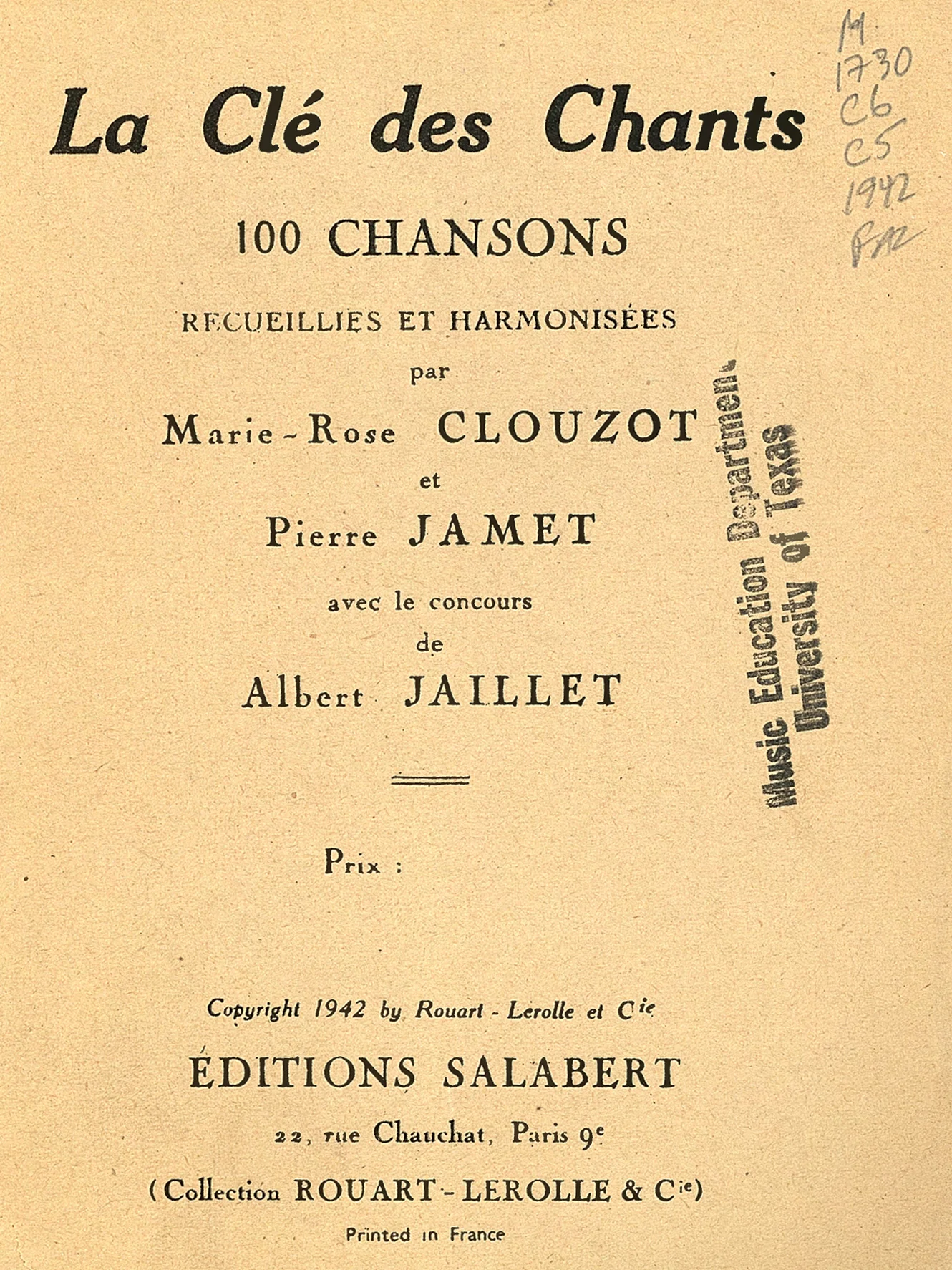
« Les deux compagnons », partition pour deux voix, dans La clé des chants, 100 chansons recueillies et harmonisées par Marie-Rose Clouzot et Pierre Jamet avec le concours d’Albert Jaillet, Paris, Éditions Salabert, 1942, p. 60-61.


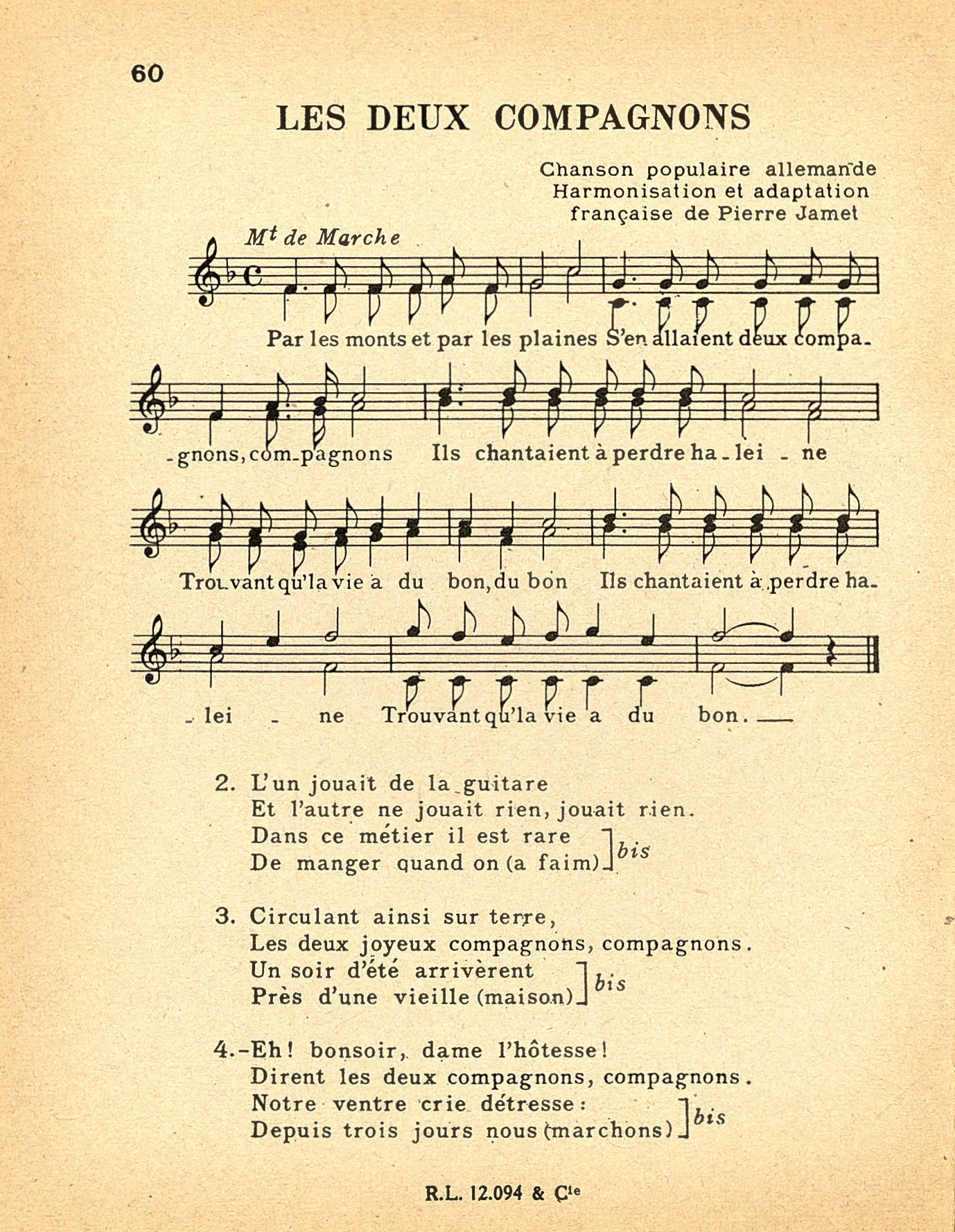
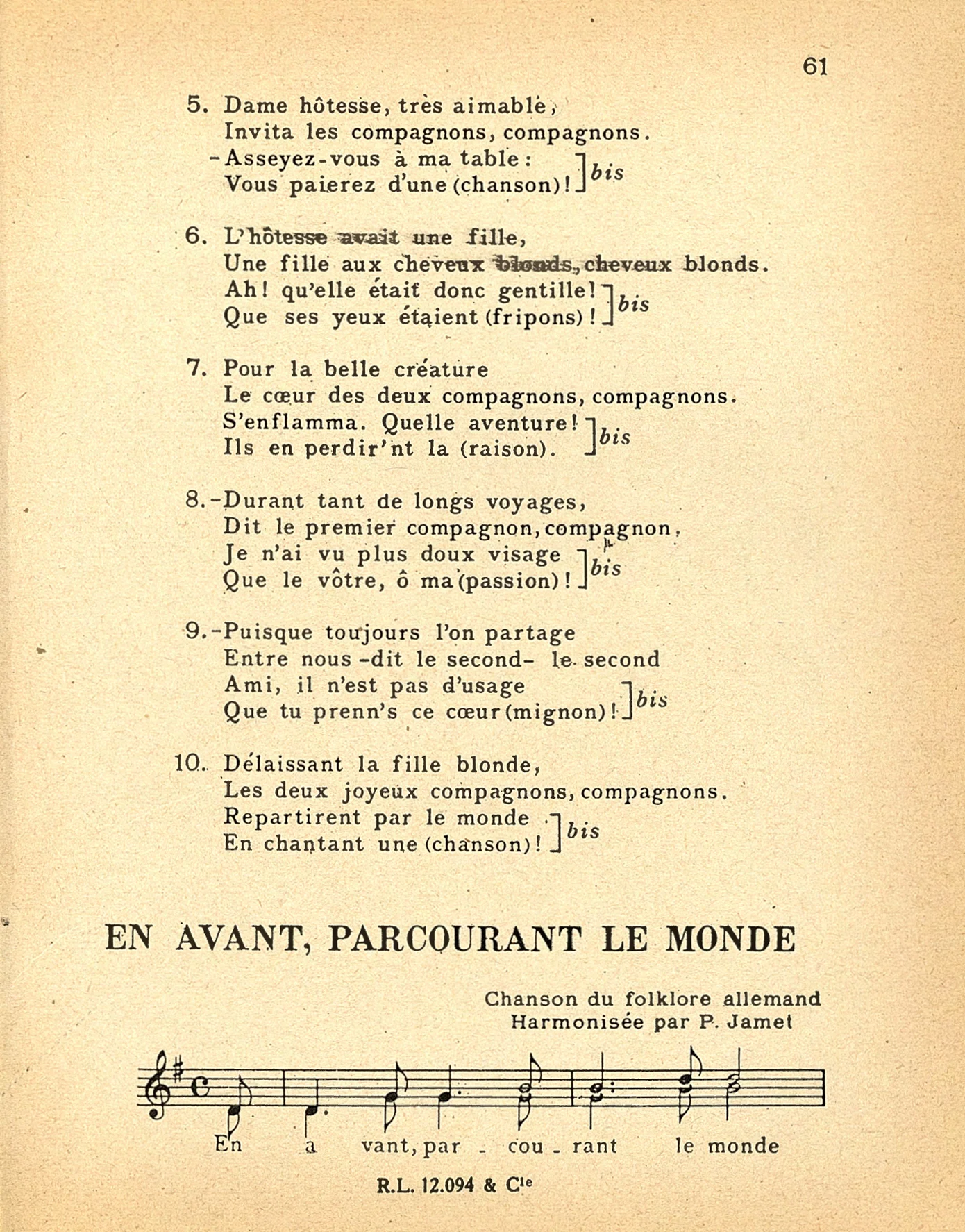
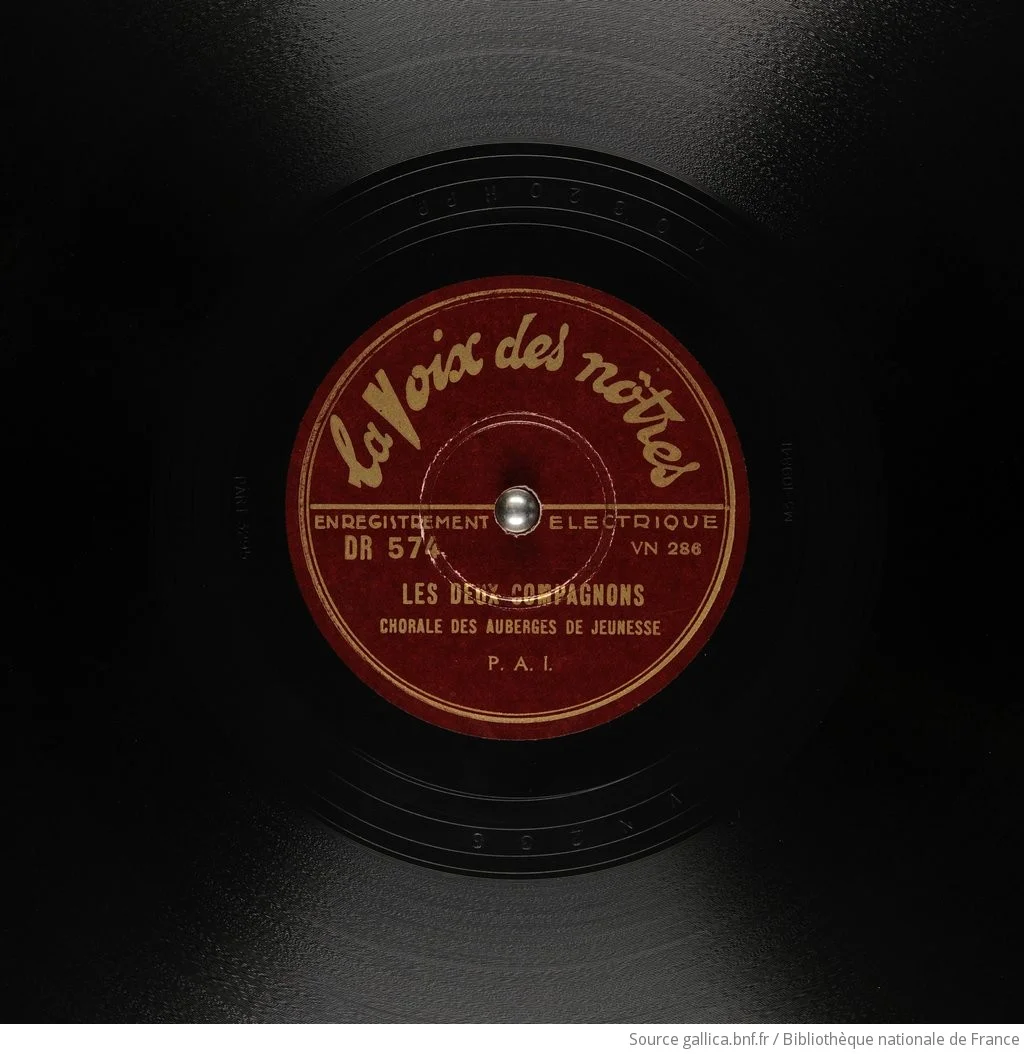
Les deux compagnons, Chorale des Auberges de jeunesse, 1 disque 78 tours, La voix des nôtres, DR574, ca 1937. Enregistrement conservé à la Bibliothèque nationale de France.
Early 1942, Anrath prison
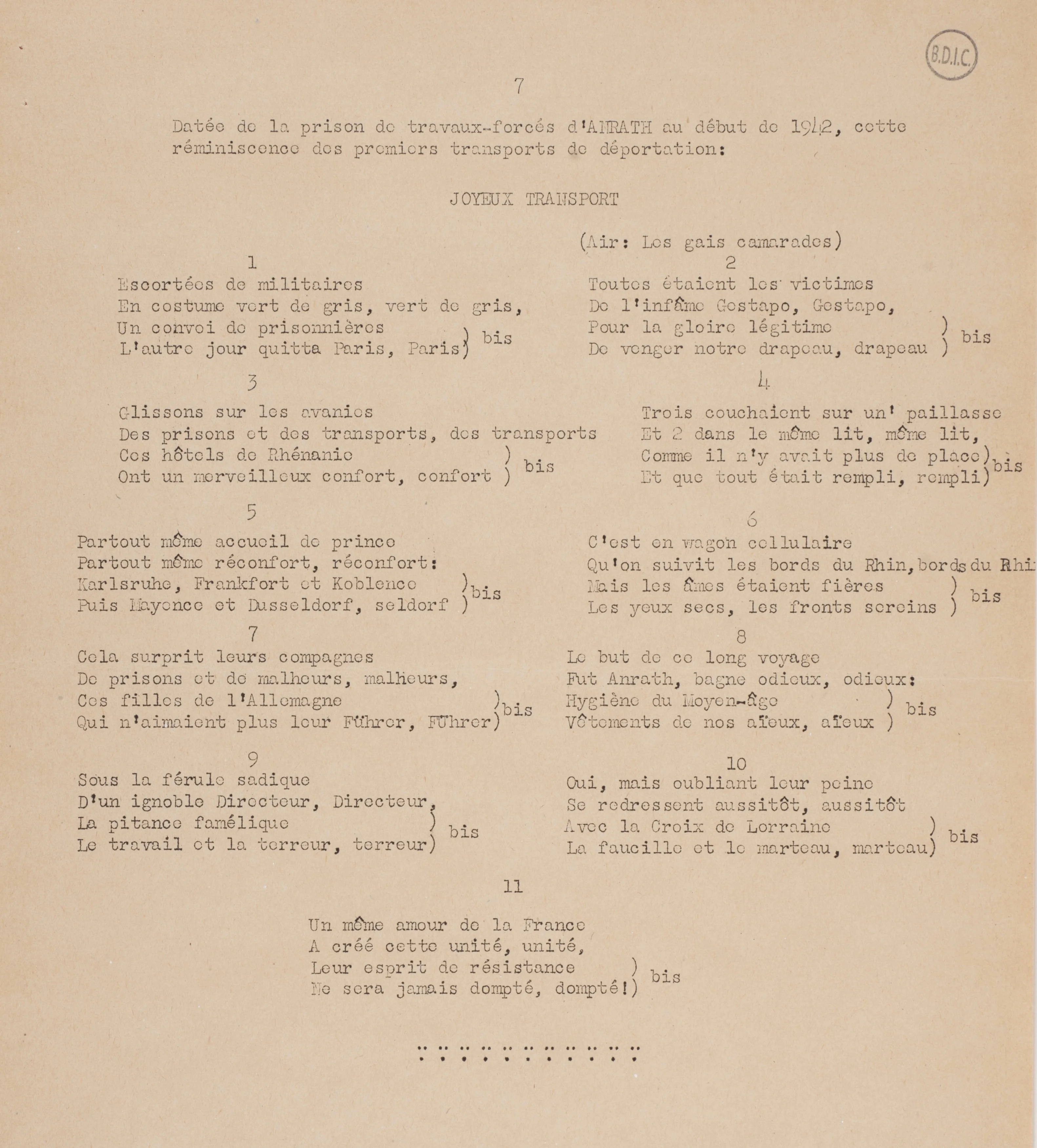
Oddon’s Joyeux transport is based on the song Les deux compagnons (erroneously identified in the typewritten document as Les gais camarades [The Happy Comrades]). The original text tells the story of two friends who stop along their way, ask a woman for lodging, and both fall in love with her daughter. Realizing that a shared love would be impossible and would ruin their friendship, the two friends decide to leave the young woman behind and carry on their way, singing as they go.
The score and period recording of Les deux compagnons that we have included here attest to the popularity of this song in socialist circles of the Popular Front, a political alliance of the 1930s that brought together members of the French Section of the Workers’ International (SFIO), the Radical Party, and the Communist Party. In the version chosen for our virtual exhibition, the score was arranged and conducted by Pierre Jamet; he was a singer, photographer and prominent member of the Centre laïque des auberges de la jeunesse (CLAJ), a secular centre affiliated with the youth hostel movement created by Léon Blum and established under the French Ministry of Recreation. The booklet with the score – titled La clé des chants and described as the equivalent of a Scout songbook, but intended for members of the youth hostel movement – sold 31,000 copies. The song performed by the Chorale des auberges de jeunesse (youth hostel choir) was recorded by La voix des nôtres (LVDN), a label whose main purpose was to distribute socialist propaganda albums for the SFIO. Side A of the record is Au-devant de la vie (the French version of a Soviet song by Dmitri Chostakovitch), a powerful symbol of the Popular Front.
It should also be noted that, starting in 1943, Pierre Jamet was one of the singers in the group Les quatre barbus. Some of their major hits (La pince à linge [The clothespin], Le parti d’en rire [The Laugh It Off Party]) were covers of contrafact songs written by Francis Blanche and Pierre Dac – the latter already known for his Resistance songs broadcast on the show Les Français parlent aux Français of the BBC’s Radio Londres (La complainte des nazis parodying La romance de Paris by Charles Trenet, broadcast in late 1943, is another example).
From the original song, Les deux compagnons, Yvonne Oddon and her fellow prisoners retained the travel, hospitality (with an ironic twist), and friendship themes. Joyeux transport tells the story of the deportation of a convoy of prisoners from Paris to Anrath, that had to stop on route in several “marvellously comfortable Rhineland hotels”. The transformed song describes the pride of the French women, who remained dignified and united despite “the labour and the terror”, “surpris[ing] their [German] companions in prison and misfortune”. Concluding with the lines “Their spirit of resistance / Will never be quashed, quashed!”, the song reaffirms that they will continue the fight, despite being arrested. Choosing a melody associated with the youth hostel movement makes perfect sense here: it highlights the importance of companionship, shared pride, and unity within the group. This unity among women of the Resistance, founded on “a shared love for France”, bridged gaps between various political factions, since the song represented the Gaullists (symbolized by the “Cross of Lorraine”) and the Communists (symbolized by “the hammer and sickle”); this alliance proved essential in times of crisis, as was the case among the Resistance groups in France beginning in 1942, echoing in some ways the spirit of the Popular Front era conveyed by the original song. Since the songs written “to the tune of” another and transcribed by Oddon were collective creations, it is not impossible that a fellow prisoner who was a socialist or communist came up with the idea to rework Les deux compagnons. This same melody was adapted in other Resistance circles: a song written by Robert Hauret in the summer of 1944 in the maquis – a term that can simultaneously refer to the scrubland or shrubs of the terrain and to the Resistance fighters in these rural areas, also called Maquisards – is a notable example that also features the symbol of the Cross of Lorraine.
[Sources: references 30, 68, 81, 84, 89, 99, 115, 116 in the bibliography]
Les deux compagnons
The Two Friends
(undated song of the youth hostel movement)
Par les monts et par les plaines
By mountain and plain
S’en allaient deux compagnons, compagnons
Went two friends, friends
Ils chantaient à perdre haleine
Singing at the top of their lungs
Trouvant qu’la vie a du bon, du bon.
Finding that life is good, good.
2.
L’un jouait de la guitare
One played guitar
Et l’autre ne jouait rien, jouait rien.
The other played nothing, nothing.
Dans ce métier il est rare
In this kind of work it’s rare
De manger quand on (a faim)
To eat when you’re (hungry)
3.
Circulant ainsi sur terre,
Roaming the earth like this
Les deux joyeux compagnons, compagnons.
The two jolly friends, friends.
Un soir d’été arrivèrent
One summer evening, approached
Près d’une vieille (maison)
An old (house).
4.
Eh! bonsoir, dame l’hôtesse!
Oh! Good evening madam hostess!
Dirent les deux compagnons, compagnons.
Said the two friends, friends.
Notre ventre crie détresse :
Our stomachs are crying out in distress:
Depuis trois jours nous (marchons)
For three days we’ve been (walking).
5.
Dame hôtesse, très aimable,
Madam hostess, so kind,
Invita les compagnons, compagnons.
Invited the friends, friends.
- Asseyez-vous à ma table :
– Come sit at my table:
Vous paierez d’une (chanson)!
For your supper, you’ll (sing)!
6.
L’hôtesse avait une fille,
The hostess had a daughter,
Une fille aux cheveux blonds, cheveux blonds.
A girl with blond hair, blond hair.
Ah! qu’elle était donc gentille!
Oh! How sweet was she!
Que ses yeux étaient (fripons)!
And how her eyes were (mischievous)!
7.
Pour la belle créature
For the pretty creature
Le cœur des deux compagnons, compagnons.
The hearts of the two companions, companions.
S’enflamma. Quelle aventure!
Burned with passion. What an adventure!
Ils en perdir’nt la (raison).
They would lose all sense of (reason).
8.
Durant tant de longs voyages,
During so many long voyages,
Dit le premier compagnon, compagnon.
Said the first companion, companion,
Je n’ai vu plus doux visage
I’ve never seen a lovelier face
Que le vôtre, ô ma (passion)!
Than yours, oh my (beloved)!
9.
Puisque toujours l’on partage
Since we always share
Entre nous – dit le second – le second
With each other – said the second – the second
Ami, il n’est pas d’usage
Friend, it’s not usual
Que tu prenn’s ce cœur (mignon)!
For you to steal this heart (so endearing)!
10.
Délaissant la fille blonde,
Leaving the blond girl behind,
Les deux joyeux compagnons, compagnons.
The two jolly companions, companions,
Repartirent par le monde
Set off once again into the world
En chantant une (chanson)!
Singing a (song)!
Joyeux transport
Jolly Transport
(ms p. 7)
1
Escortées de militaires
Escorted by soldiers
En costume vert de gris, vert de gris,
In uniforms of grey-green, grey-green
Un convoi de prisonnières
A convoy of prisoners
L’autre jour quitta Paris, Paris
Left the other day from Paris, Paris
2
Toutes étaient les victimes
All were victims
De l’infâme Gestapo, Gestapo,
Of the infamous Gestapo, Gestapo
Pour la gloire légitime
For the righteous glory
De venger notre drapeau, drapeau
Of avenging our flag, flag
3
Glissons sur les avanies
Let’s gloss over the indignities
Des prisons et des transports, des transports
Of the prisons and the transports, the transports
Ces hôtels de Rhénanie
These hotels of Rhineland
Ont un merveilleux confort, confort
Provide marvellous comfort, comfort
4
Trois couchaient sur un’ paillasse
Three were sleeping on a bed of straw
Et 2 dans le même lit, même lit,
And 2 in the same bed, same bed
Comme il n’y avait plus de place
Since there was no more room
Et que tout était rempli, rempli
And everywhere was full, full
5
Partout même accueil de prince
Everywhere the same princely welcome
Partout même réconfort, réconfort :
Everywhere the same comfort, comfort
Karlsruhe, Fran[c]fort et [C]oblence
Karlsruhe, Fran[k]furt and [K]oblenz
Puis Mayence et D[ü]sseldorf, seldorf
Then Mainz and D[ü]sseldorf, sseldorf
6.
C’est en wagon cellulaire
It’s in a prison van
Qu’on suivit les bords du Rhin, bords du Rhin
We traced the shores of the Rhine, shores of the Rhine
Mais les âmes étaient fières
But our souls were proud
Les yeux secs, les fronts sereins
Our eyes dry, our brows uncreased.
7
Cela surprit leurs compagnes
This surprised their companions
De prisons et de malheurs, malheurs
In prison and misfortune, misfortune
Ces filles de l’Allemagne
Those German girls
Qui n’aimaient plus leur Führer, Führer
Who no longer liked their Führer, Führer
8
Le but de ce long voyage
The goal of this long journey
Fut Anrath, bagne odieux, odieux :
Was Anrath, a labour camp most odious, odious:
Hygiène du Moyen [Â]ge
Sanitation quite medieval
Vêtements de nos aïeux, aïeux
Clothing of our ancestors, ancestors
9
Sous la férule sadique
Under the sadistic rule
D’un ignoble Directeur, Directeur,
Of a vile dictator, dictator
La pitance famélique
The meager rations
Le travail et la terreur, terreur
The labour and the terror, terror
10
Oui, mais oubliant leur peine
Yes, but putting aside their sorrow
Se redressent aussitôt, aussitôt
Rising again at once, at once
Avec la Croix de Lorraine
With the Cross of Lorraine
La faucille et le marteau, marteau
The sickle and hammer, hammer
11
Un même amour de la France
A shared love of France
A créé cette unité, unité,
Created this unity, unity
Leur esprit de résistance
Their spirit of resistance
Ne sera jamais dompté, dompté!
Will never be quashed, quashed!