
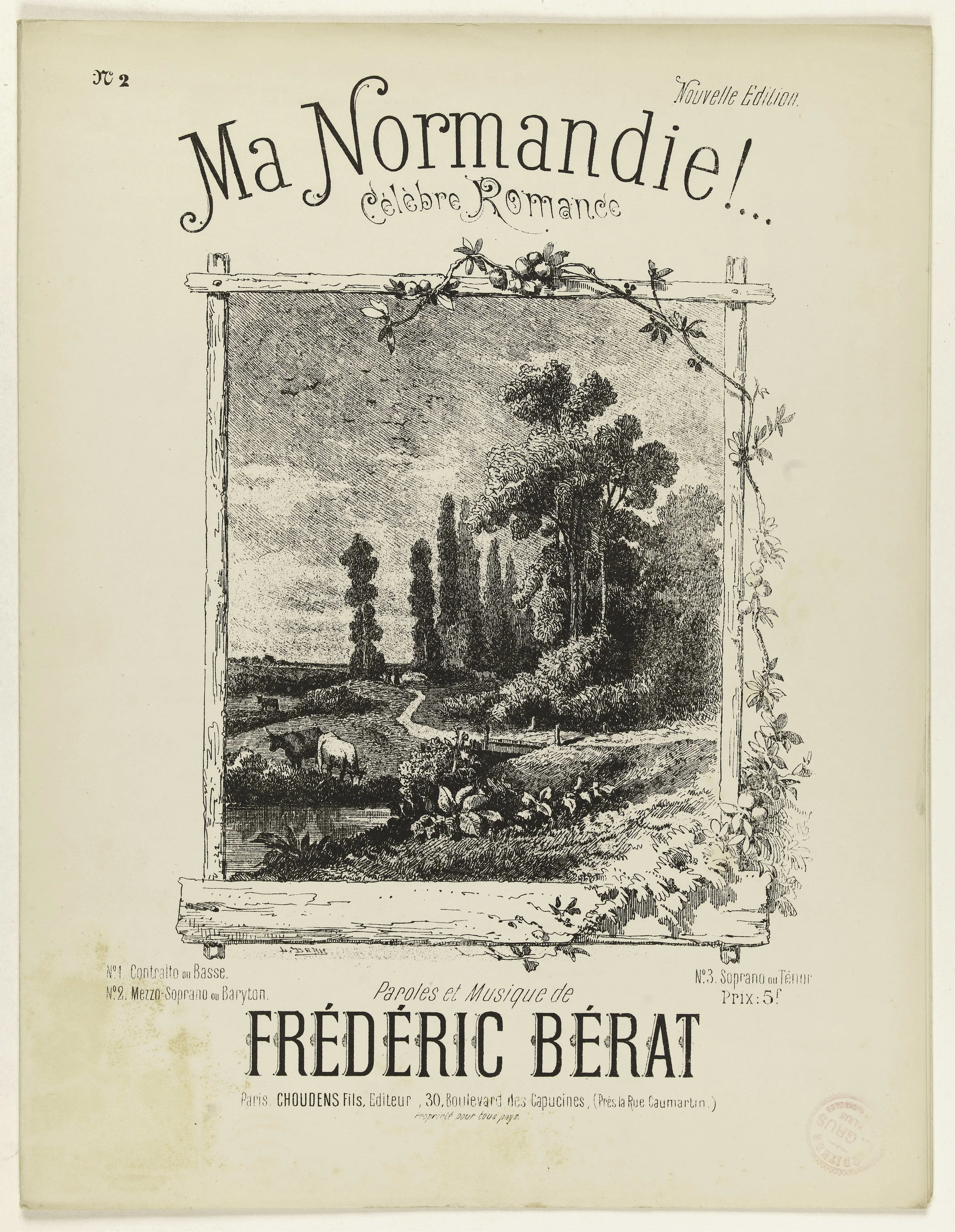
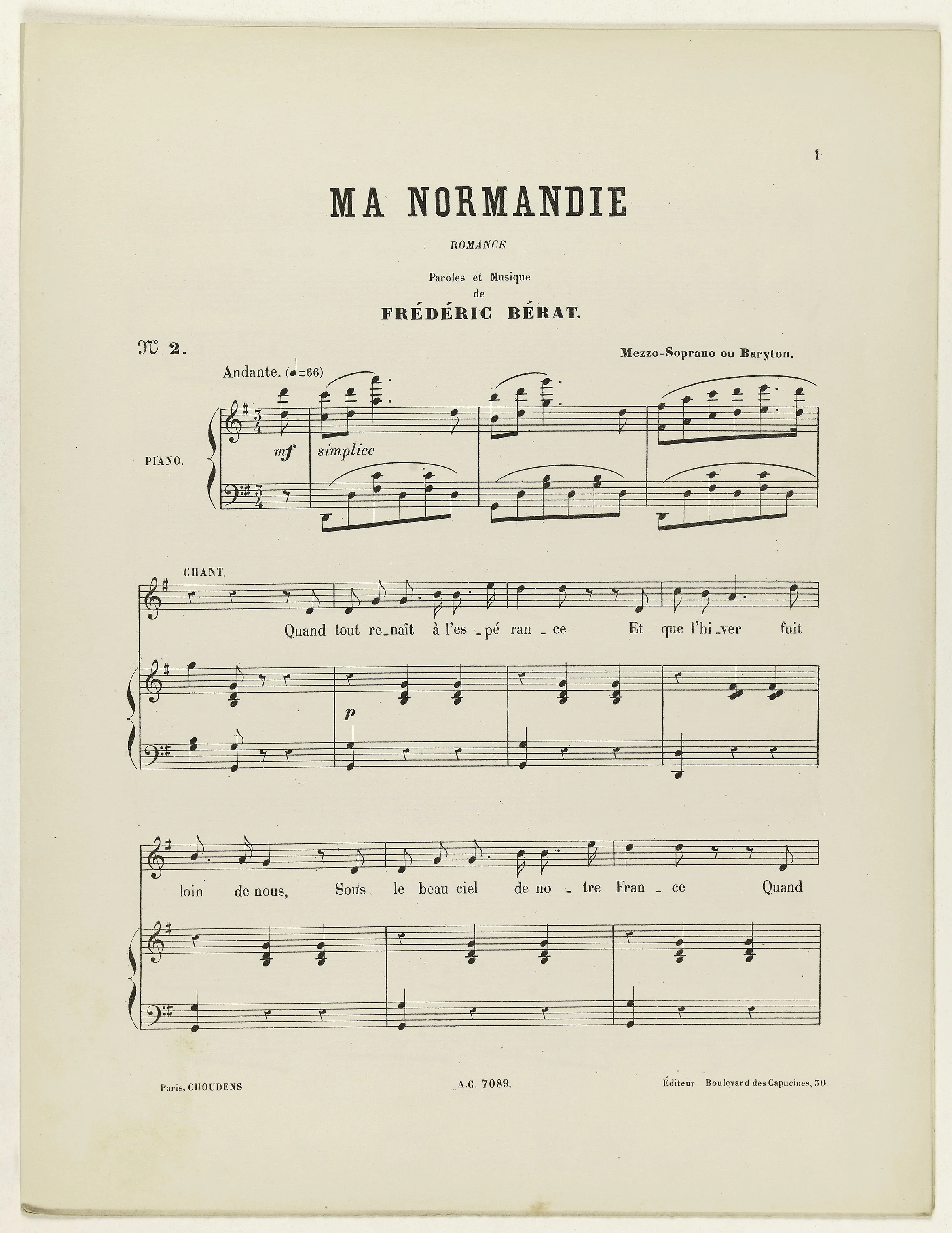
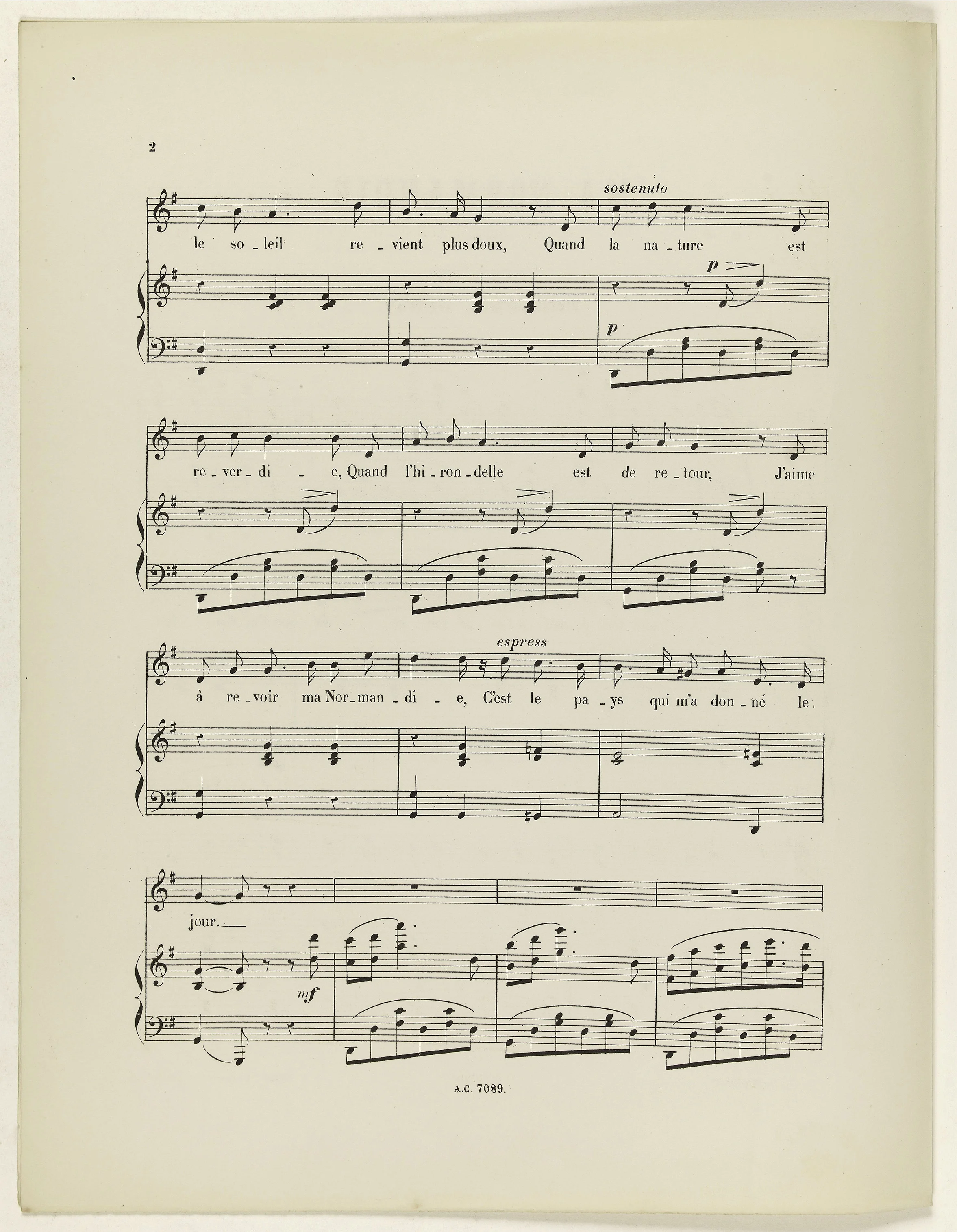
Frédéric Bérat (paroles et musique), Ma Normandie, romance, partition pour chant et piano, Paris, Choudens, A.C. 7089, v. 1890.


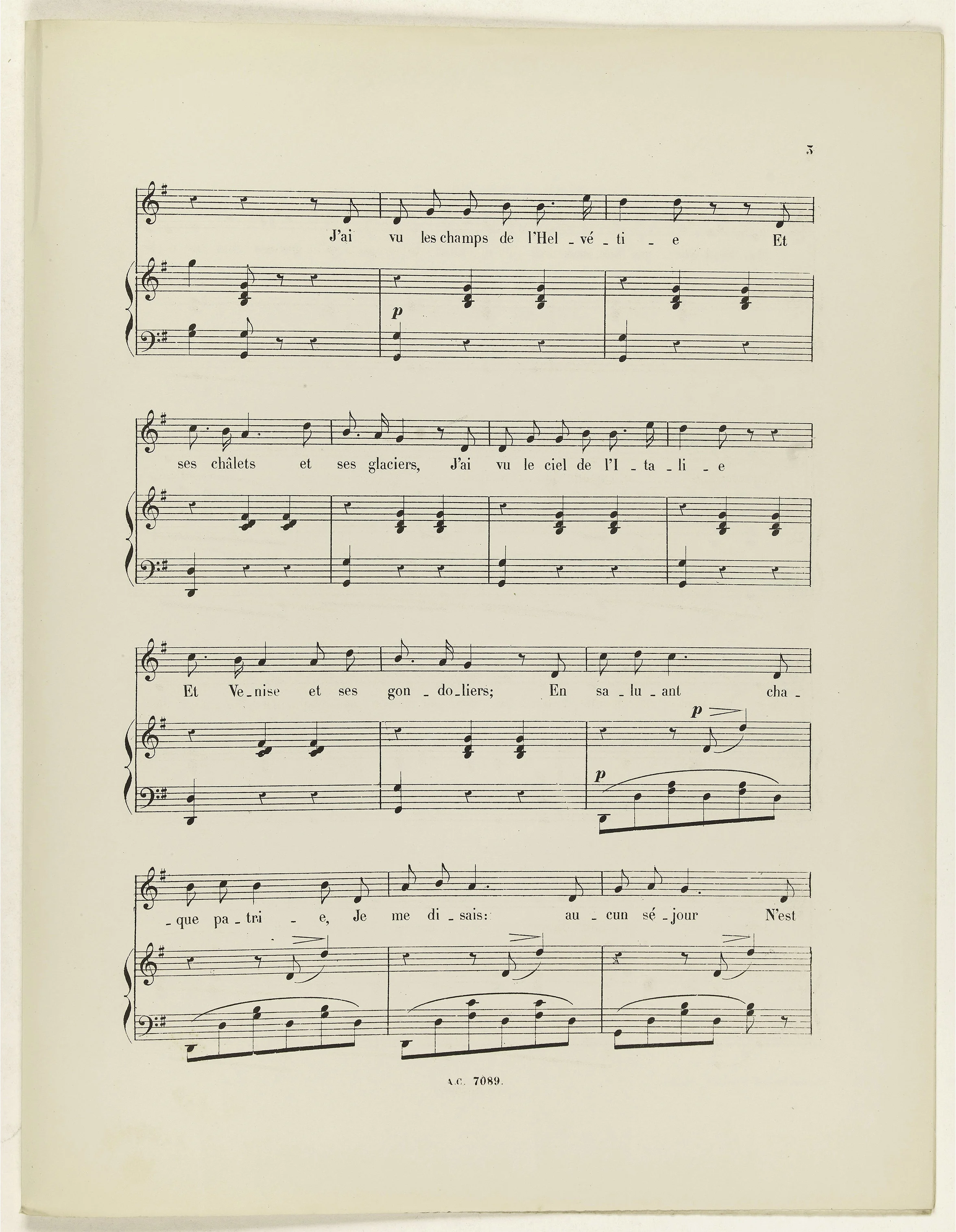
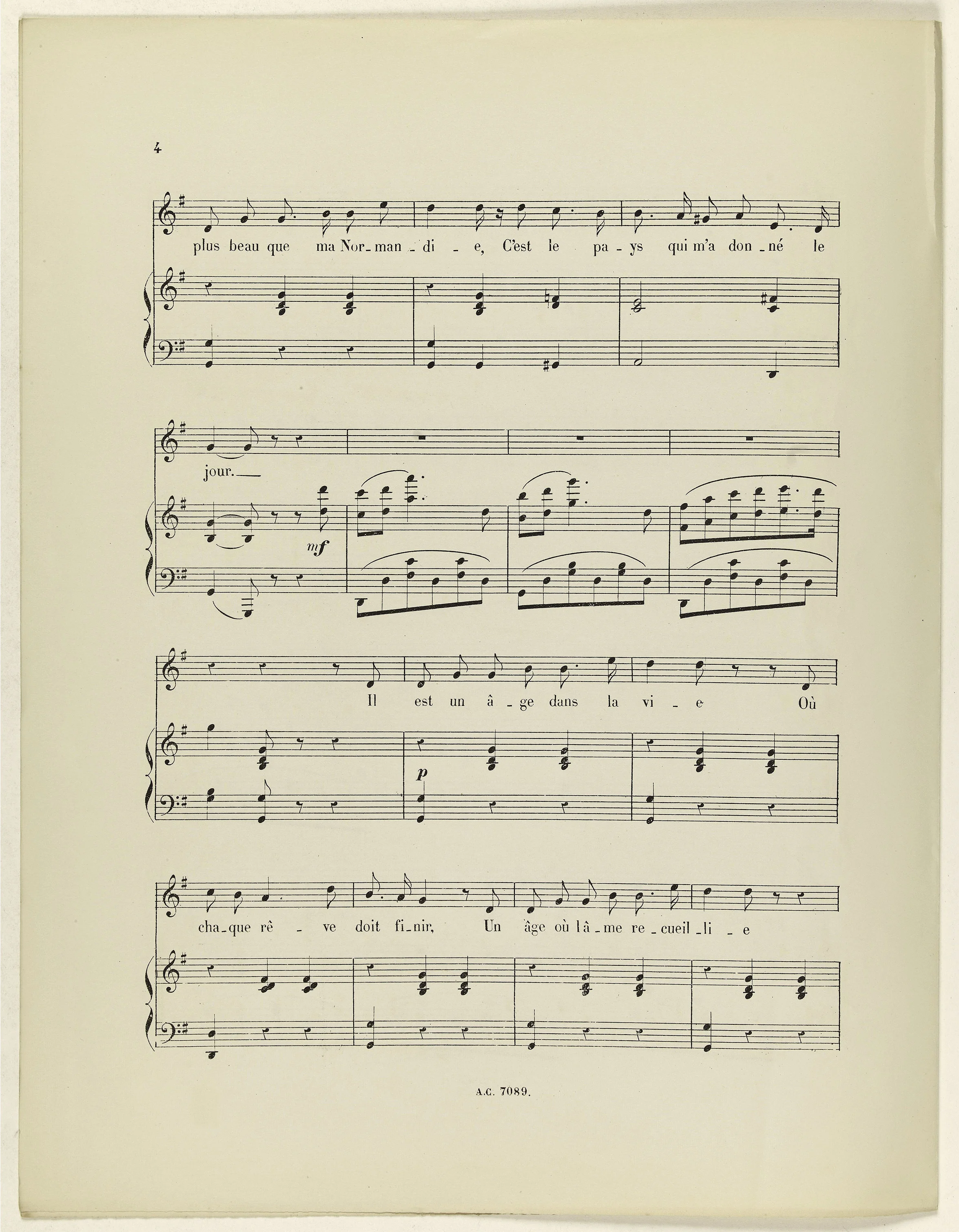
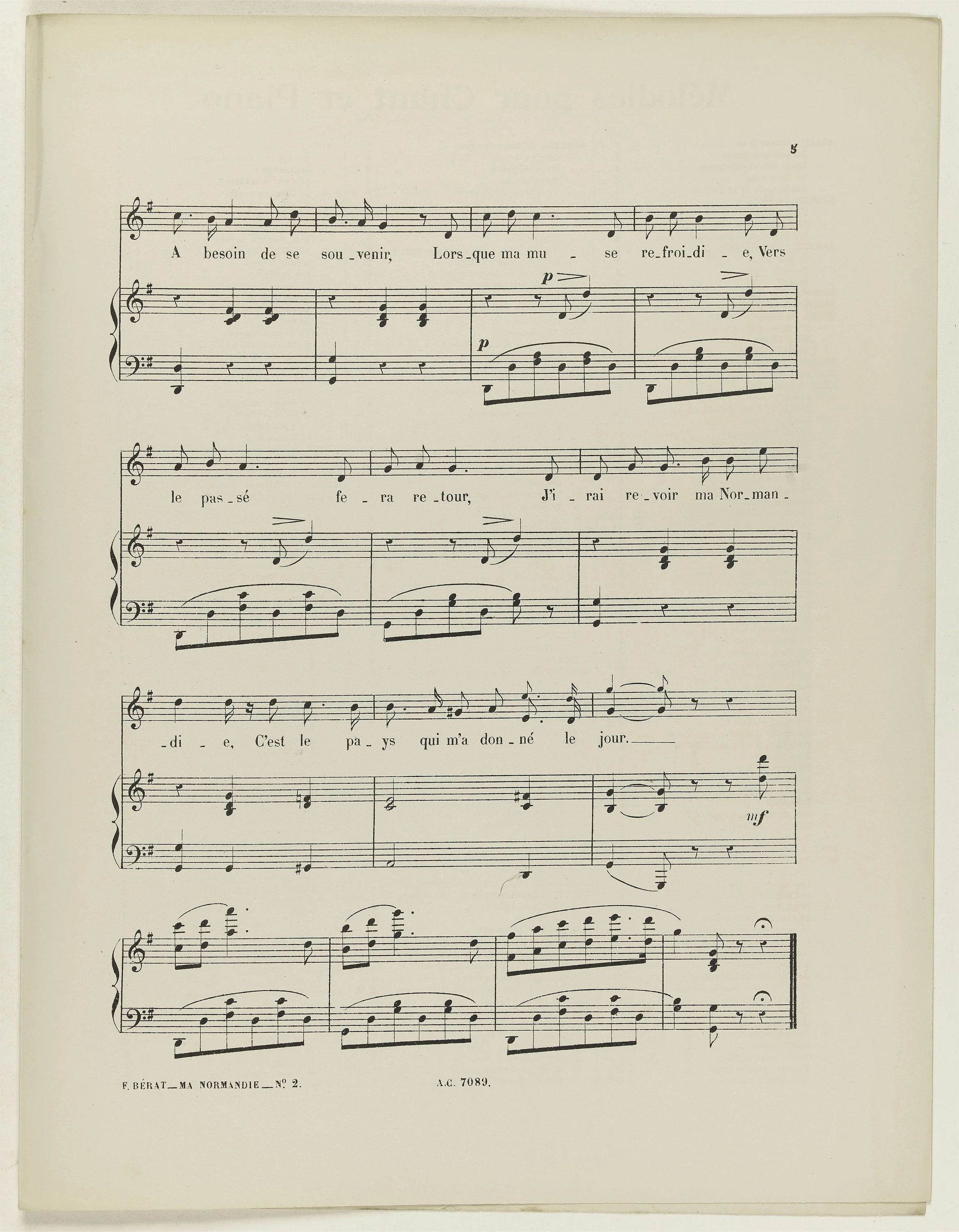
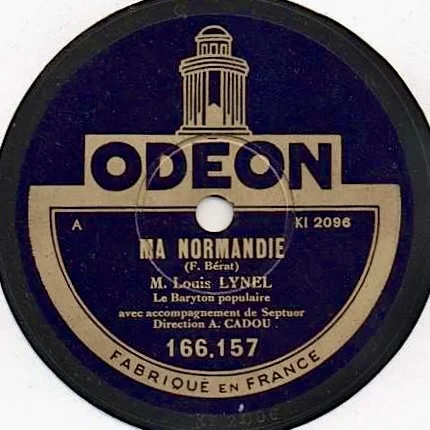
Frédéric Bérat (paroles et musique), Ma Normandie, Louis Lynel (chant), André Cadou (chef d’orchestre), 1 disque 78 tours, Odéon, 166.157, v. 1933.
1942, Anrath prison
This song uses the melody of the popular romance song Ma Normandie, which was composed in 1836 par Frédéric Bérat and had become an integral part of French oral tradition by the late nineteenth century. Originally from Rouen, Bérat reportedly wrote the words and music to Ma Normandie during a boat trip on the Seine between Le Havre and his hometown, taking his inspiration from the beauty of the region. A collection of popular French songs published in 1866 under the title Chansons nationales et populaires de France shows that just thirty years after the song’s first publication as sheet music, it had “sold over a million copies and [it was] still being print[ed] daily;” while this number is quite likely exaggerated, it nonetheless attests to the immense popularity of the song which, throughout the nineteenth century, spread from Parisian salons to the rest of France. When it was adapted by Yvonne Oddon and her fellow detainees, Ma Normandie had become so well-known that (almost) everyone in France could sing it from memory, without necessarily knowing its origin.
This song tinged with patriotism and nostalgia serves here as the foundation for a “sentimental song” written in the German prison Anrath in 1942 “to celebrate the first Allied air raids,” as Oddon wrote in her collection. In five verses (although the original song had only three), the transformed lyrics refer to the harsh reality of detention, but above all the hope of liberation for the prisoners who finally catch a glimpse of “the wings of our fighters.” This hope is alluded to using an intertextual reference to “sister Anne” from the tale of Bluebeard by Charles Perrault (thus implying the monstrosity of their jailers): the narrator of the first verse, who would seem to be a newly-condemned prisoner, addresses her more experienced prison “sisters” and asks them what they think will happen. The rest of the song is presented as a dialogue between the prisoner and her cell “sisters,” who, speaking collectively as a sisterhood, describe their suffering until the first narrator calls them to order by asking them if there is “a light in the distance;” the group then responds by voicing its hopes for justice and rescue, born out of the Allies’ war efforts. The song thus reflects the emotional ups and downs the prisoners could experience, shifting rapidly from despair to hope in response to the exhausting daily drudgery of incarceration and news of the war.
[Sources: references 45, 61, 94, 105 in the bibliography]
Ma Normandie
My Normandy
(1836)
Quand tout renaît à l’espérance
When all is reborn in hope
Et que l’hiver fuit loin de nous,
And winter retreats far from us
Sous le beau ciel de notre France
Beneath the beautiful sky of our France
Quand le soleil revient plus doux,
When the sun returns, now gentler
Quand la nature est reverdie,
When nature springs green once again
Quand l’hirondelle est de retour,
When the swallows return
J’aime à revoir ma Normandie,
I love to see my Normandy again
C’est le pays qui m’a donné le jour.
It’s the land that gave me life.
J’ai vu les champs de l’Helvétie
I’ve seen the fields of Helvetia
Et ses châlets et ses glaciers,
And its chalets and glaciers
J’ai vu le ciel de l’Italie
I’ve seen the sky of Italy
Et Venise et ses gondoliers;
And Venice and its gondoliers
En saluant chaque patrie,
When bidding adieu to each land
Je me disais : aucun séjour
I said to myself: no destination
N’est plus beau que ma Normandie,
Is more beautiful than my Normandy
C’est le pays qui m’a donné le jour.
It’s the land that gave me life.
Il est un âge dans la vie
There comes a time in life
Où chaque rêve doit finir,
When every dream must end,
Un âge où l[’]âme recueillie
A time when the soul, in contemplation,
A besoin de se souvenir,
Needs to remember,
Lorsque ma muse refroidie,
When my fading muse,
Vers le passé fera retour,
Turns toward the past,
J’irai revoir ma Normandie,
I’ll go see my Normandy once again,
C’est le pays qui m’a donné le jour.
It’s the land that gave me life.
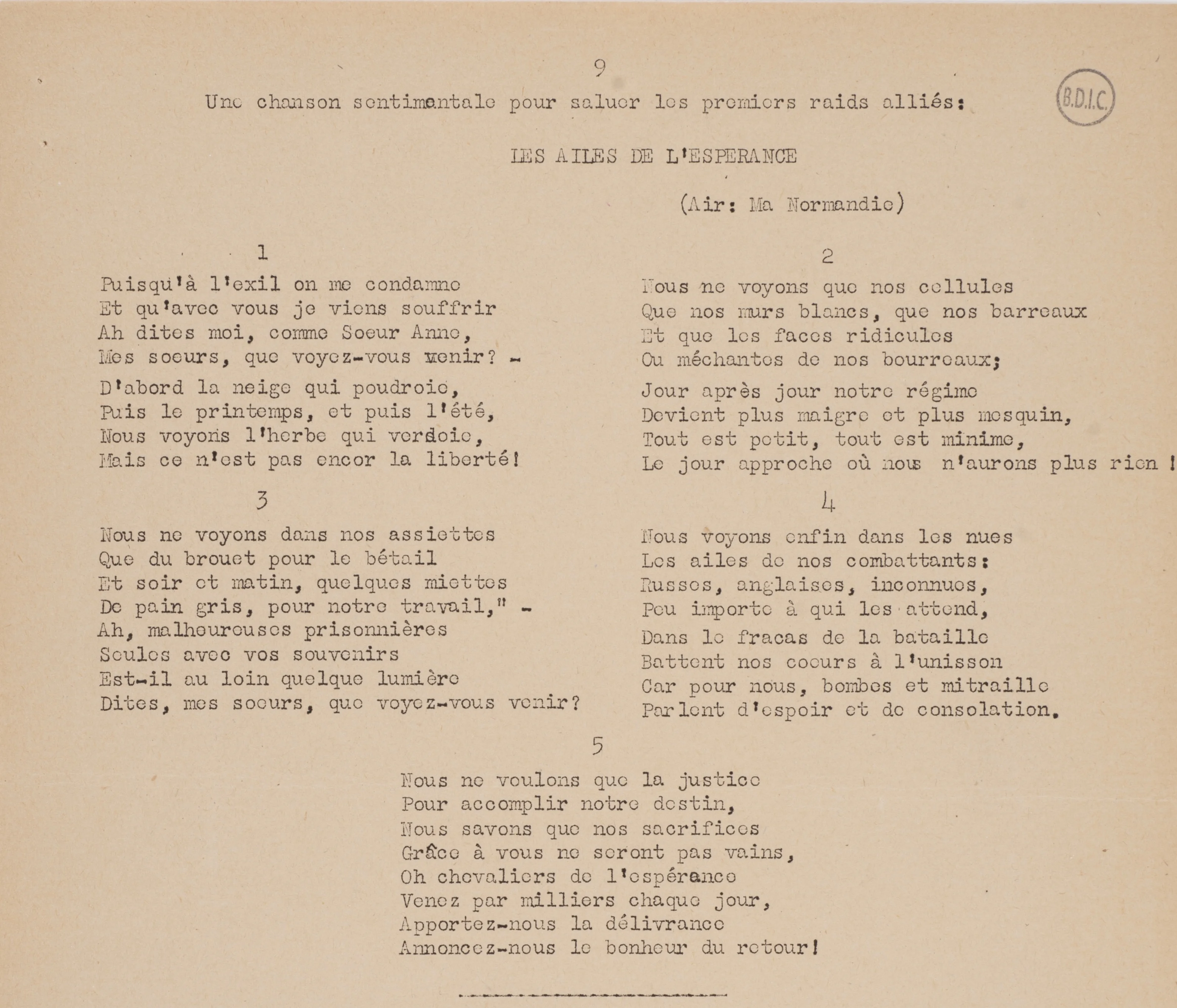
Les ailes de l’espérance
The Wings of Hope
(ms p. 9)
1
Puisqu’à l’exil on me condamne
Since to exile I’ve been condemned
Et qu’avec vous je viens souffrir
And with you come to suffer
Ah dites[-]moi, comme Sœur Anne,
Oh tell me, like Sister Anne,
Mes sœurs, que voyez-vous venir? –
My sisters, what do you see coming? –
D’abord la neige qui poudroie,
First the powdery snow,
Puis le printemps, et puis l’été,
Then spring, then summer,
Nous voyons l’herbe qui verdoie,
We see the grass grow green,
Mais ce n’est pas encor la liberté!
But that’s not yet freedom!
2
Nous ne voyons que nos cellules
We see nothing but our cells
Que nos murs blancs, que nos barreaux
Our white walls, our bars
Et que les faces ridicules
And only the ridiculous
Ou méchantes de nos bourreaux;
Or wicked faces of our persecutors;
Jour après jour notre régime
Day after day our rations
Devient plus maigre et plus mesquin,
Become more meager and miserly
Tout est petit, tout est minime,
Everything is small, everything is minimal
Le jour approche où nous n’aurons plus rien!
The day is coming when we’ll have nothing at all!
3
Nous ne voyons dans nos assiettes
All we see on our plates
Que du brouet pour le bétail
Is slop for cattle
Et soir et matin, quelques miettes
And night and day, a few crumbs
De pain gris, pour notre travail, –
Of dry bread, for our labour, –
Ah, malheureuses prisonnières
Oh woeful prisoners
Seules avec vos souvenirs
Alone with your memories
Est-il au loin quelque lumière
Is there a light in the distance
Dites, mes sœurs, que voyez-vous venir?
Tell me, sisters, do you see it coming?
4
Nous voyons enfin dans les nues
At last we see in the clouds
Les ailes de nos combattants :
The wings of our fighters:
Russes, anglaises, inconnues,
Russian, English, unknown,
Peu importe à qui les attend,
It matters not to those awaiting them
Dans le fracas de la bataille
In the roar of battle
Battent nos cœurs à l’unisson
Our hearts beat as one
Car pour nous, bombes et mitraille
For to us, bombs and gunfire
Parlent d’espoir et de consolation.
Proclaim hope and solace.
5
Nous ne voulons que la justice
All we want is justice
Pour accomplir notre destin,
To fulfil our destiny,
Nous savons que nos sacrifices
We know that our sacrifices
Grâce à vous ne seront pas vains,
Thanks to you will not be in vain,
Oh chevaliers de l’espérance
Oh knights of hope
Venez par milliers chaque jour,
Come daily by the thousands
Apportez-nous la délivrance
Deliver us
Annoncez-nous le bonheur du retour!
Herald the joy of homecoming!