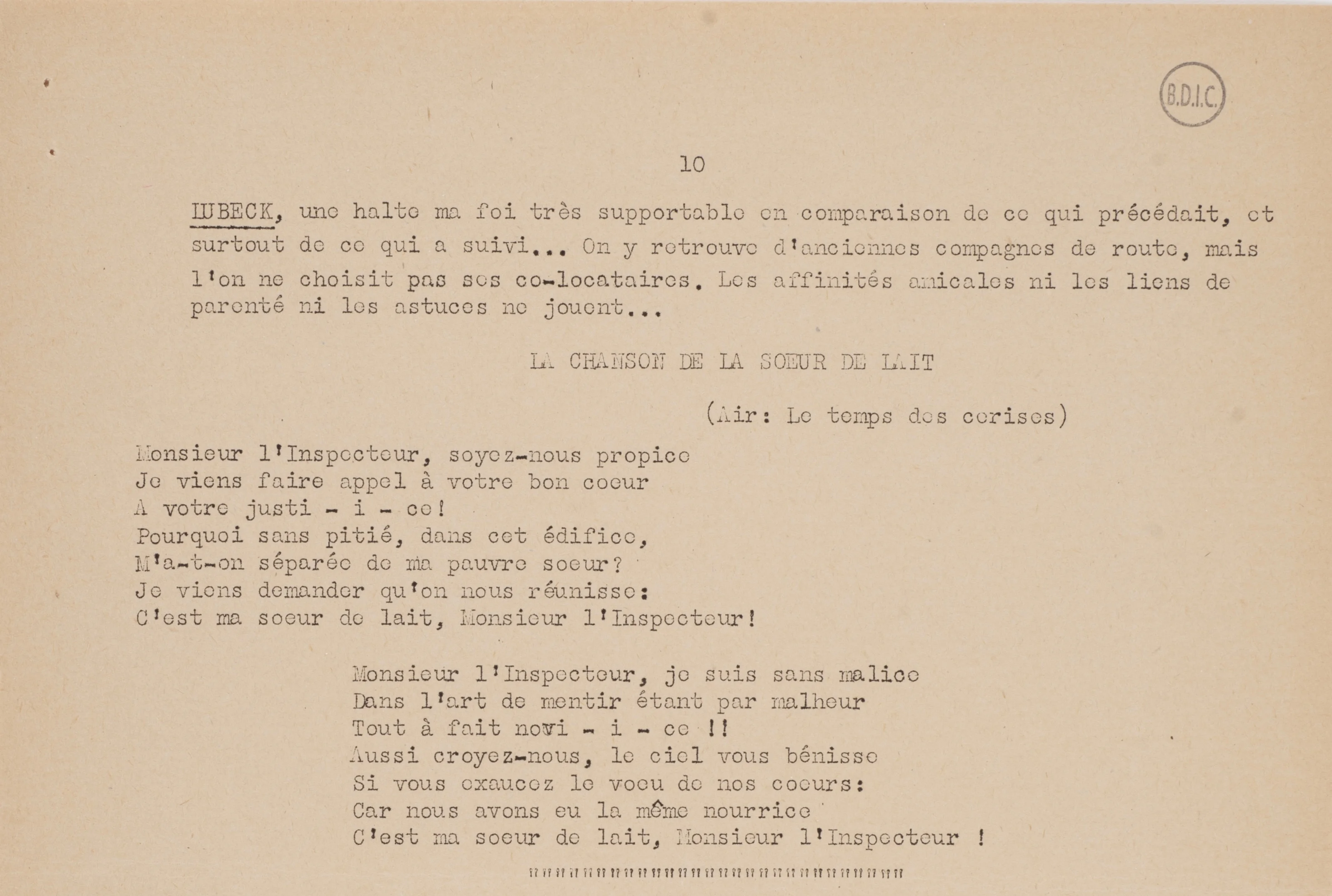

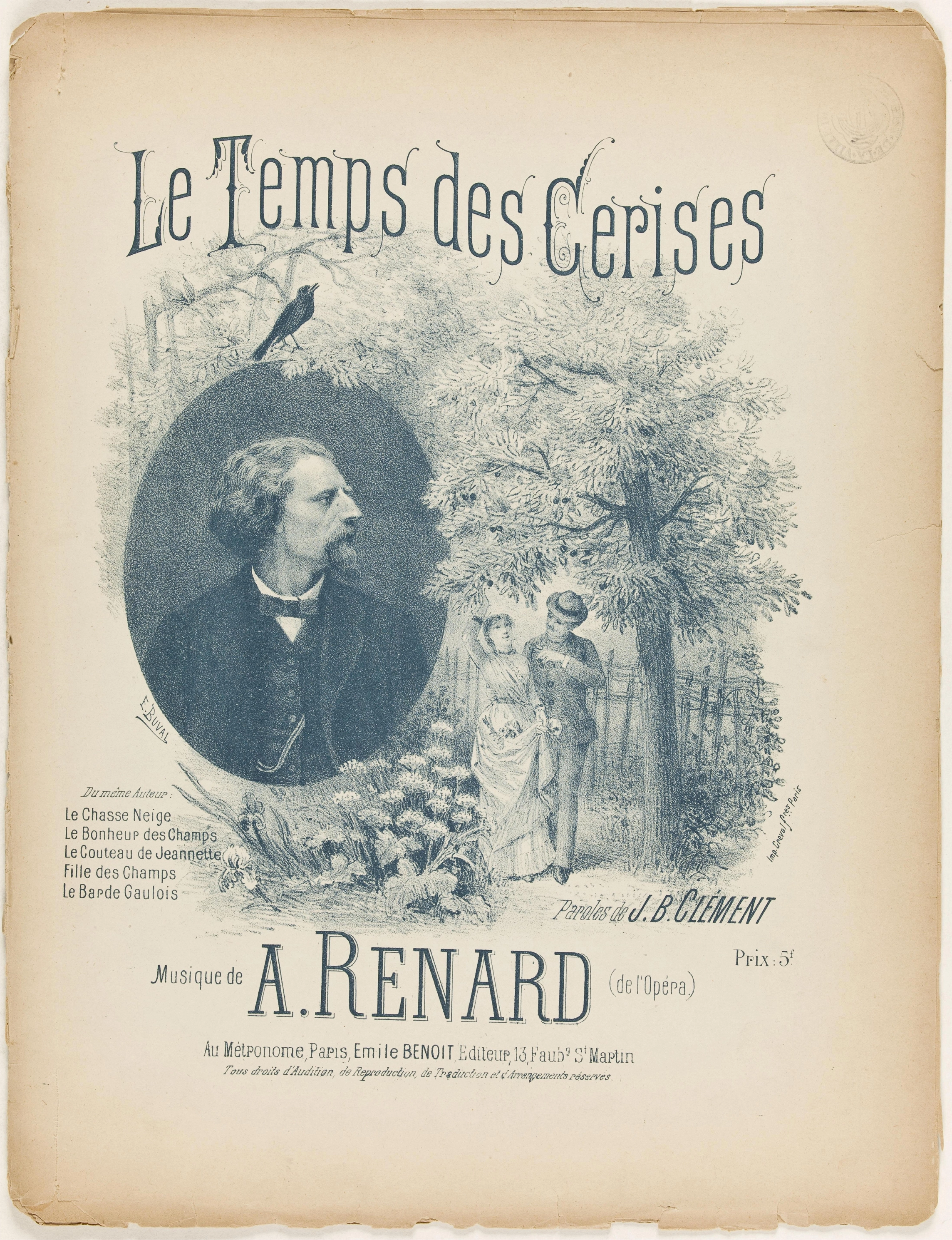
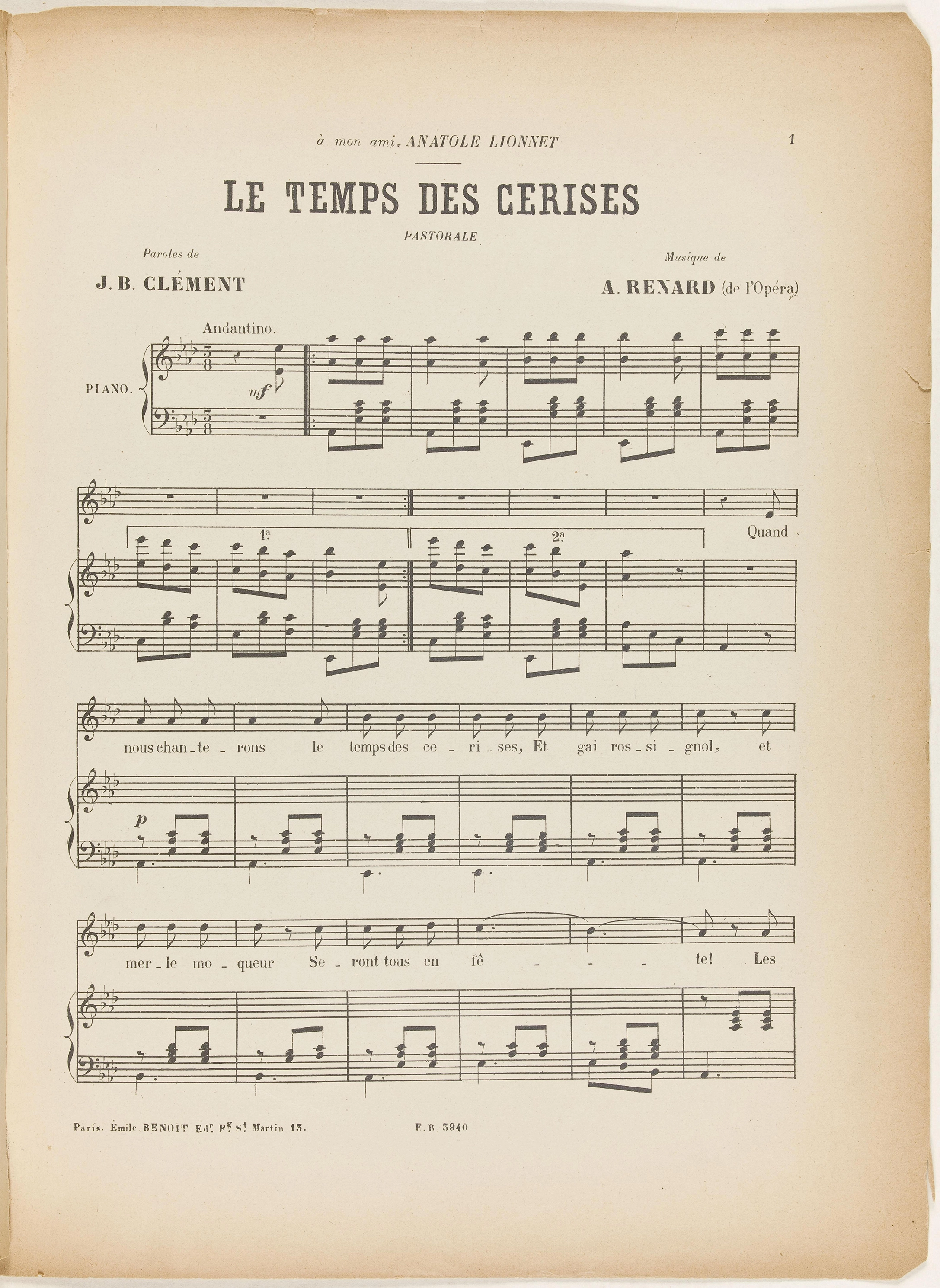
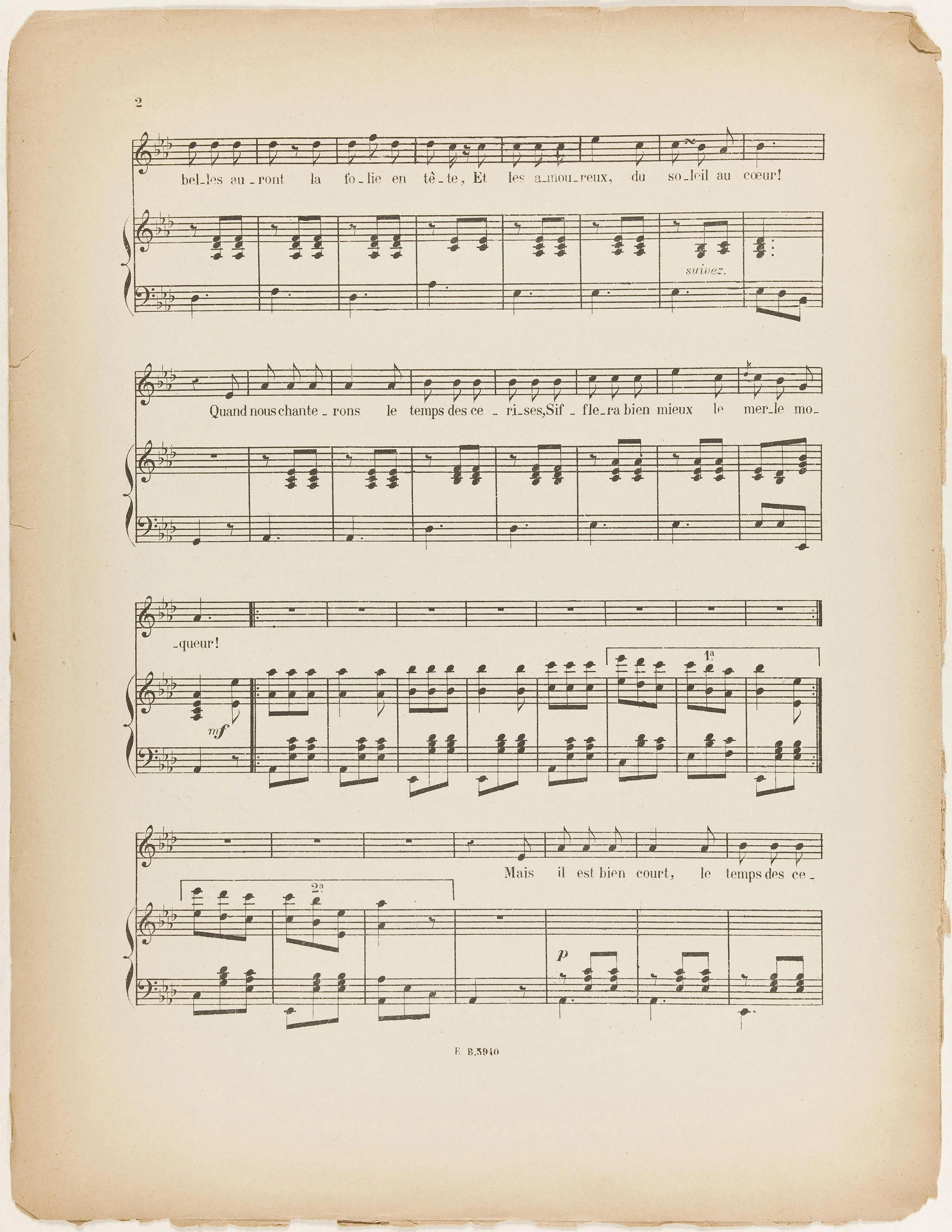
Jean Baptiste Clément (paroles), Antoine Renard (musique), Le temps des cerises, pastorale, partition pour chant et piano, Paris, Émile Benoît, E.B. 3940, 1889.


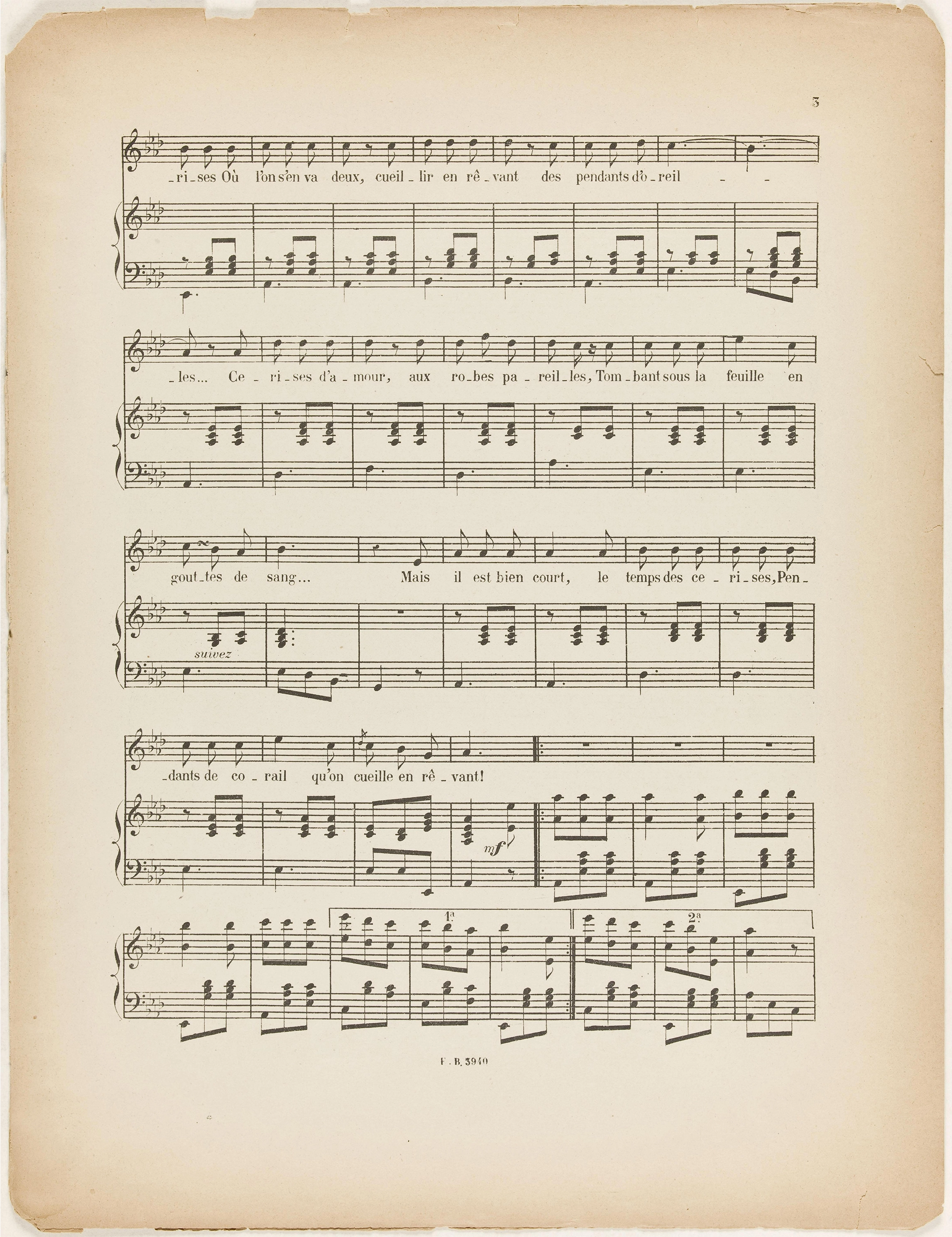
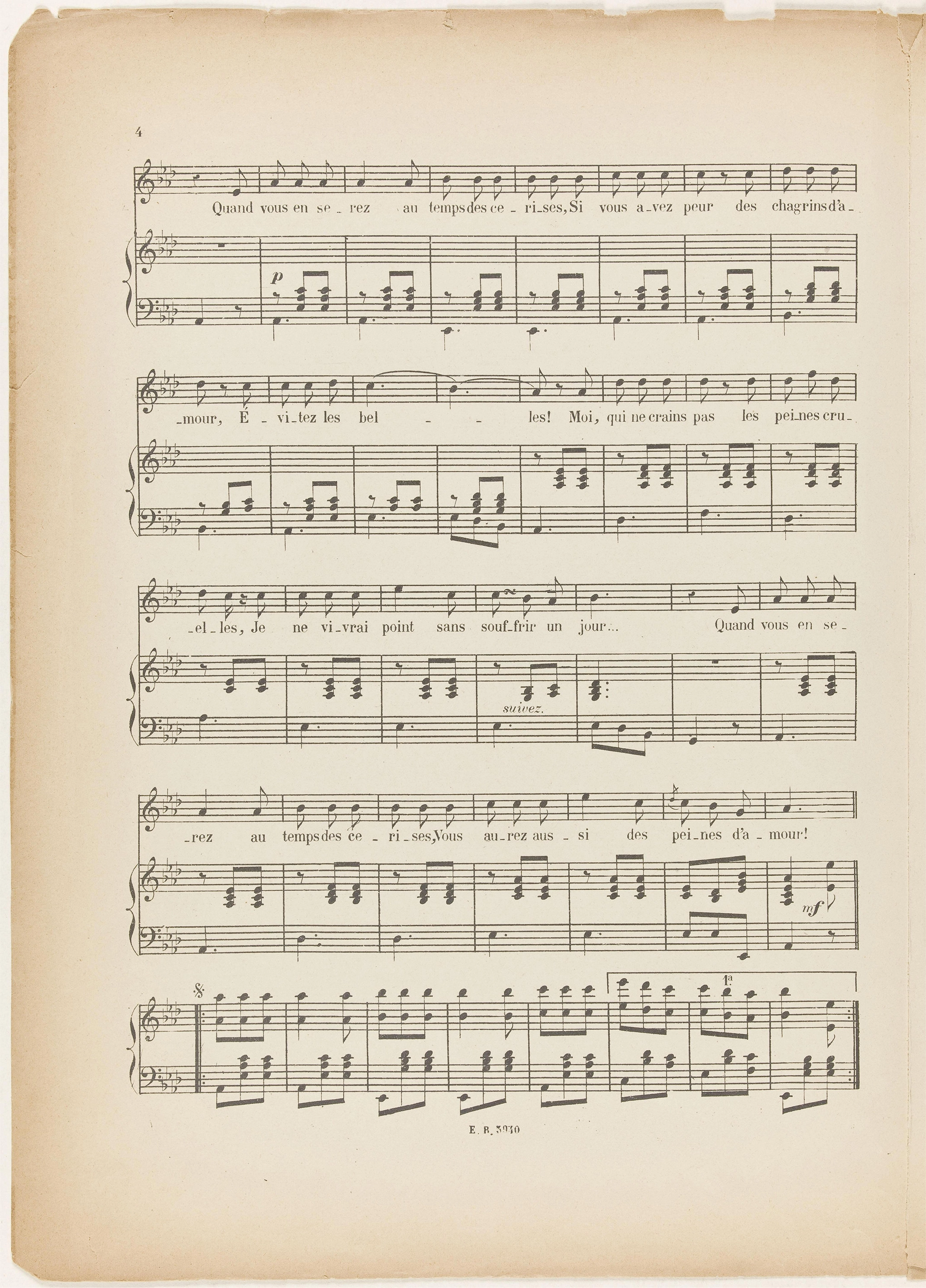
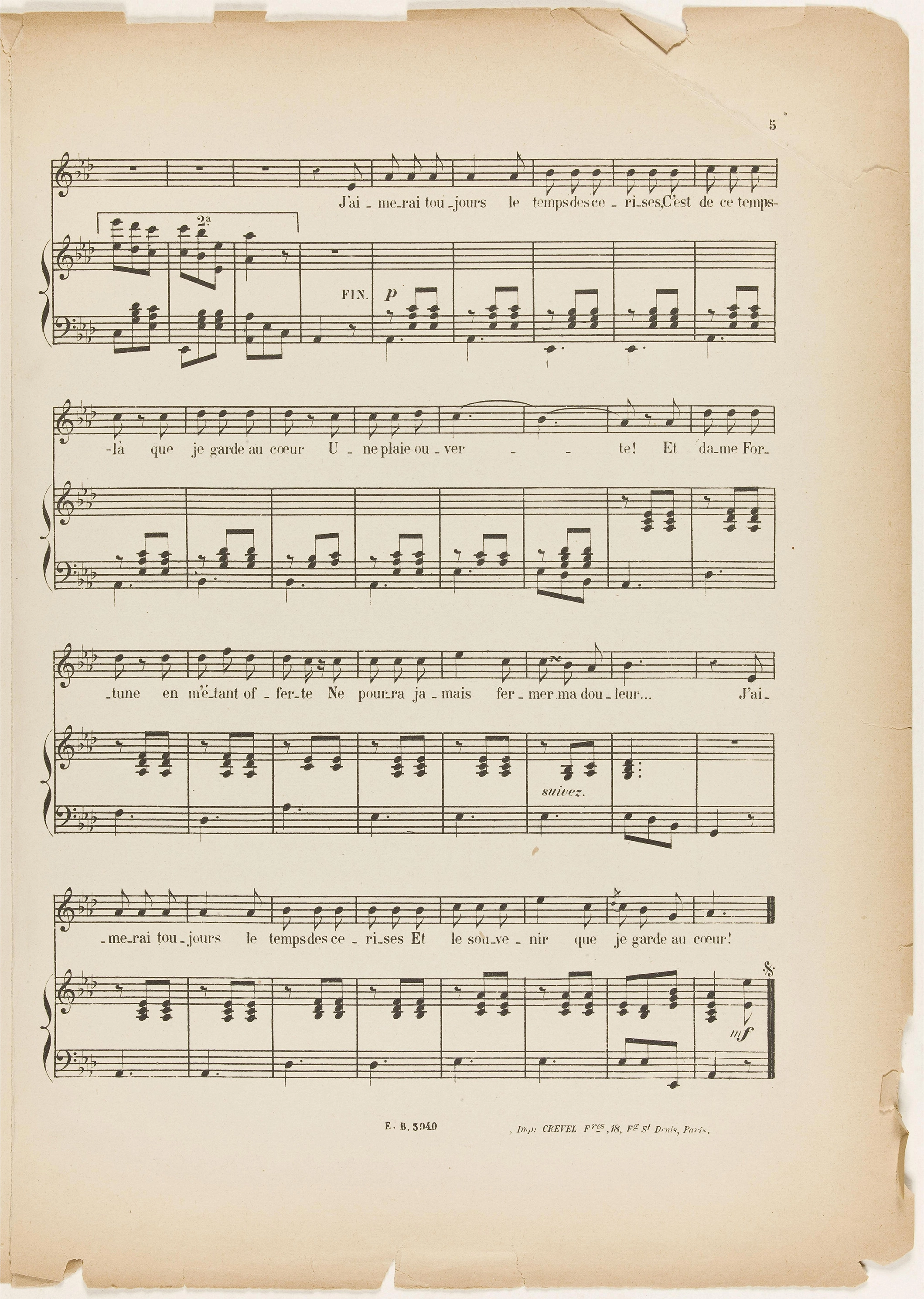
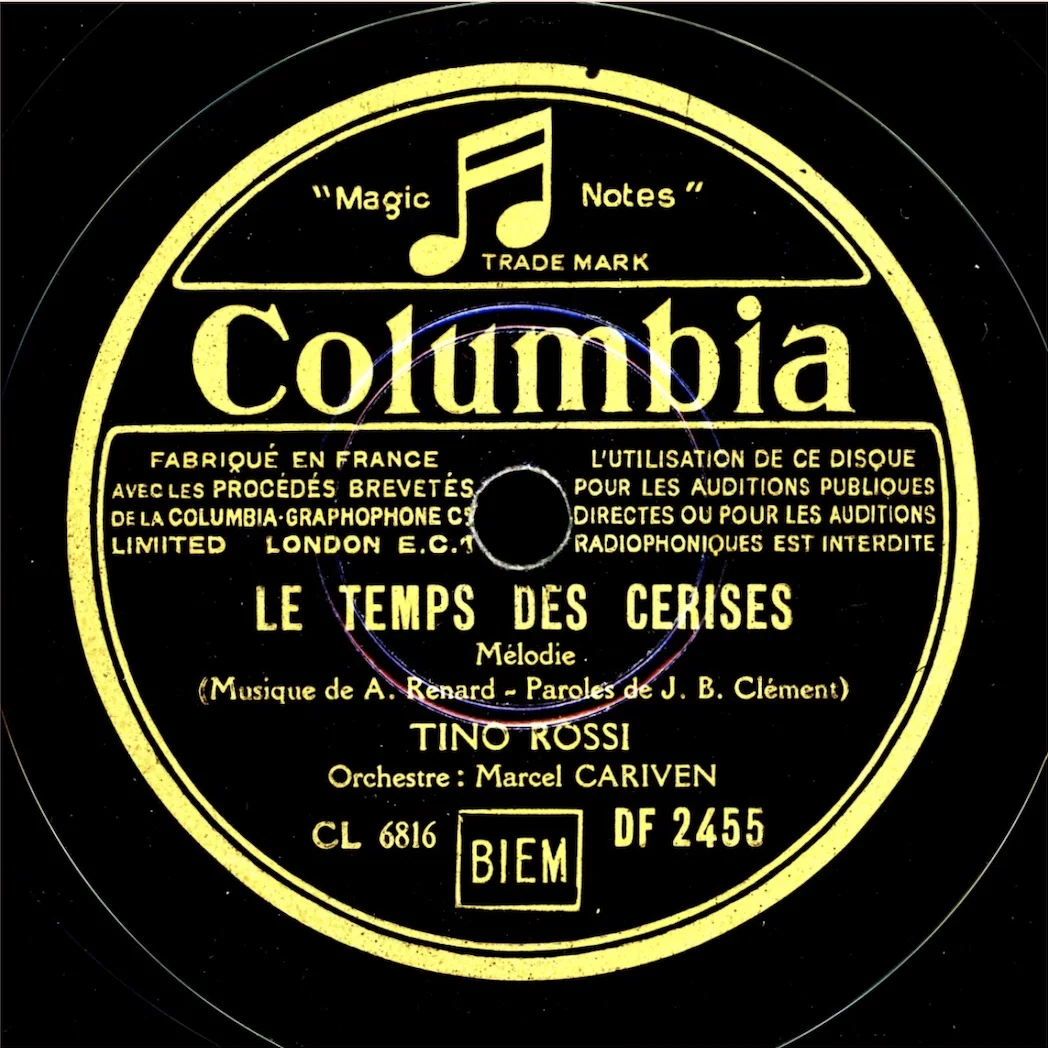
Jean Baptiste Clément (paroles), Antoine Renard (musique), Le temps des cerises, Tino Rossi (chant), orchestre Marcel Cariven, 1 disque 78 tours, Columbia, DF 2455, 1939.
1943, Lübeck prison
The song at the origin of this adaptation, Le temps des cerises, is probably the most emblematic example of how deeply Oddon’s collection is rooted in a tradition of musical resistance. Written in 1866 by the Montmartre journalist, trade unionist, and singer-songwriter Jean Baptiste Clément and set to music in 1868 by composer and operatic tenor Antoine Renard, the song was then picked up in spring 1871 by the insurgents of the Paris Commune, to which Clément belonged. Dedicated posthumously “to the valiant citizen Louise, the ambulance worker of Rue Fontaine-au-Roi, on Sunday 28 May 1871,” Le temps des cerises has since been associated with grassroots movements of resistance against the tyranny of power – movements in which women played a decisive role, as Clément’s dedication highlights.
Le temps des cerises was initially a pastoral romance that nostalgically evoked the heartbreak of a lost love. It was only later that Clément forged a connection between the song lyrics and the events of the “Bloody Week.” This web of political associations became even more intricate under the Popular Front with the release of the communist propaganda film Le temps des cerises, directed by French Communist Party member Jean-Paul Le Chanois (pseudonym of Jean-Paul Dreyfus) and distributed in 1937 by Les Films Populaires. The song Le temps des cerises serves as a leitmotif in the soundtrack (composed by Joseph Kosma) of this film that advocates for introducing a universal pension, a key demand of the Popular Front. It is also worth noting that during the war, Le Chanois set about making Au cœur de l’orage [At the heart of the storm] (1948), the only documentary about the Resistance that included scenes filmed during the Occupation, recorded by the director in 1943, in the Vercors maquis (a term that can simultaneously refer to the scrubland or shrubs of the terrain and to the Resistance fighters in these rural areas, also called Maquisards). Incidentally, the melody of Le temps des cerises was also the basis for a song of hope composed around the same time in another maquis on the other side of the country, Le chant du bataillon de Gâtine ouest [Song of the Western Gâtine Battalion].
The hugely famous song Le temps des cerises has also been covered by a great many performers, including Jean Lumière, Charles Trenet, Nana Mouskouri, Yves Montand, Renaud, and Marie-Denise Pelletier. Tino Rossi’s presented here was released in France in 1939.
In the reworked version transcribed by Yvonne Oddon, the narrator is pleading with “Mister Inspector” at Lübeck Prison, begging him to place her in the same cell as her foster sister from whom she has been separated. The text has only two verses, while the original song (in strophic form) has four; its melody uses the same melisma found in each verse of the original song (“justi-i-ce”, “novi-i-ce”). In the French adaptation transcribed by Oddon, the rhyme scheme alternates words ending in “-ice” and “-eur” and uses a consistent ABAABAB pattern for each verse, demonstrating the same strict application of form as the original song, which uniformly follows an ABCCBAB pattern, adapting the rhyme sound from one verse to the next. In terms of content, it is worth noting that in the final line of the first verse, “Mister Inspector” is used in place of the “mockingbird.” It would be fair to ask who is truly mocking whom in this highly ironic version where the narrator praises the inspector’s “good heart” while claiming to be a “novice” “in the art of deception,” which would clearly be quite problematic for a member of the Resistance.
Blending humour and history with remarkable formal elegance, this case proves to be representative of the various registers mastered by Yvonne Oddon and her fellow detainees.
[Sources: references 4, 6, 16, 30, 103, 114 in the bibliography]
Le temps des cerises
Cherry Season
(1866-1868)
Quand nous chanterons le temps des cerises,
When we sing in cherry season
Et gai rossignol, et merle moqueur
The joyful nightingale, and the mockingbird
Seront tous en fête!
Will both be celebrating!
Les belles auront la folie en tête,
The beautiful girls’ heads will all be filled with folly
Et les amoureux, du soleil au cœur!
And the lovers will have sunshine in their hearts!
Quand nous chanterons le temps des cerises,
When we sing in cherry season
Sifflera bien mieux le merle moqueur !
Even better will trill the mockingbird!
Mais il est bien court, le temps des cerises
But it is so brief, the cherry season
Où l’on s’en va deux, cueillir en rêvant
When we go off in pairs, picking and dreaming of
Des pendants d’oreilles...
Earrings...
Cerises d’amour, aux robes pareilles,
Cherries of love, their gowns the same,
Tombant sous la feuille en gouttes de sang...
Falling under the leaves like drops of blood...
Mais il est bien court, le temps des cerises,
But it is so brief, the cherry season,
Pendants de corail qu’on cueille en rêvant!
Coral earrings picked while dreaming!
Quand vous en serez au temps des cerises,
When you reach cherry season,
Si vous avez peur des chagrins d’amour,
If you fear heartbreak,
Évitez les belles!
Avoid the pretty girls!
Moi, qui ne crains pas les peines cruelles,
I do not fear cruel sorrow,
Je ne vivrai point sans souffrir un jour...
One day I’ll not live without suffering...
Quand vous en serez au temps des cerises,
When you reach cherry season,
Vous aurez aussi des peines d’amour!
You’ll also feel love’s pain!
J’aimerai toujours le temps des cerises,
I will always love cherry season,
C’est de ce temps-là que je garde au cœur
It’s from that time that I carry in my heart
Une plaie ouverte!
An open wound!
Et dame Fortune en m’étant offerte
And Lady Luck smiling upon me
Ne pourra jamais fermer ma douleur...
Will never ease my pain...
J’aimerai toujours le temps des cerises
I will always love cherry season
Et le souvenir que je garde au cœur!
And its memory I hold dear in my heart!
La chanson de la sœur de lait
The Song of the Foster Sister
(ms p. 10)
Monsieur l’Inspecteur, soyez-nous propice
Mister Inspector, show us favour
Je viens faire appel à votre bon cœur
I appeal to your good heart
À votre justi – i – ce!
To your justi – i – ce!
Pourquoi sans pitié, dans cet édifice,
Why without mercy, in this building,
M’a-t-on séparée de ma pauvre sœur?
Was I separated from my poor sister?
Je viens demander qu’on nous réunisse :
I’m here asking to be reunited:
C’est ma sœur de lait, Monsieur l’Inspecteur!
She’s my foster sister, Mister Inspector!
Monsieur l’Inspecteur, je suis sans malice
Mister Inspector, I mean no harm
Dans l’art de mentir étant par malheur
In the art of deception, I am sadly
Tout à fait novi – i – ce!!
A complete novi – i – ce!!
Aussi croyez-nous, le ciel vous bénisse
Also, believe us, the heavens bless you
Si vous exaucez le vœu de nos cœurs :
If you grant our hearts’ desire:
Car nous avons eu la même nourrice
For we had the same wet nurse
C’est ma sœur de l’ait, Monsieur l’Inspecteur!
She’s my foster sister, Mister Inspector!