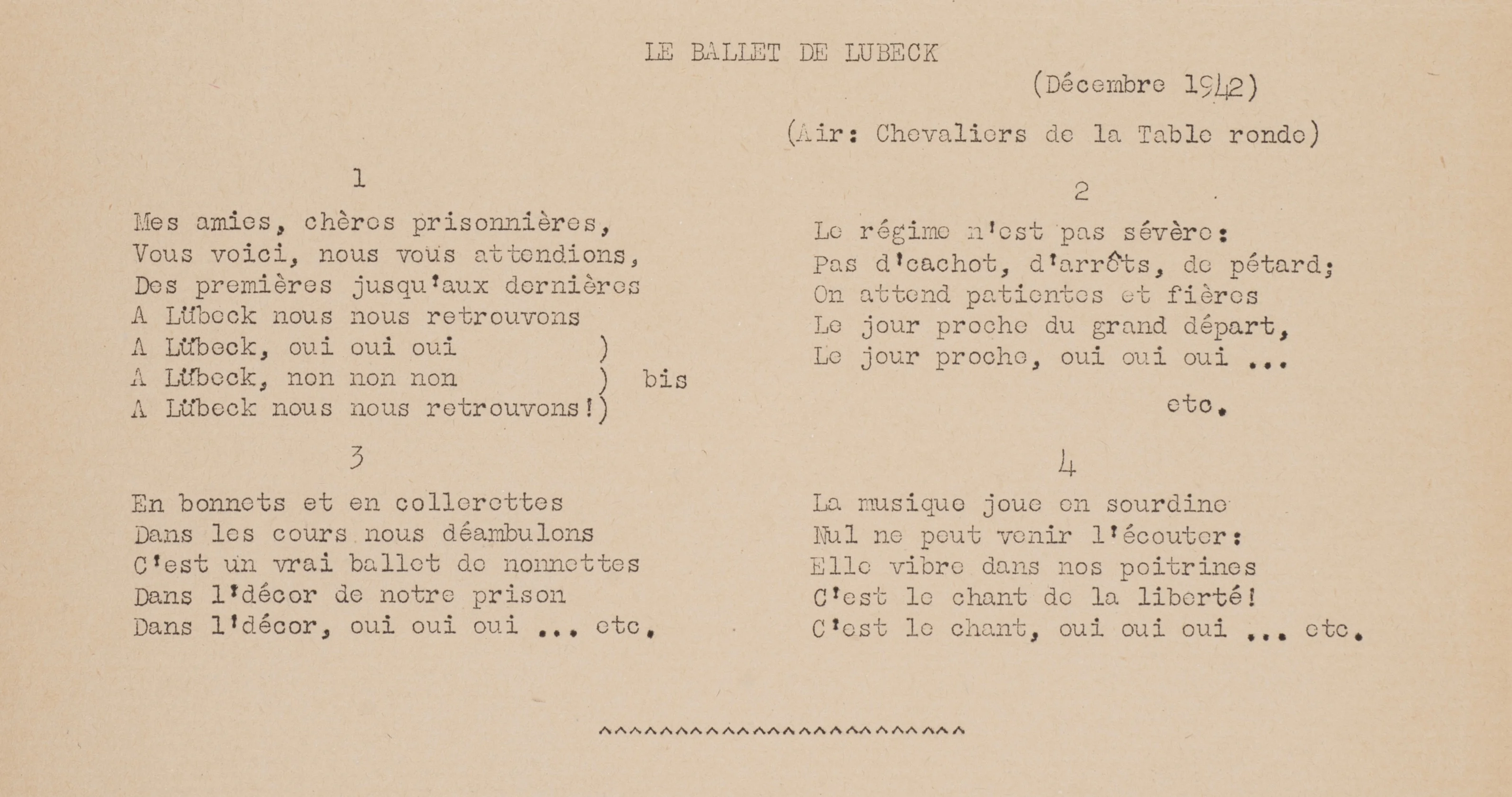

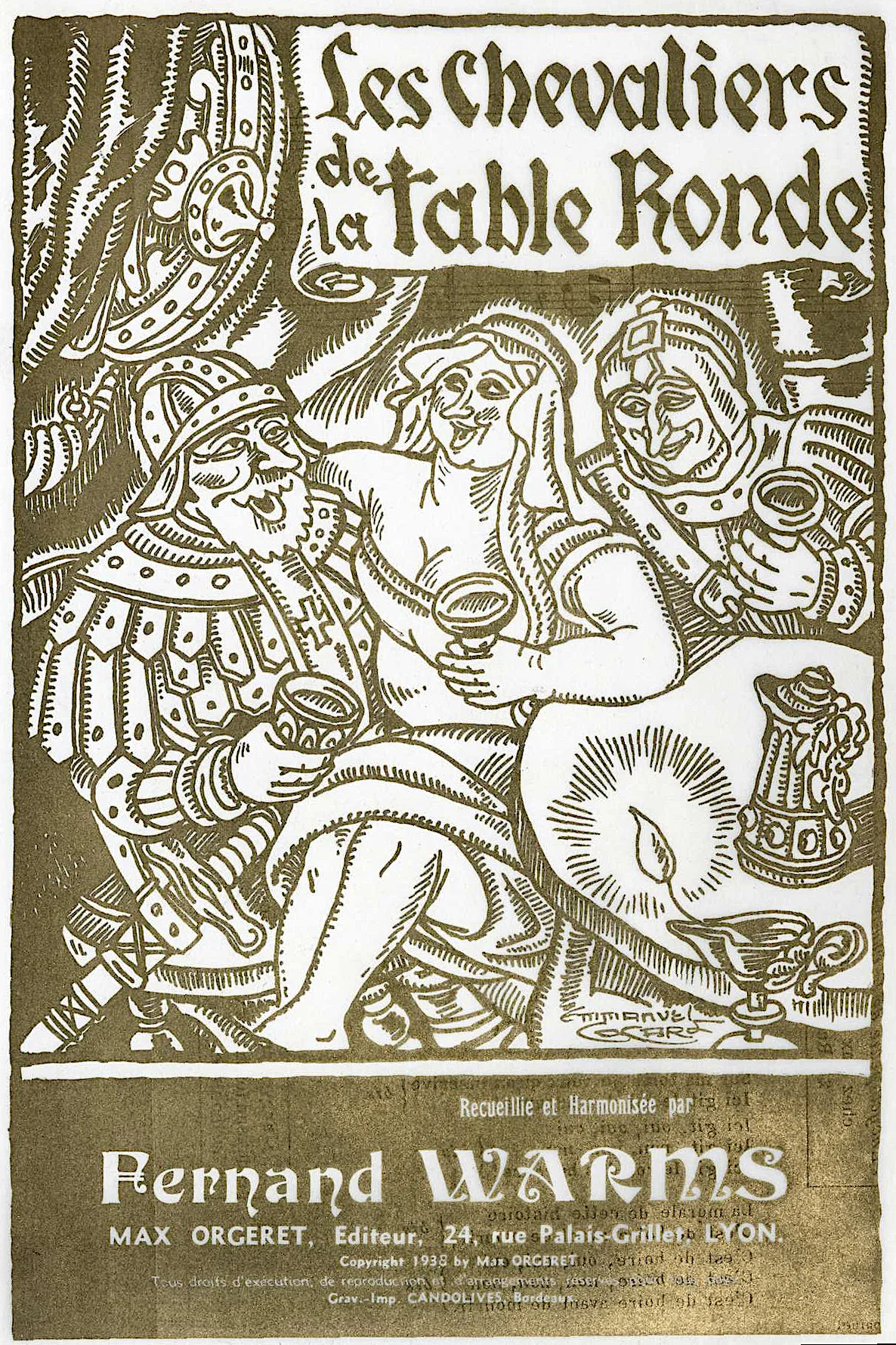
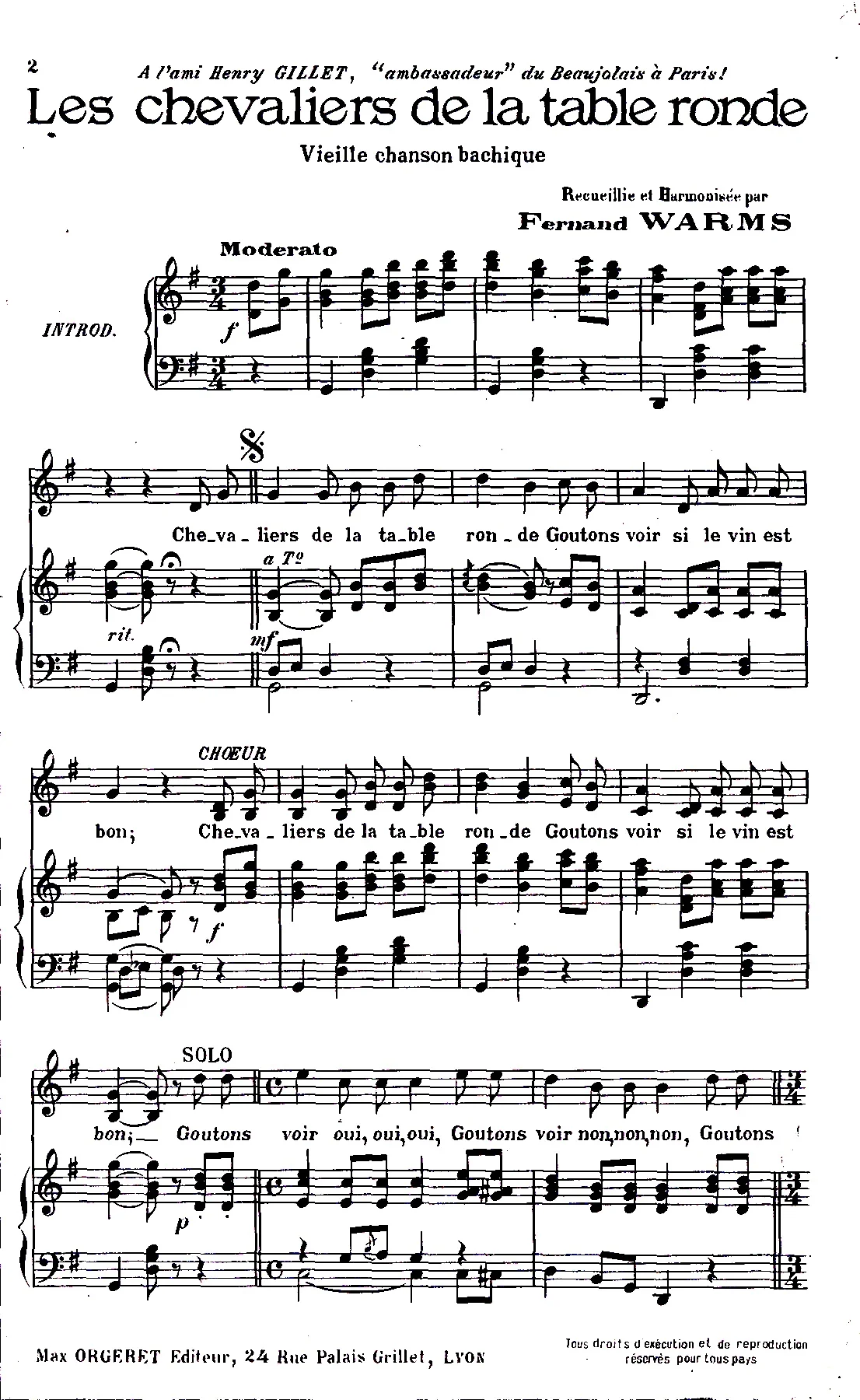
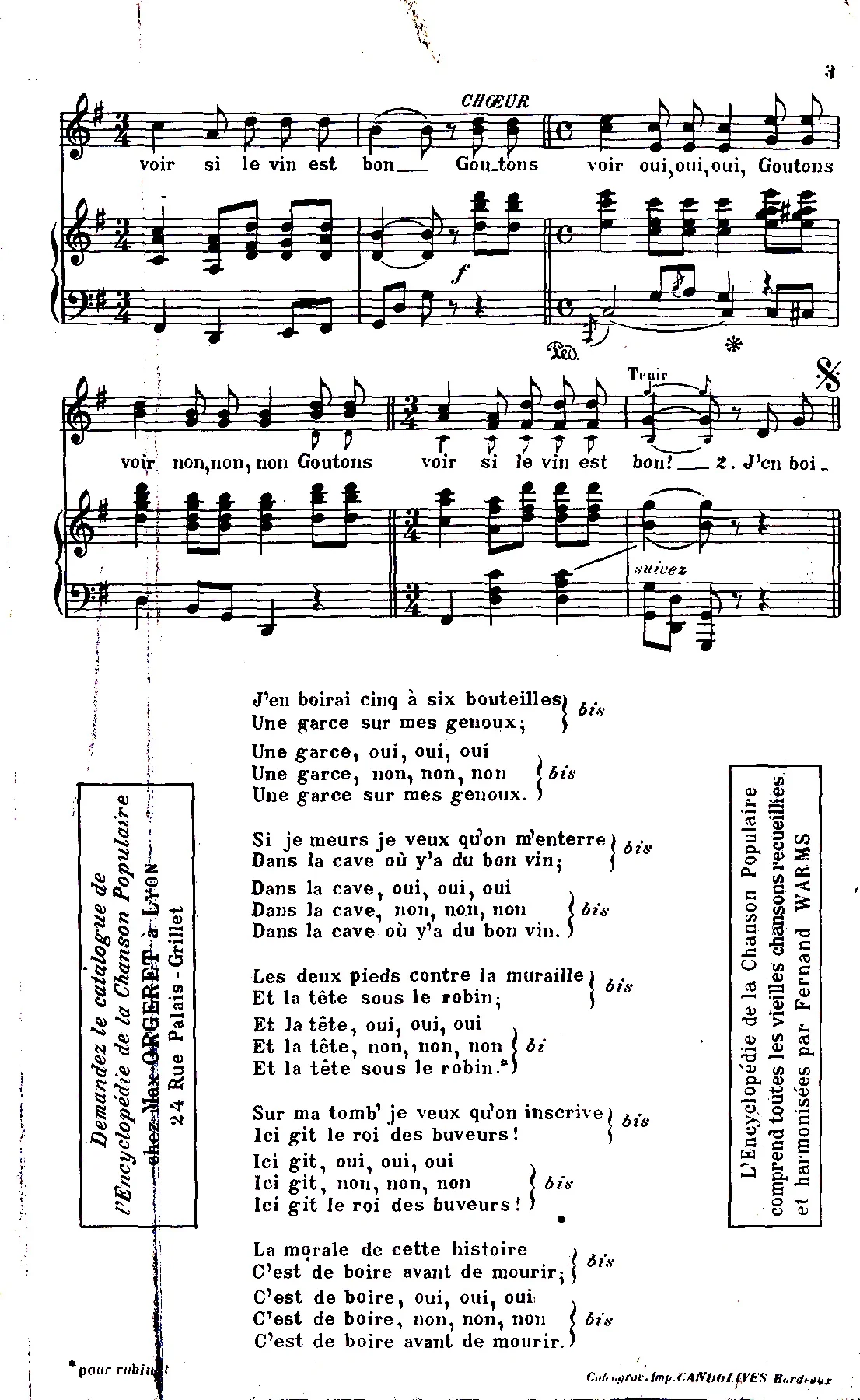
Chevaliers de la table ronde : Vieille chanson bachique, recueillie et harmonisée par Fernand Warms, partition pour chant et piano, Lyon, Max Orgeret, 1938.


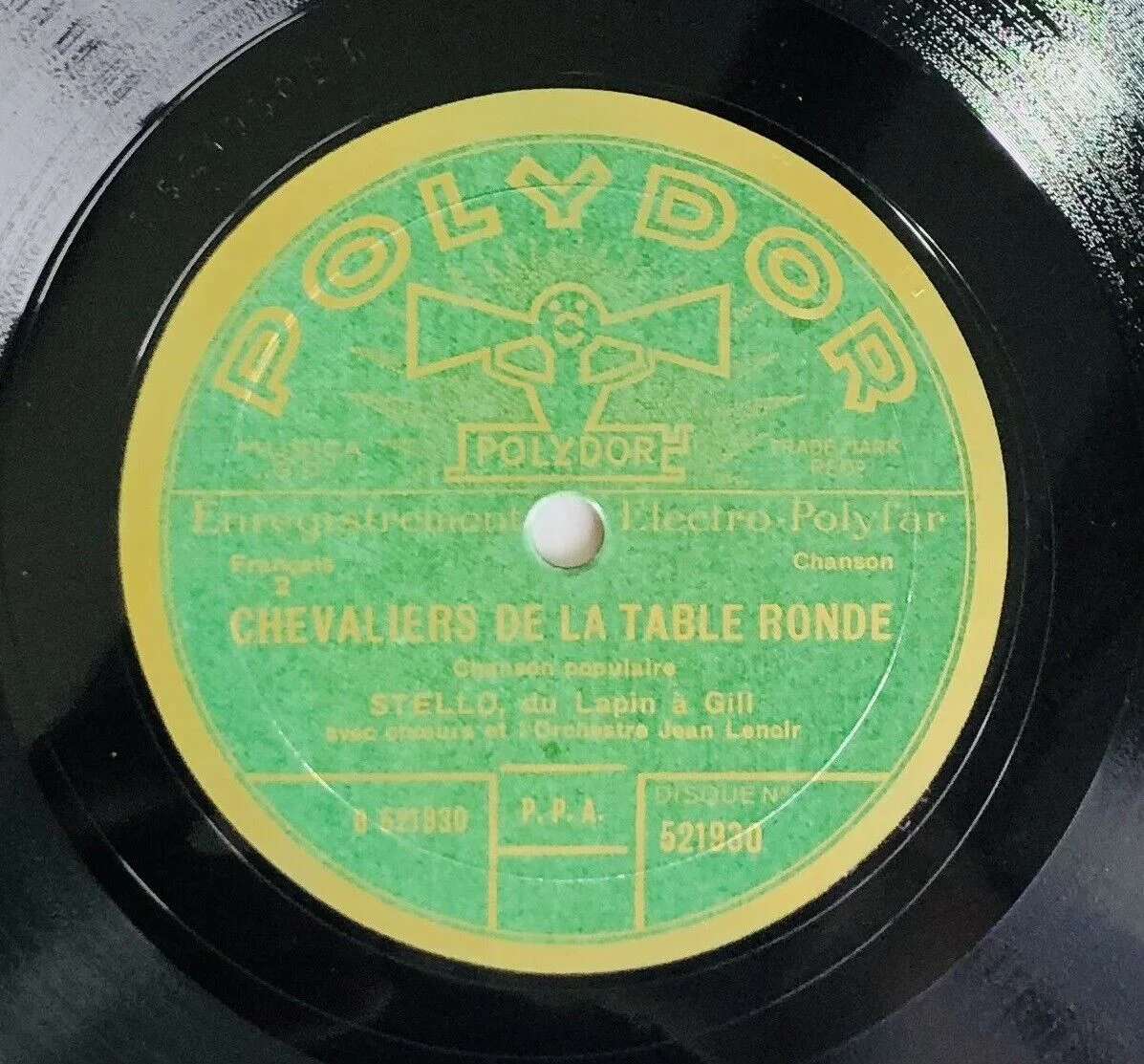
Chevaliers de la table ronde, Stello (chant), chœurs et orchestre Jean Lenoir, 1 disque 78 tours, Polydor, 521.930, v. 1931.
December 1942, Lübeck prison
This song reworks the infamous drinking song Chevaliers de la Table ronde, whose earliest versions date back to the eighteenth century and whose form, still in use today, took shape in the Latin Quarter of Paris at the turn of the twentieth century.
Inspired by Arthurian legend, written by anonymous authors, and transformed over centuries, the song is meant to be sung by a crowd of revelers: the very simple strophic form involves many text repetitions, and its call-and-response style is well suited to group singing. The latter aspect is especially prominent in the version recorded in 1931 by one-legged singer Stello, who was wounded during the Great War; a star of the legendary Montmartre cabaret Au Lapin Agile, he was in fact in the habit of performing with a choir, which is also the case in the version of Le Joueur de luth that accompanies the very first song in this virtual exhibition. Comparing the musical references between songs – in this case the songs by Stello – makes it possible to begin to imagine the sound world of Oddon and those around her.
Published many times over the years, the score for Chevaliers de la Table ronde circulated in booklets of traditional folk songs and as sheet music. The version selected here appeared right before the war, in 1938; unlike most of the other versions (or Stello’s rendition), it uses the word “wench” [garce] instead of “woman” in the second verse. This slight modification attests perhaps to the specifically male-oriented social context from which this song emerged – a song that, until the early twentieth century, was associated with “boys’ nights out,” especially among medical students.
Yet the song also circulated in more female-oriented circles, as can be seen in its presence in the Plein-Air collection compiled in 1941 by Resistance fighter Yvonne Baratte, with the help of a few of the children to whom, in her spare time, she was introducing choral singing and outdoor activities. Arrested in Paris in July 1944 and deported the following month to Ravensbrück (where she died in March 1945), Baratte continued singing the songs from her collection during her incarceration and teaching them to her fellow prisoners; it is entirely possible that Chevaliers de la Table ronde was one of these songs with which she brightened the lives of her companions in misery.
While Baratte and Oddon could not have crossed paths in prison, nor at Ravensbrück (their deportation and transfer dates between prisons do not coincide), the fact that they both included Chevaliers de la Table ronde in their respective compilations attests to the widespread circulation of this “old drinking song” during the Second World War. In the reworked version transcribed by Oddon under the title The Lübeck Ballet, the familiar melody provides a backdrop for a hopeful song with only four verses (compared to the six in the original score reproduced here, and up to eight or nine in other versions of Chevaliers de la Table ronde). The new text not only praises the supposedly less harsh conditions at Lübeck Prison, but even more so the “great departure” that the prisoners are expecting, while letting “the song” of this “freedom” they so fervently hope to regain “resonate in [their] hearts.”
[Sources: references 12, 37, 61, 67 in the bibliography]
Les chevaliers de la table ronde
Knights of the Round Table
(oral tradition)
Chevaliers de la table ronde
Knights of the Round Table
Go[û]tons voir si le vin est bon;
Let’s taste and see if the wine is good;
Chevaliers de la table ronde
Knights of the Round Table
Go[û]tons voir si le vin est bon;
Let’s taste and see if the wine is good;
Go[û]tons voir oui, oui, oui,
Let’s taste and see yes, yes, yes,
Go[û]tons voir non, non, non
Let’s taste and see no, no, no
Go[û]tons voir si le vin est bon!
Let’s taste and see if the wine is good!
Go[û]tons voir oui, oui, oui,
Let’s taste and see yes, yes, yes,
Go[û]tons voir non, non, non
Let’s taste and see no, no, no
Go[û]tons voir si le vin est bon!
Let’s taste and see if the wine is good!
J’en boirai cinq à six bouteilles
I’d drink five or six bottles
Une garce sur mes genoux;
A wench on my knee;
J’en boirai cinq à six bouteilles
I’d drink five or six bottles
Une garce sur mes genoux;
A wench on my knee;
Une garce, oui, oui, oui
A wench yes, yes, yes,
Une garce, non, non, non
A wench no, no, no
Une garce sur mes genoux
A wench on my knee
Une garce, oui, oui, oui
A wench yes, yes, yes,
Une garce, non, non, non
A wench no, no, no
Une garce sur mes genoux
A wench on my knee
Si je meurs je veux qu’on m’enterre
If I die, I want to be buried
Dans la cave où y’a du bon vin;
In a cellar with good wine;
Si je meurs je veux qu’on m’enterre
If I die, I want to be buried
Dans la cave où y’a du bon vin;
In a cellar with good wine;
Dans la cave, oui, oui, oui
In a cellar yes, yes, yes,
Dans la cave, non, non, non
In a cellar no, no, no
Dans la cave où y’a du bon vin
In a cellar with good wine
Dans la cave, oui, oui, oui
In a cellar yes, yes, yes,
Dans la cave, non, non, non
In a cellar no, no, no
Dans la cave où y’a du bon vin
In a cellar with good wine
Les deux pieds contre la muraille
Both feet against the wall
Et la tête sous le robin;
And my head under the spigot;
Les deux pieds contre la muraille
Both feet against the wall
Et la tête sous le robin;
And my head under the spigot;
Et la tête, oui, oui, oui
And my head yes, yes, yes,
Et la tête, non, non, non
And my head no, no, no
Et la tête sous le robin
And my head under the spigot
Et la tête, oui, oui, oui
And my head yes, yes, yes,
Et la tête, non, non, non
And my head no, no, no
Et la tête sous le robin
And my head under the spigot
Sur ma tomb’ je veux qu’on inscrive
On my tomb I want it written
Ici g[î]t le roi des buveurs!
Here lies the king of the boozers!
Sur ma tomb’ je veux qu’on inscrive
On my tomb I want it written
Ici g[î]t le roi des buveurs!
Here lies the king of the boozers!
Ici g[î]t, oui, oui, oui
Here lies yes, yes, yes,
Ici g[î]t, non, non, non
Here lies no, no, no
Ici g[î]t le roi des buveurs!
Here lies the king of the boozers!
Ici g[î]t, oui, oui, oui
Here lies yes, yes, yes,
Ici g[î]t, non, non, non
Here lies no, no, no
Ici g[î]t le roi des buveurs!
Here lies the king of the boozers!
La morale de cette histoire
The moral of this story
C’est de boire avant de mourir;
Is drink before you die;
La morale de cette histoire
The moral of this story
C’est de boire avant de mourir;
Is drink before you die;
C’est de boire, oui, oui, oui
Drink yes, yes, yes,
C’est de boire, non, non, non
Drink no, no, no
C’est de boire avant de mourir.
Drink before you die.
C’est de boire, oui, oui, oui
Drink yes, yes, yes,
C’est de boire, non, non, non
Drink no, no, no
C’est de boire avant de mourir.
Drink before you die.
Le ballet de Lübeck
The Lübeck Ballet
(ms p. 10)
1
Mes amies, chères prisonnières,
My friends, dear prisoners,
Vous voici, nous vous attendions,
Here you are, we’ve been waiting for you,
Des premières jusqu’aux dernières
From the first to the last
À Lübeck, nous nous retrouvons
At Lübeck, we’ll meet again
À Lübeck, oui oui oui
At Lübeck, yes yes yes
À Lübeck, non non non
At Lübeck, no no no
À Lübeck nous nous retrouvons!
At Lübeck we’ll meet again!
À Lübeck, oui oui oui
At Lübeck, yes yes yes
À Lübeck, non non non
At Lübeck, no no no
À Lübeck nous nous retrouvons!
At Lübeck we’ll meet again!
2
Le régime n’est pas sévère :
The conditions are not so harsh:
Pas d’cachot, d’arrêts, de pétard;
No dungeons, no arrests, no trouble;
On attend patientes et fières
We await, patient and proud
Le jour proche du grand départ,
The imminent day of the great departure,
Le jour proche, oui oui oui…
The imminent day, yes yes yes…
etc.
3
En bonnets et en collerettes
The conditions are not so harsh:
Dans les cours nous déambulons
No dungeons, no arrests, no trouble;
C’est un vrai ballet de nonnettes
We await, patient and proud
Dans l’décor de notre prison
The imminent day of the great departure,
Dans l’décor, oui oui oui… etc.
The imminent day, yes yes yes… etc.
4
La musique joue en sourdine
The music plays softly
Nul ne peut venir l’écouter :
No one can come to hear it:
Elle vibre dans nos poitrines
It resonates in our hearts
C’est le chant de la liberté!
It’s the song of freedom!
C’est le chant, oui oui oui… etc.
It’s the song, yes yes yes… etc.