
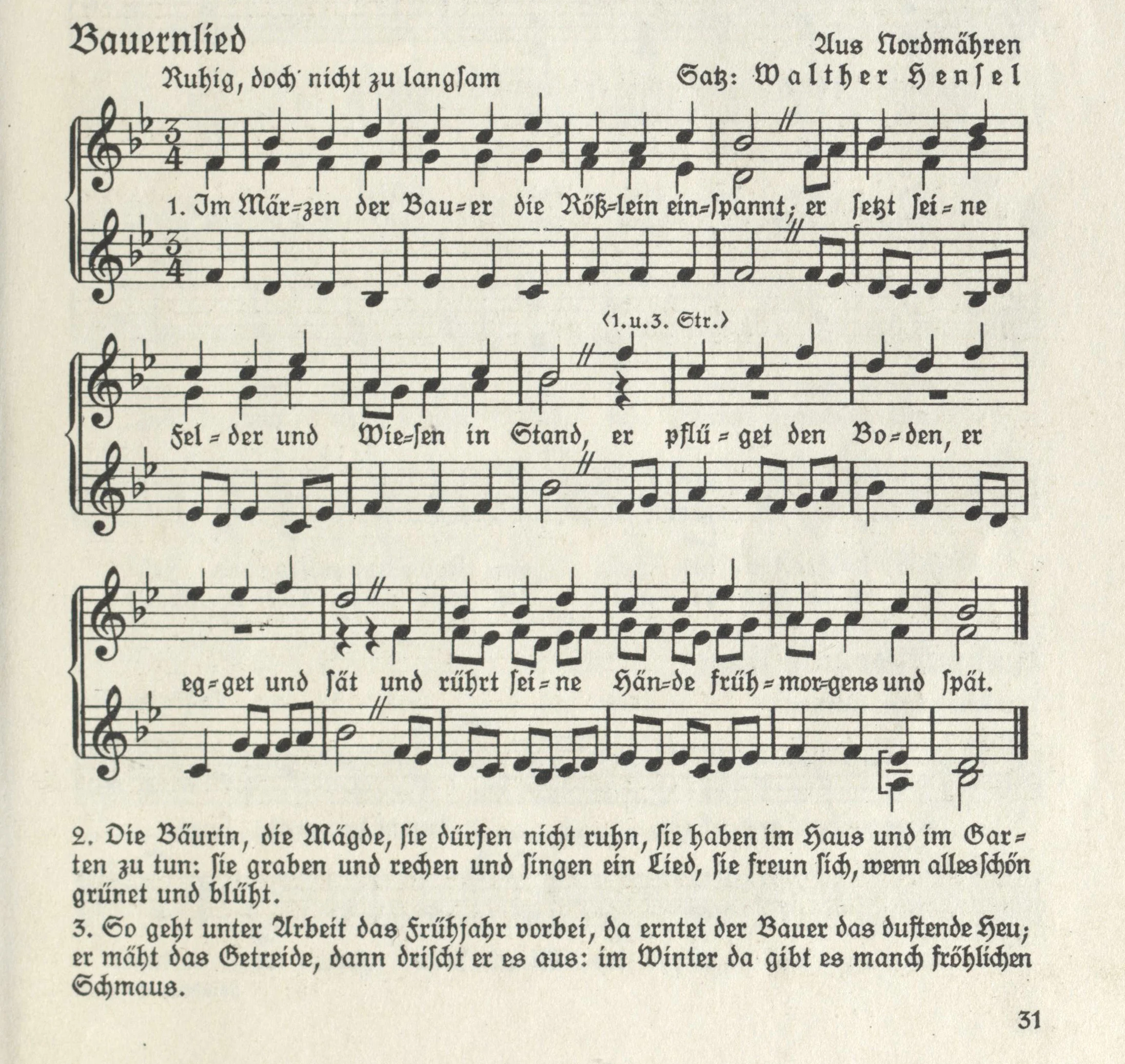
« Bauernlied », dans Werkleute singen : Lieder der NS-Gemeinschaft „Kraft durch Freude“, édité par Heinz Ameln, Kassel, Bärenreiter, 1936, p. 31.


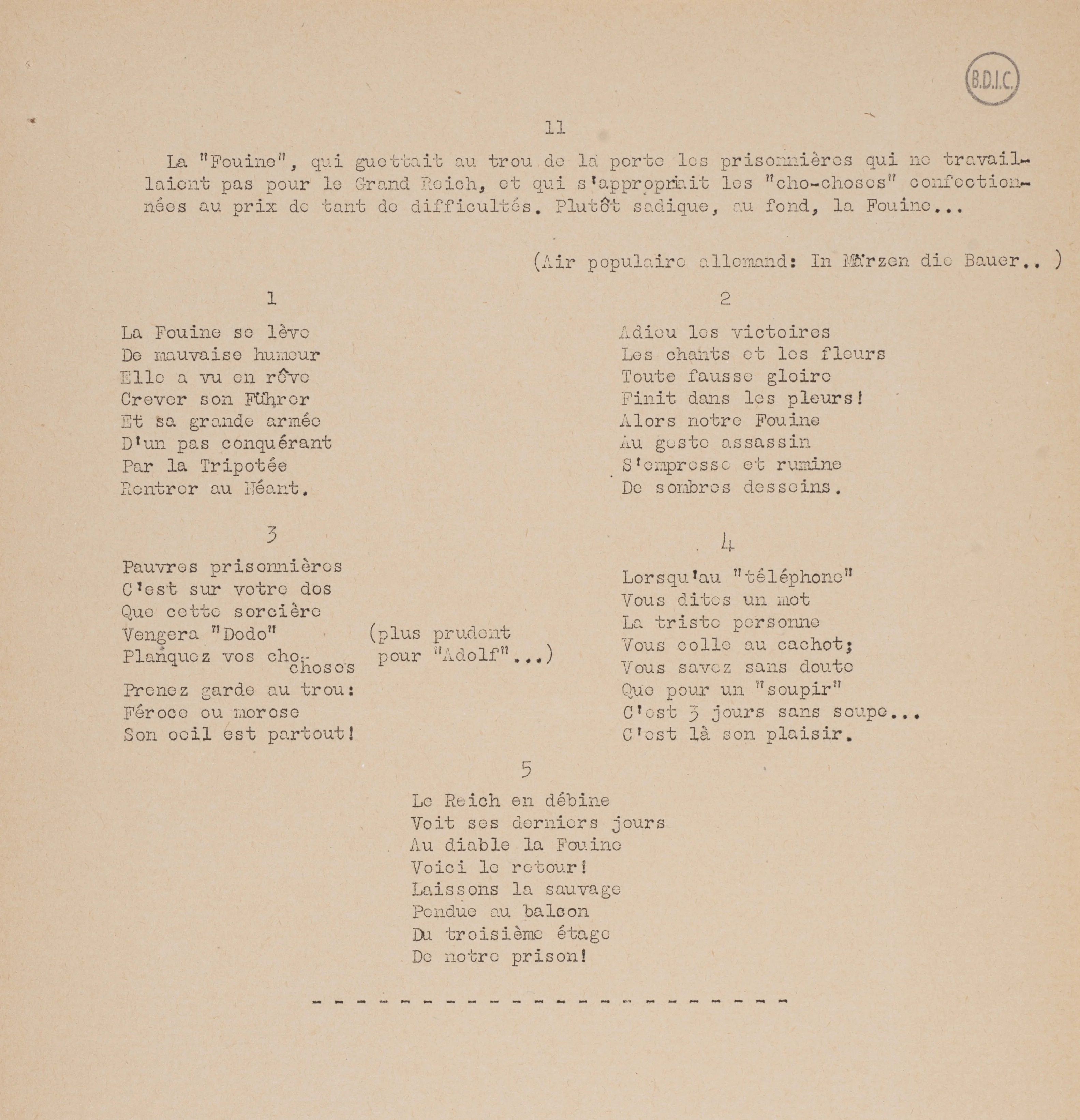
1943, Lübeck prison
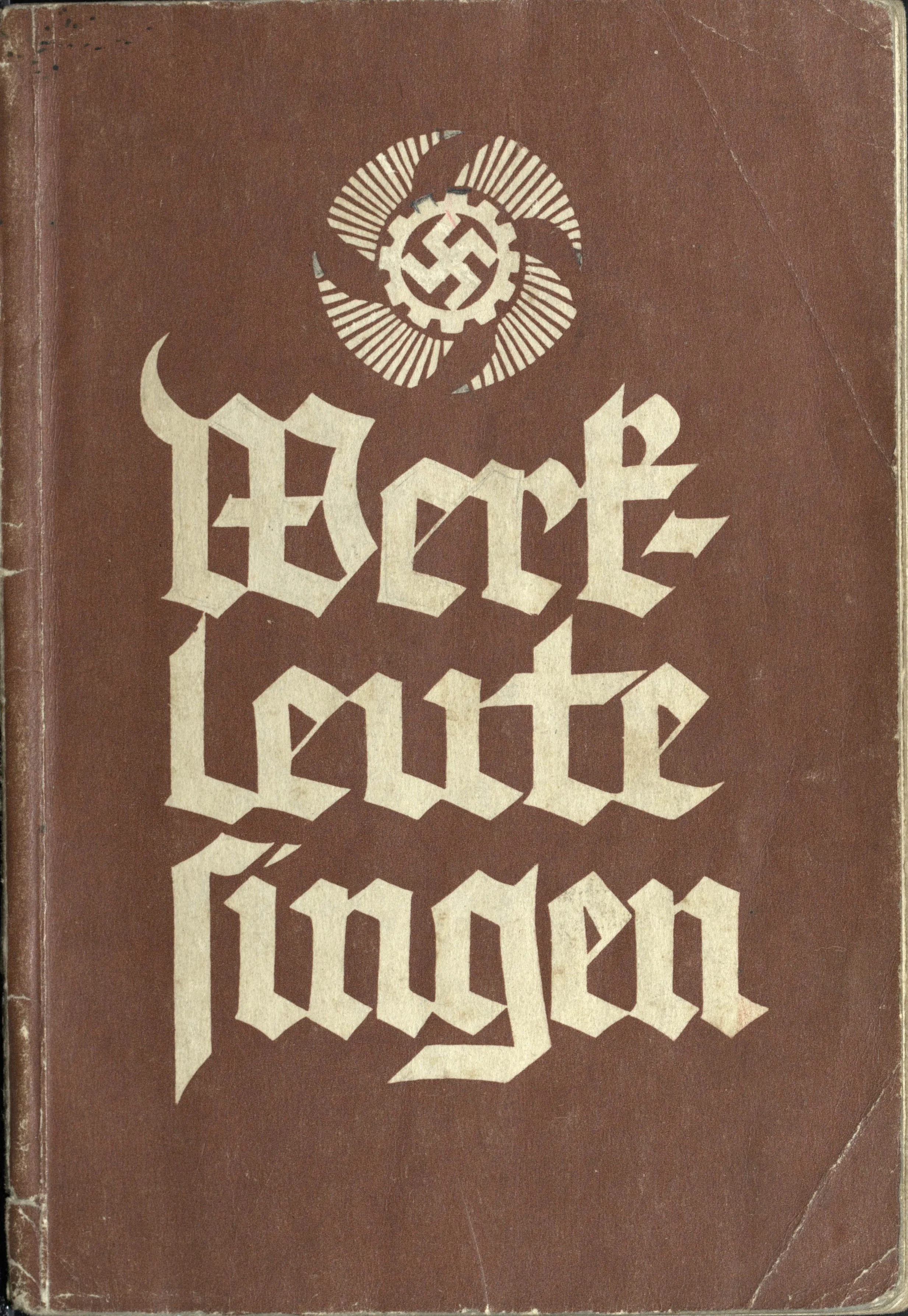
This song is the only one in Yvonne Oddon’s entire collection that is based not on a French song, but on a German folk melody: Im Märzen der Bauer [In March, the Farmer]. Its circulation has been documented in German-speaking countries since the late nineteenth century, and a version still popular there today (especially among children) was published in 1923 in a collection compiled by Walther Hensel titled “Das Aufrecht Fähnlein”: Liederbuch für Studenten und Volk [“The Battalion Stands Tall”: Songs for Students and the People]. This same version of the song was also included in numerous songbooks produced during the Third Reich, associated in particular with the German Air Force or with associations like the Bund Deutscher Mädel (“League of German Girls,” the women’s equivalent of the Hitler Youth) or Kraft durch Freude (“Strength Through Joy,” the organization that replaced unions after they were abolished by the Nazi party). The score we have chosen to include in this virtual exhibition comes from a Kraft durch Freude collection entitled Werkleute singen [Workers’ Songs]. The theme of primacy of the earth, central to Nazi ideology, is highlighted here in a three-part polyphonic arrangement, in keeping with the growing importance placed on choral singing within many Nazi associations.
This choral aspect is also reflected in the only period recording of Im Märzen der Bauer that could be found. It is a performance by one of the Hitler Youth choirs that was broadcast on Radio Breslau in July 1940, the recording of which has been preserved by the Deutscher Rundfunkarchiv (German Radio Archives). The recording is password protected here, as it cannot be made freely available online.
Created in Lübeck Prison, the transformed version of this song is explicitly aimed at a woman prison guard, which would suggest that Yvonne Oddon and her companions became familiar with the original song through prison staff (or a German co-detainee). The new text is especially grim, referencing a sadistic guard “the weasel” who “spied through the keyhole on the prisoners who were not working for the Greater Reich, and helped herself to ‘thi-ings’ so painstakingly made,” as Oddon wrote in the introduction to the song. In especially striking contrast to the child-like character of the original song, the song’s conclusion foretells a rather undesirable fate for “the weasel” when the war is finally over: “Leave the beast / Hanging from the balcony / On the third floor / Of our prison.” This contrast creates an ironic effect that is all the more aggressive given that the original text innocently describes the springtime activities of a family of farmers, and is just as innocuous as the melody to which it is set; the fact that the original song comes from the German cultural sphere cannot be unrelated to the prisoners’ choice of such violent imagery for their newly invented lyrics.
[Sources: references 25, 82, 101, 102 in the bibliography]
Im Märzen der Bauer
In March the Farmer
(German oral tradition)
[1]
Im Märzen der Bauer
In March, the farmer
die Rößlein einspannt;
Harnesses his little horse,
er setzt seine Felder
Gets his fields
und Wiesen in Stand,
And meadows ready.
er pflüget den Boden,
He plows the soil,
er egget und sät
Harrows and sows
und rührt seine Hände
And works with his hands
frühmorgens und spät.
From morning ’til night.
[2]
Die Bäurin, die Mägde,
The farmer’s wife and the servants
sie dürfen nicht ruhn,
Never rest,
sie haben im Haus und
They tend to the house and
im Garten zu tun:
The garden.
sie graben und rechen
They hoe and rake
und singen ein Lied,
And sing a song,
sie freun sich, wenn alles
They rejoice when everything
schön grünet und blüht.
Is green and beautifully in bloom.
[3]
So geht unter Arbeit
When along with the work,
das Frühjahr vorbei,
Springtime ends,
da erntet der Bauer
The farmer harvests
das duftende Heu;
The fragrant hay.
er mäht das Getreide,
He reaps the grain,
dann drischt er es aus:
And then threshes it,
im Winter da gibt es
In winter, there are
manch fröhlichen Schmaus.
Jolly feasts.
La fouine
(ms p. 11)
1
La Fouine se lève
The Weasel wakes up
De mauvaise humeur
In a bad mood
Elle a vu en rêve
She saw in a dream
Crever son Führer
The death of her Führer
Et sa grande armée
And his great army
D’un pas conquérant
Marching triumphantly
Par la Tripotée
Through bitter defeat
Rentrer au Néant.
To return to nothingness.
2
Adieu les victoires
Farewell to victories
Les chants et les fleurs
To songs and flowers
Toute fausse gloire
All false glory
Finit dans les pleurs!
Ends in tears!
Alors notre Fouine
And so our Weasel
Au geste assassin
With a murderous streak
S’empresse et rumine
Hastens and hatches
De sombres desseins.
Nefarious plans.
3
Pauvres prisonnières
Poor prisoners
C’est sur votre dos
It’s at your expense
Que cette sorcière
That this witch
Vengera « Dodo »
Will avenge “Dodo”
Planquez vos cho-choses
Stash your thi-ings
Prenez garde au trou :
Mind the keyhole:
Féroce ou morose
Ferocious or morose
Son œil est partout!
Her eyes see all!
4
Lorsqu’au « téléphone »
When on the “telephone”
Vous dites un mot
You say a word
La triste personne
The wretched person
Vous colle au cachot;
Sticks you in the dungeon;
Vous savez sans doute
You no doubt know
Que pour un « soupir »
That for a “sigh”
C’est 3 jours sans soupe…
It’s 3 days without soup…
C’est là son plaisir.
That’s how she gets her jollies.
5
Le Reich en débine
The Reich is in rough shape
Voit ses derniers jours
Its days are numbered
Au diable la Fouine
To hell with the Weasel
Voici le retour!
Behold the comeback!
Laissons la sauvage
Leave the beast
Pendue au balcon
Hanging from the balcony
Du troisième étage
On the third floor
De notre prison!
Of our prison!