
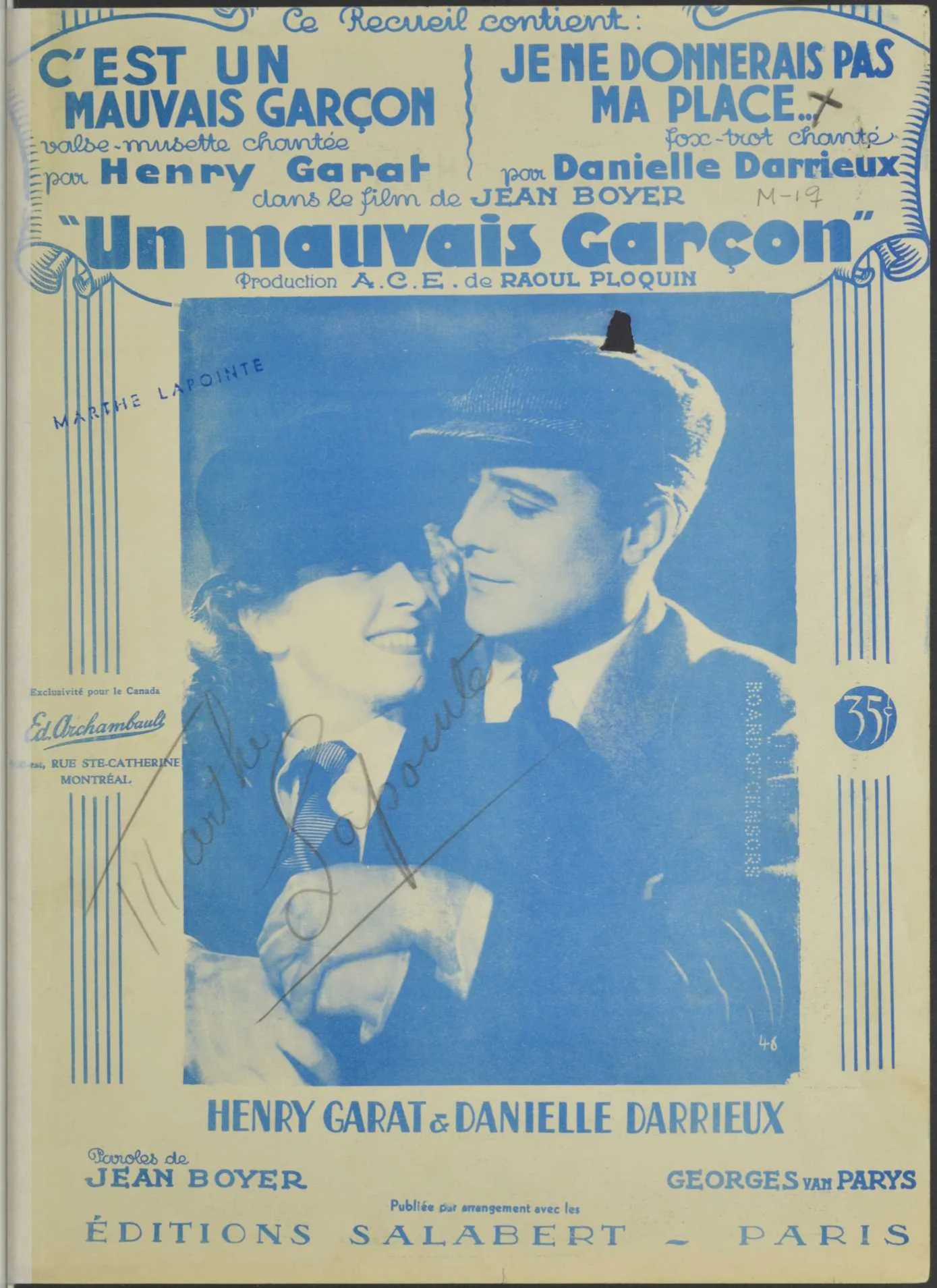
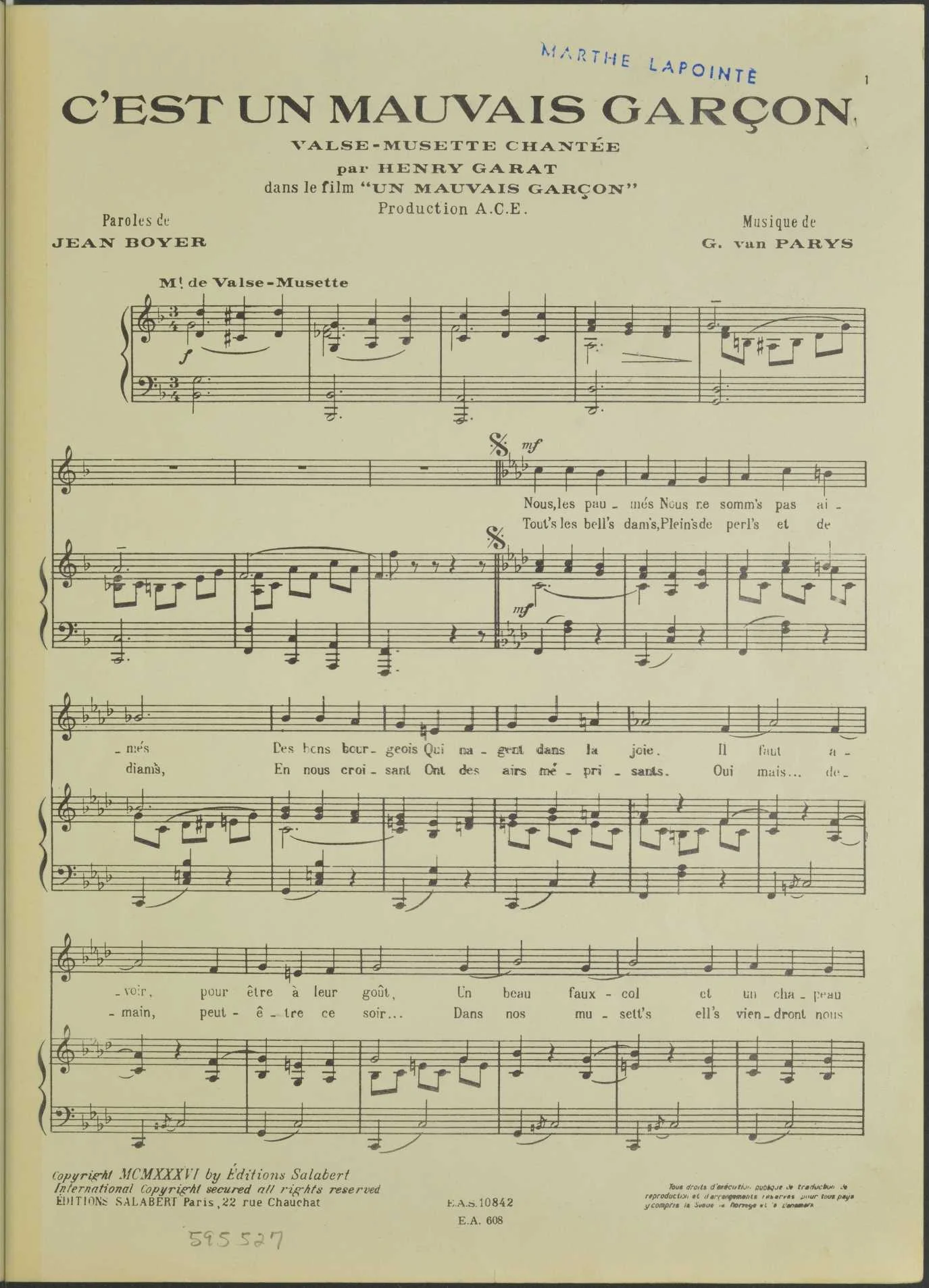
Jean Boyer (paroles) et Georges van Parys (musique), C’est un mauvais garçon, valse-musette tirée du film Un mauvais garçon, partition pour chant et piano, Paris, Salabert, E.A.S. 10842, 1936, p. 1-3.



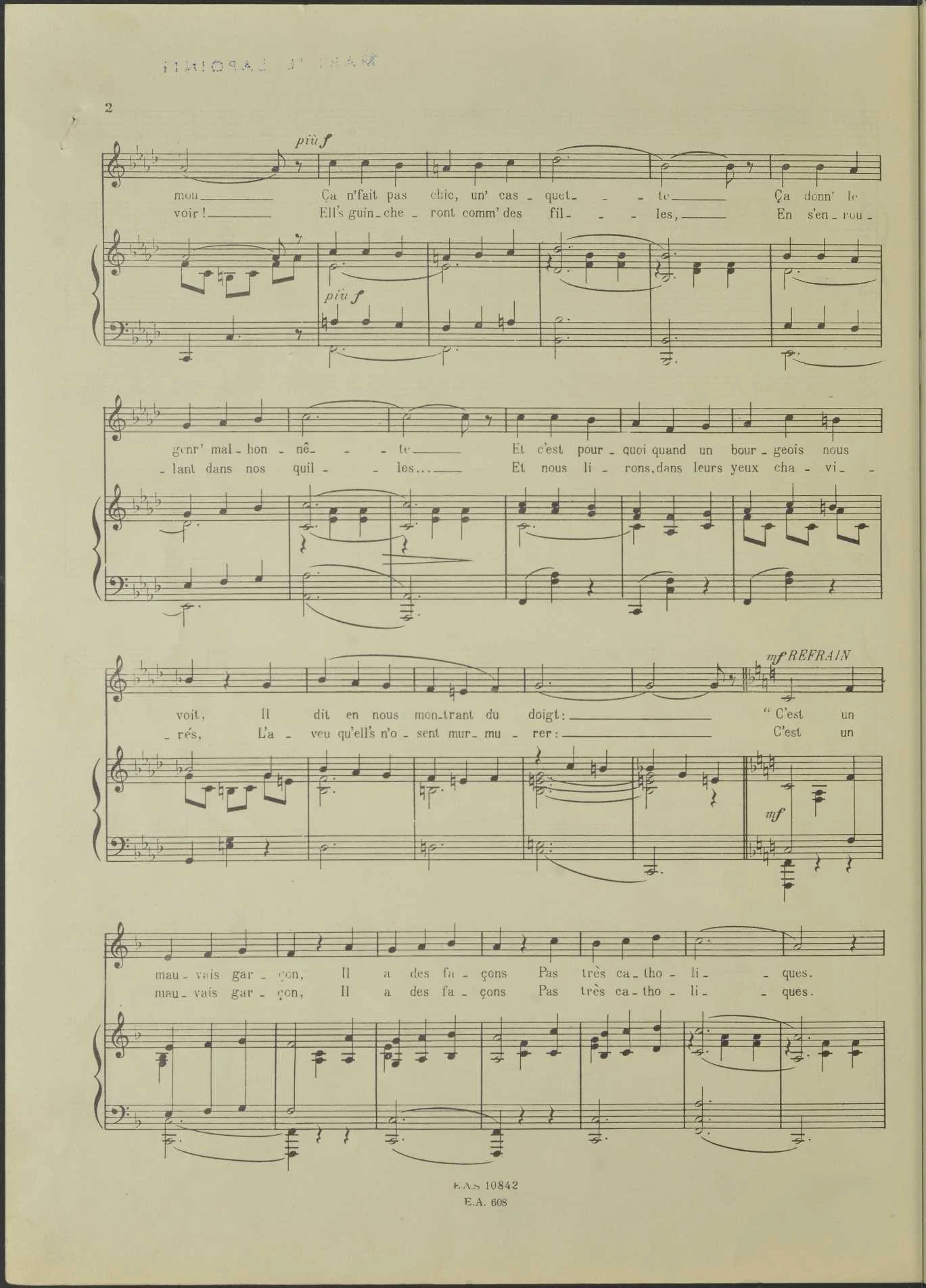
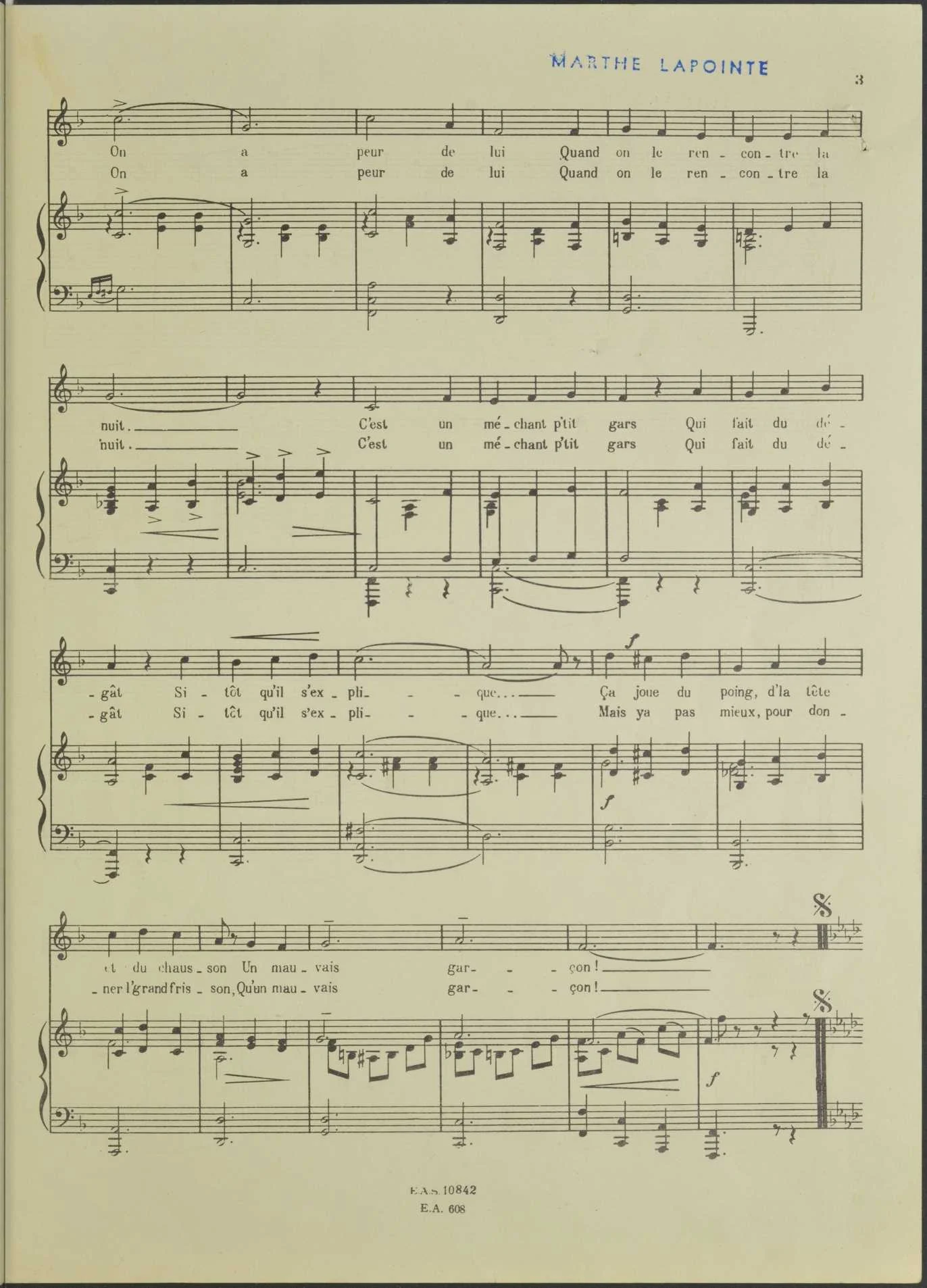
Jean Boyer (paroles) et Georges van Parys (musique), C’est un mauvais garçon, Henry Garat (chant), Orchestre WAL-BERG, 1 disque 78 tours, Polydor, 524.244, 1936.

Jean Boyer, Un mauvais garçon, 1936, 1 DVD, Éditions René Chateau vidéo, 2008.
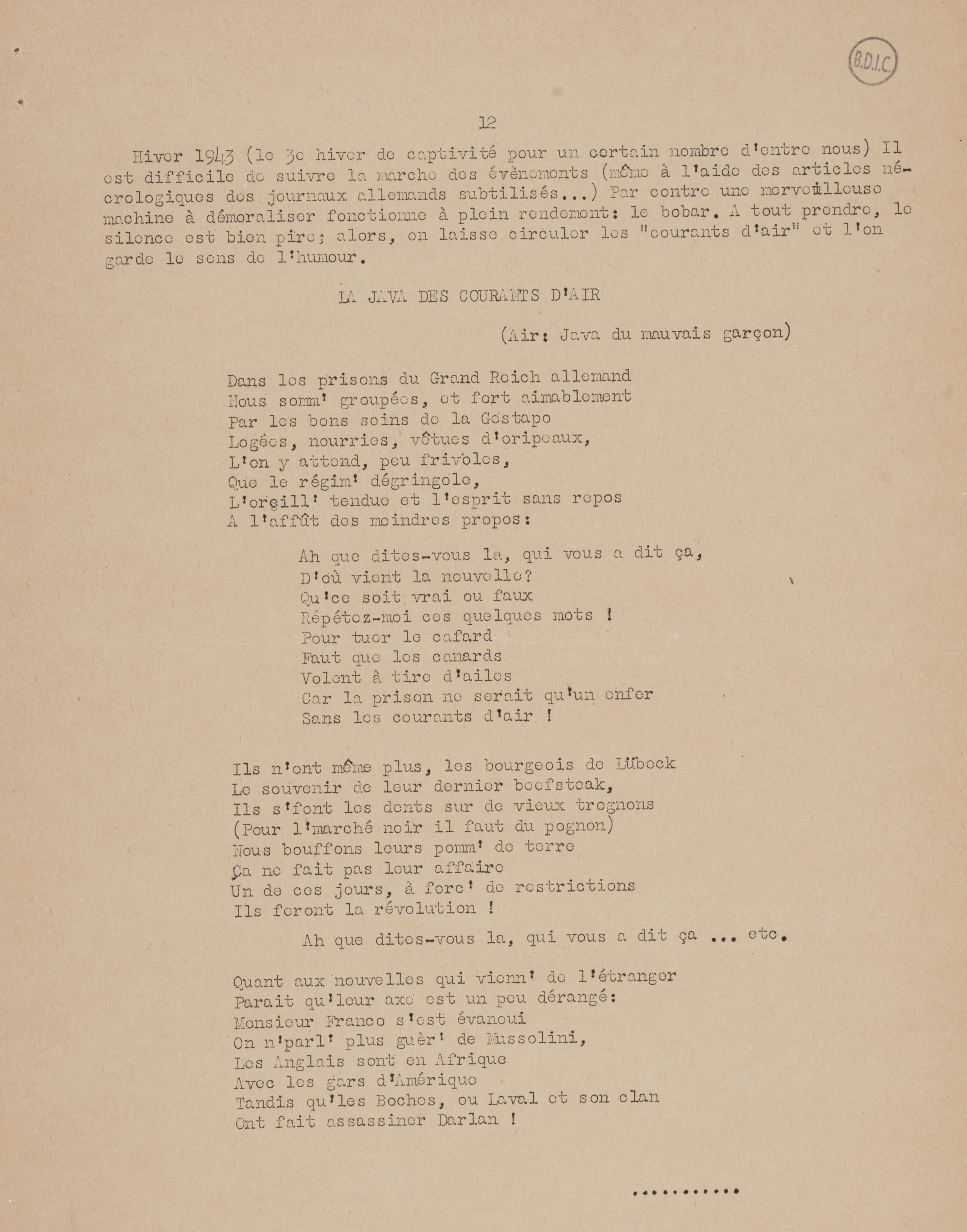
Winter 1943, Lübeck prison
This song uses the melody of C’est un mauvais garçon [He’s a Thug] from the film of the same name by Jean Boyer (starring Danielle Darrieux and Henri Garat), released in December 1936 in the La Scala movie theatre, in Paris. In the original song, the protagonist Pierre Mesnard (played by Garat) mocks the middle class and especially their hypocrisy towards the marginalized, to whose ranks he claims to belong. Extremely well-known during the interwar period, this song was adapted many times within Resistance circles; the collection La Résistance en chantant compiled by Sylvain Chimello takes stock of no fewer than four different versions, three of which were created in the maquis – a term that simultaneously refers to the scrubland or shrubs of the terrain and to the Resistance fighters in these rural areas – and one in a German forced labour camp.
Oddon’s transformed version has six verses and as many refrains whose lyrics often change. It references the rumours of liberation circulating in the prisons by giving a plethora of exaggerated details that, as they accumulate, create a comic effect. This new text is three times longer than the original, which has a refrain (sung twice) and two verses. This exaggerated length highlights how disproportionately important these rumours became in the prisons and labour camps – a phenomenon later analyzed by Germaine Tillion, who stressed that detachment in the face of hardship was needed to avoid losing the critical thinking skills that were vital for continuing to resist. From the original to the altered version, the “thug” became the group of women prisoners, and the “proper middle class” was replaced by the Gestapo.
Although Oddon called this song La java des courants d’air, the original score refers to a waltz-musette rather than a java. In fact, the two terms are interchangeable, since the java is a “dance in three-quarter time, rather uneven, popular at dances in working class neighbourhoods” of Paris during the interwar period. Its unpretentious style, along with its less sophisticated, bouncier movements, fit well into the environment in which Un mauvais garçon and its rebel protagonist exist. The movie scene where the protagonist sings C’est un mauvais garçon is nevertheless a typical waltz-musette dance.
[Sources: references 30, 42, 55, 58, 66, 90, 118, 121 in the bibliography]
C’est un mauvais garçon
He’s a Thug
(1936)
Nous, les paumés nous ne somm’s pas aimés
We lost souls are not loved
Des bons bourgeois qui nagent dans la joie.
By the proper middle class who are swimming in joy.
Il faut avoir, pour être à leur goût,
You must have, to meet their standards,
Un beau faux-col et un chapeau mou
A nice false collar and a fedora
Ça n’fait pas chic, un’ casquette
It’s not too sharp, a cap
Ça donn’ le genr’ malhonnête
It makes you look shady
Et c’est pourquoi quand un bourgeois nous voit
And that’s why when the middle class sees us
Il dit en nous montrant du doigt :
They say while pointing at us:
Refrain
« C’est un mauvais garçon
“There’s a thug
Il a des façons
He has his ways
Pas très catholiques.
That aren’t quite by the Book
On a peur de lui
We’re afraid of him
Quand on le rencontre la nuit.
When we cross paths at night.
C’est un méchant p’tit gars
He’s a wicked little boy
Qui fait du dégât
Who makes a mess
Sitôt qu’il s’explique…
The minute he speaks…
Ça joue du poing, d’la tête et du chausson
He uses his fists, his head, and his feet
Un mauvais garçon! »
A thug!”
Tout’s les bell’s dam’s, plein’s de perl’s et de diams,
All the fine ladies, dripping with pearls and diamonds,
En nous croisant ont des airs méprisants
When crossing our paths give us nasty looks
Oui mais… demain, peut-être ce soir…
Yes but… tomorrow, maybe tonight…
Dans nos musett’s ell’s viendront nous voir!
They’ll come see us in our dance halls!
Ell’s guincheront comm’ des filles,
They’ll cut a rug like young girls,
En s’enroulant dans nos quilles...
Wrapping themselves ’round our legs...
Et nous lirons, dans leurs yeux chavirés,
And we’ll see, in their glazed eyes,
L’aveu qu’ell’s n’osent murmurer :
The confession they dare not utter:
Refrain
« C’est un mauvais garçon
“There’s a thug
Il a des façons
He has his ways
Pas très catholiques.
That aren’t quite by the Book
On a peur de lui
We’re afraid of him
Quand on le rencontre la nuit.
When we cross paths at night.
C’est un méchant p’tit gars
He’s a wicked little boy
Qui fait du dégât
Who makes a mess
Sitôt qu’il s’explique…
The minute he speaks…
Mais ya pas mieux, pour donner l’grand frisson
But there’s no one better, to give you a big thrill
Qu’un mauvais garçon! »
Than a thug!”
La java des courants d’air
The Tall Tale Java
(ms p. 12-13)
Dans les prisons du Grand Reich allemand
In the prisons of the Greater German Reich
Nous somm’ groupées, et fort aimablement
We are grouped together, and very kindly
Par les bons soins de la Gestapo
With good care by the Gestapo
Logées, nourries, vêtues d’oripeaux,
Housed, fed, draped in fineries,
L’on y attend, peu frivoles,
There we wait, not idly,
Que le régim’ dégringole.
For the regime to topple.
L’oreill’ tendue et l’esprit sans repos
With ears pricked and a restless mind
A l’affût des moindres propos :
Tuned in for the slightest remark:
[Refrain]
Ah que dites-vous l[à],
Oh what are you saying there,
Qui vous a dit ça,
Who told you that,
D’où vient la nouvelle?
Where did you hear that news?
Qu’ce soit vrai ou faux
Whether it’s true or false
Répétez-moi ces quelques mots!
Repeat these few words for me!
Pour tuer le cafard
To swat the blues away
Faut que les canards
It takes tall tales
Volent à tire d’ailes
Flying around at full speed
Car la prison ne serait qu’un enfer
For prison would be hell
Sans les courants d’air!
Without tall tales flapping in the breeze!
Ils n’ont même plus, les bourgeois de Lübeck
They no longer even have, that Lübeck middle class
Le souvenir de leur dernier beefsteak.
A memory of their last steak.
Ils s’font les dents sur de vieux trognons
They gnaw on old bones
(Pour l’marché noir il faut du pognon)
(For the black market, you need some dough)
Nous bouffons leurs pomm’ de terre
We eat their potatoes
Ça ne fait pas leur affaire
They’re not pleased
Un de ces jours, à forc’ de restrictions
One of these days, with all these restrictions
Ils feront la révolution!
They will revolt!
[Refrain]
Ah que dites vous l[à], qui a vous a dit ça… etc.
Oh what are you saying there, who told you that… etc.
Quant aux nouvelles qui vienn’ de l’étranger
As for news from abroad
Parait qu’leur axe est un peu dérangé :
Things there seem to be off kilter:
Monsieur Franco s’est évanoui
Mister Franco vanished
On n’parl’ plus guèr’ de Mussolini,
There’s no longer much talk about Mussolini,
Les Anglais sont en Afrique
The English are in Africa
Avec les gars d’Amérique
With the guys from America
Tandis qu’les Boches, ou Laval et son clan
While the Krauts, or Laval and his squad
Ont fait assassiner Darlan!
Have had Darlan assassinated!
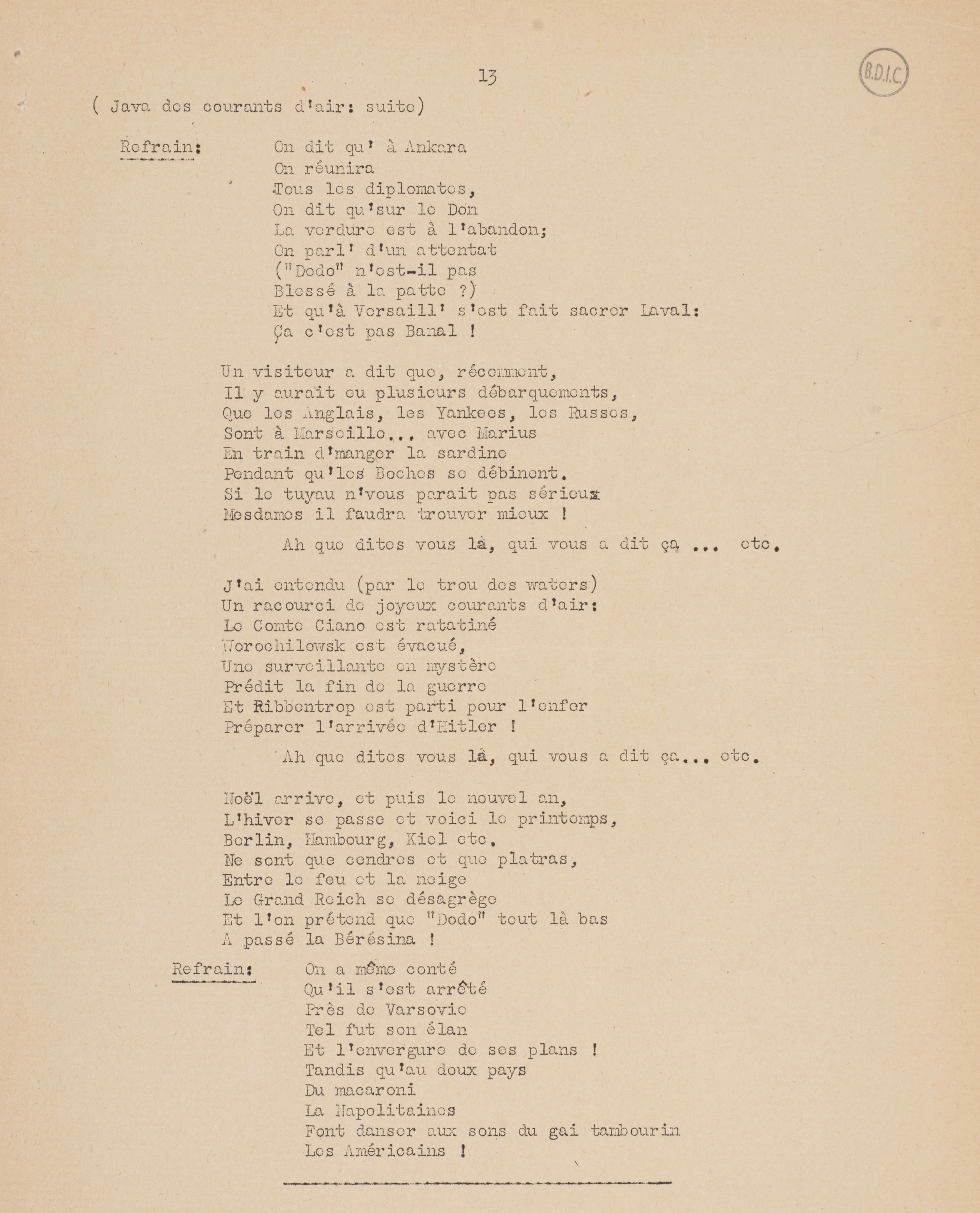
Refrain :
On dit qu’à Ankara
It’s said that in Ankara
On réunira
They’ll gather
Tous les diplomates,
All the diplomats,
On dit qu’sur le Don
It’s said that along the Don
La verdure est à l’abandon;
The foliage grows unattended;
On parl’ d’un attentat
There’s talk of an assassination attempt
(« Dodo » n’est-il pas
(Isn’t “Dodo”
Blessé à la patte ?)
Wounded on the leg?)
Et qu’à Versaill’ s’est fait sacrer Laval :
And in Versailles they anointed Laval:
Ça c’est pas [b]anal!
That’s not banal!
Un visiteur a dit que, récemment,
A visitor said that, recently,
Il y aurait eu plusieurs débarquements,
There had been several landings,
Que les Anglais, les Yankees, les Russes,
That the English, the Yankees, the Russians,
Sont à Marseille… avec Marius
Are in Marseille… with Marius
En train d’manger la sardine
Eating sardines
Pendant qu’les Boches se débinent.
While the Krauts are falling apart.
Si le tuyau n’vous parait pas sérieux
If this tip doesn’t seem reliable
Mesdames il faudra trouver mieux!
Ladies, you’ll have to find something better!
[Refrain]
Ah que dites-vous l[à], qui a vous a dit ça… etc.
Oh what are you saying there, who told you that… etc.
J’ai entendu (par le trou des waters)
I heard (through the toilet bowl)
Un raccourci de joyeux courants d’air :
Fleeting cheerful tall tales:
Le Comte Ciano est ratatiné
Count Ciano has fled
Worochilowsk est évacué,
Voroshilovsk has been evacuated,
Une surveillante en mystère
A mysterious watchwoman
Prédit la fin de la guerre
Is predicting the end of the war
Et Ribbentrop est parti pour l’enfer
And Ribbentrop has gone to hell
Préparer l’arrivée d’Hitler!
To ready the place for Hitler!
[Refrain]
Ah que dites-vous l[à], qui a vous a dit ça… etc.
Oh what are you saying there, who told you that… etc.
Noël arrive, et puis le nouvel an,
Christmas has come, and then the New Year,
L’hiver se passe et voici le printemps,
Winter has gone and here is spring,
Berlin, Hambourg, Kiel etc.
Berlin, Hamburg, Kiel etc.
Ne sont que cendres et que pl[â]tras,
Are nothing but ashes and plaster,
Entre le feu et la neige
Between fire and snow
Le Grand Reich se désagrège
The Greater Reich is collapsing
Et l’on prétend que « Dodo » tout là[-]bas
And they claim that “Dodo” over there
A passé la Bérésina!
Has crossed the Berezina!
Refrain :
On a même conté
It’s even been said
Qu’il s’est arrêté
That he stopped
Près de Varsovie
Near Warsaw
Tel fut son élan
So great was his momentum
Et l’envergure de ses plans!
And the scope of his plans!
Tandis qu’au doux pays
While in the gentle country
Du macaroni
of macaroni
L[es] Napolitaines
The Neapolitan women
Font danser aux sons du gai tambourin
To the sound of the cheerful tambourine
Les Américains!
Get the Americans dancing!