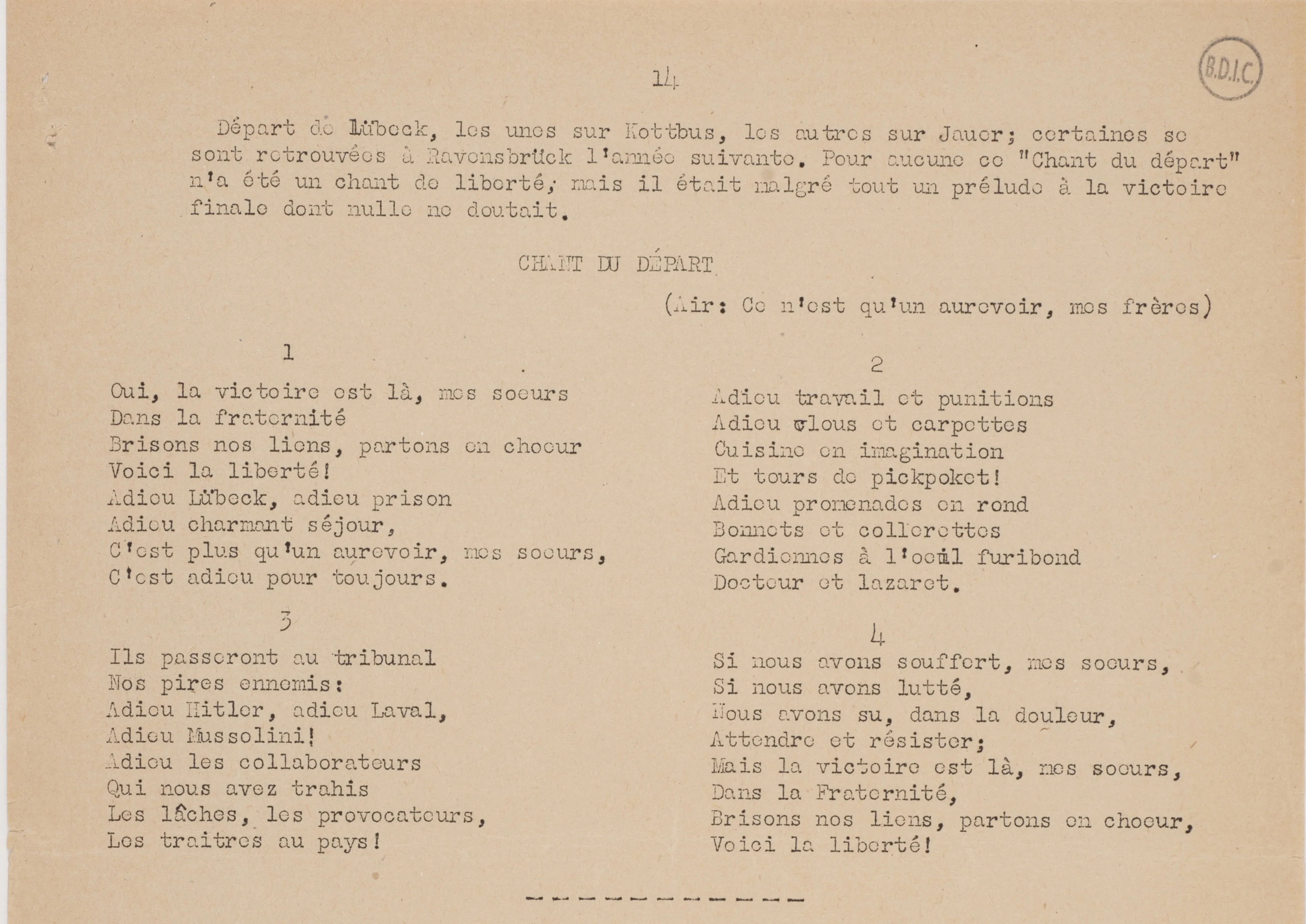

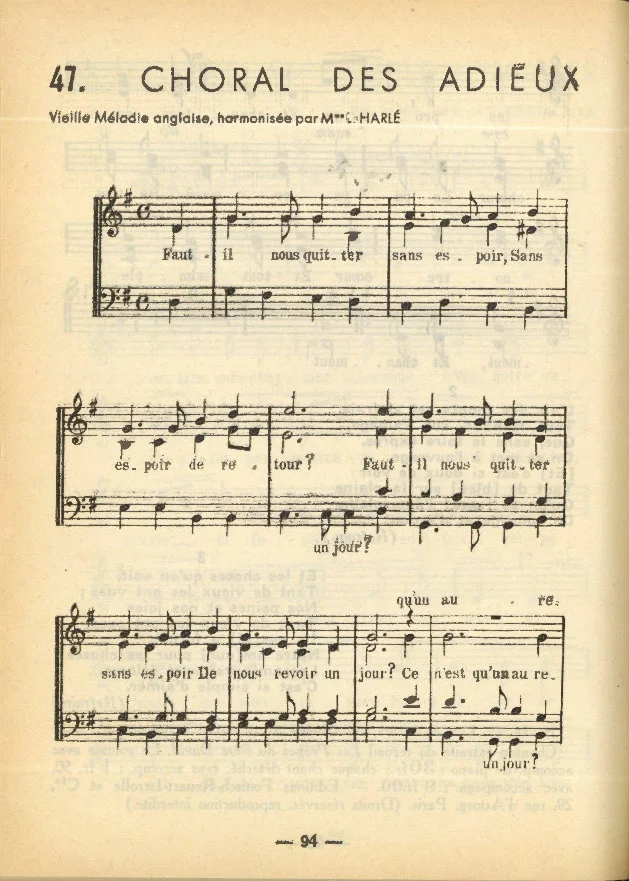
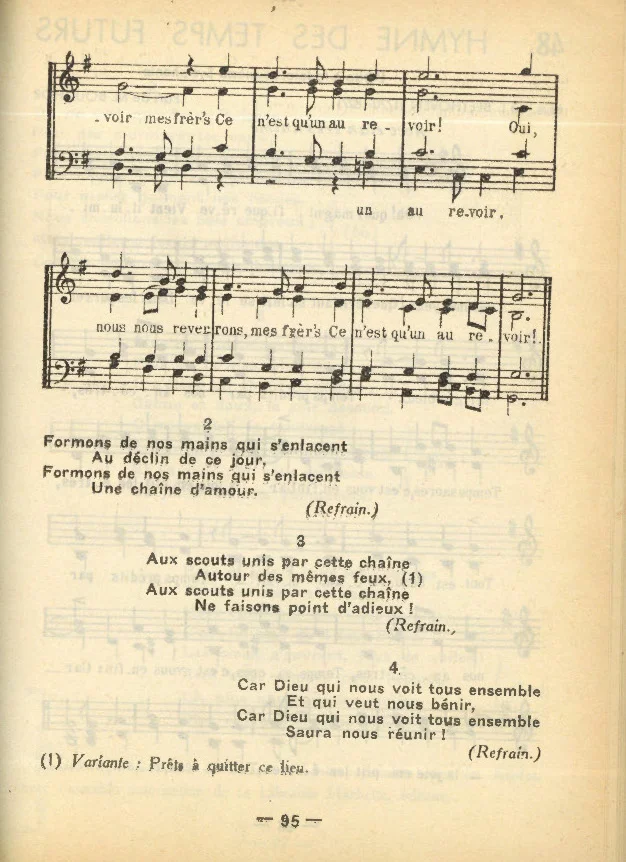
« Choral des adieux », partition pour 4 voix, dans Le Coq : Chansonnier scout des éclaireurs unionistes de France, Paris, Éclaireurs unionistes de France, 1939, p. 94-95.


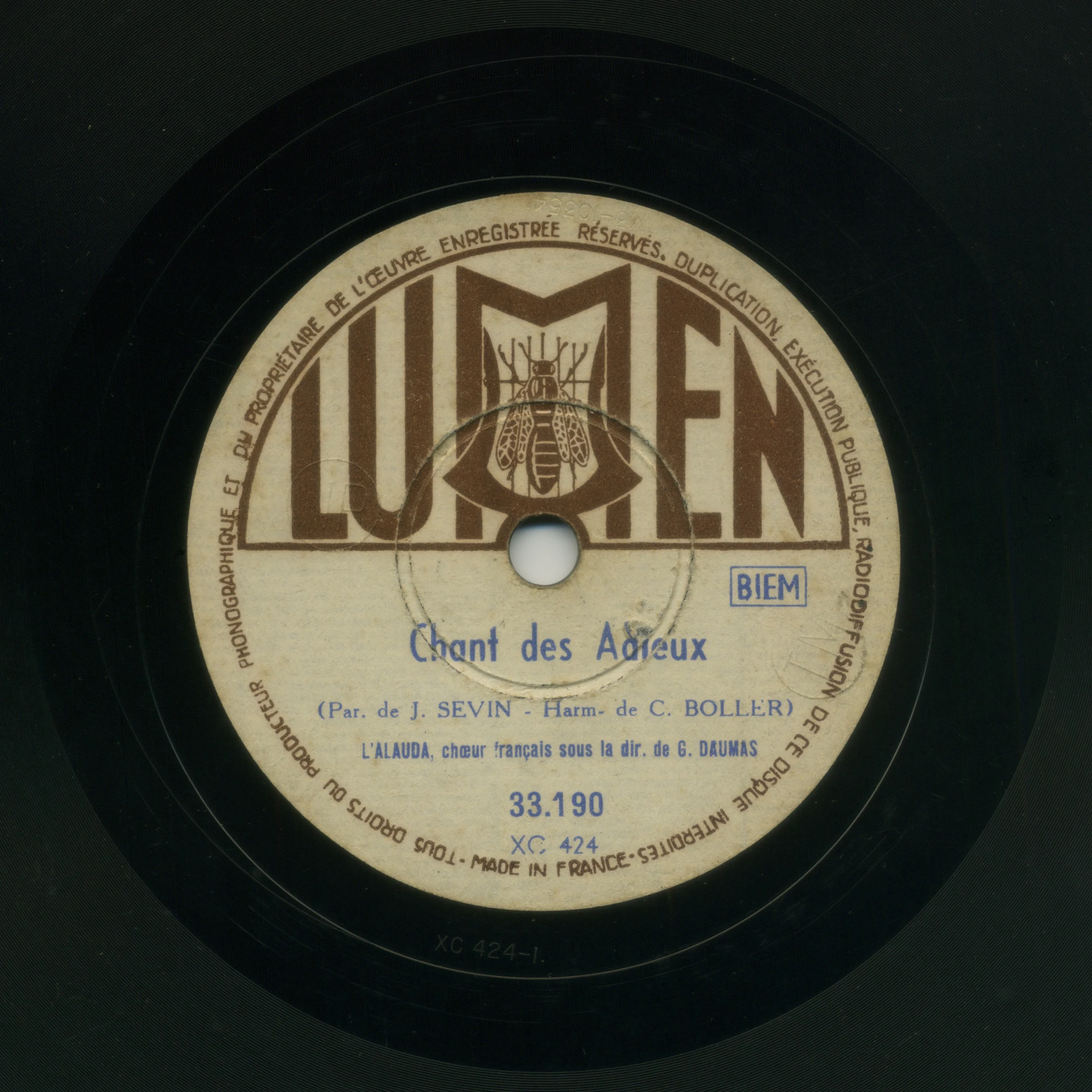
Chant des adieux, Chorale de l’Alauda, 1 disque 78 tours, Lumen, XC 424, [entre 1927 et 1946].
1943, Lübeck prison
This song’s famous source melody, Ce n’est qu’un au revoir (also known under the titles Chant des adieux and Choral des adieux), is itself an adaptation of the traditional Scottish tune Auld Lang Syne composed by Robert Burns in 1788. Sung in every language represented at the World Scout Jamboree – an international gathering of Scouts held every four years since the summer of 1920 – the song has been widely circulated internationally. It has been adapted into French many times; the French lyrics became standardized around 1920 using a text by Father Jacques Sevin, who was very involved in the Scout movement. He was also the one who gave the song religious overtones not present in the Scottish version.
The sources presented here documenting the French version show the Scout movement’s influence on the song’s dissemination during the interwar period. The score comes from a Scout leader songbook, and the recording is a performance by the Alauda Choir – a Scout choir conducted by Gustave Daumas – in an arrangement by Carlo Boller. The popularity of Ce n’est qu’un au revoir carried through the Second World War, largely due to the Vichy government’s establishment, in 1940, of a Youth Secretariat and a Youth Movements Office, with the aim of “rebuilding the nation.” The appointment of former Scout leaders to senior leadership roles within these government bodies and movements contributed to Scout choral repertoire being passed on to the Vichy youth movements.
Many accounts from Nazi camp survivors highlight the song’s widespread circulation among prisoners. It is said to have been most often sung at the fateful moment of deportation from France toward unknown destinations, sometimes leading the authors themselves to bitter reflections in hindsight when reminded of this memory, as seen in journalist and Resistance fighter Marcel Conversy’s Quinze mois à Buchenwald [Fifteen months at Buchenwald]: “Yes, we’ll meet again my brothers, / It’s only goodbye for now. This statement reeks of awful doubt, of the words of comfort spoken to the dying. No, my brothers, my friends, my companions, for many of us, it is a final farewell to life that we have just sung.” Beyond the version transcribed by Oddon, there is at least one other known case of this song being transformed by French prisoners: Penbreuil known as Le Barbu (bearded one) and Ohion known as Le Facteur (mailman) made up a song to the tune of Chant des adieux in January 1942 at the Fort de Villeneuve-Saint-Georges (Val-de-Marne), “in memory of our fellow sufferers, imprisoned at La Santé who, with each departure for the fortresses of Germany, sang Ce n’est qu’un au revoir.”
Like Penbreuil and Ohion, Oddon and her companions used this melody to create a new song looking to the future, thus standing out significantly from the more common prison versions of this well-known song. Although most prisoners sang Ce n’est qu’un au revoir nostalgically while saying their goodbyes to France, the group around Yvonne Oddon rewrote the lyrics while at Lübeck: in a passionate goodbye to the German prison, the new song carries a message of hope for freedom. It also imagines harsh justice against “our worst [political] enemies” (Hitler, Laval, and Mussolini) and “the cowards, instigators, and traitors to the country” as a reward for the Resistance fighters’ tireless struggle. In fact, Chant du départ notated by Oddon got its title from the famous song of the French Revolution by Marie-Joseph Chénier and Étienne-Nicholas Méhul, which the Resistance fighters sang frequently (the title of Béatrix de Toulouse-Lautrec’s account, La Victoire en pleurant – Triumph While Crying – is an example of a twist on the song’s opening lines “Triumph while singing”). The original formula “my brothers” in Ce n’est qu’un au revoir having been systematically replaced by “my sisters,” Chant du départ comes across both as a song of resistance and of feminism, by emphasizing the need for brotherhood – or rather sisterhood (i.e. kinship) – in order to triumph. As a sign of the importance of these values, the first four lines of the song (which reference victory, kinship, and the freedom to come) are repeated verbatim at the end of the song.
[Sources: references 3, 13, 30, 34, 44, 52, 55, 61, 67, 70, 120 in the bibliography]
Choral des adieux [Ce n’est qu’un au revoir]
Farewell Chorus [It’s Only Goodbye for Now]
(traditional Scottish song)
[1]
Faut-il nous quitter sans espoir,
Must we part without hope,
Sans espoir de retour?
Without hope of return?
Faut-il nous quitter sans espoir
Must we part without hope
De nous revoir un jour?
Of one day meeting again?
[Refrain]
Ce n’est qu’un au revoir mes frèr’s
It’s only goodbye for now, my brothers,
Ce n’est qu’un au revoir!
It’s only goodbye for now!
Oui, nous nous reverrons, mes frèr’s
Yes, we’ll meet again, my brothers
Ce n’est qu’un au revoir!
It’s only goodbye for now!
2
Formons de nos mains qui s’enlacent
Let our hands clasped together
Au déclin de ce jour,
As day winds down,
Formons de nos mains qui s’enlacent
Let our hands clasped together
Une chaîne d’amour.
Form a chain of love.
(Refrain.)
3
Aux scouts unis par cette chaîne
To the Scouts united by this chain
Autour des mêmes feux, (1)
Around the same fires, (1)
Aux scouts unis par cette chaîne
To the Scouts united by this chain
Ne faisons point d’adieux!
Let there be no goodbyes!
(Refrain.)
4
Car Dieu qui nous voit tous ensemble
For God who sees us all together
Et qui veut nous bénir
And wants to bless us
Car Dieu qui nous voit tous ensemble
For God who sees us all together
Saura nous réunir!
Will reunite us!
(Refrain.)
(1) Variante : Prêts à quitter ce lieu.
(1) Variation: ready to leave this place.
Chant du départ
Departure Song
(ms p. 14)
1
Oui, la victoire est là, mes sœurs
Yes, victory is coming, my sisters
Dans la fraternité
In kinship
Brisons nos liens, partons en chœur
Let us break our shackles, and go as one
Voici la liberté!
Here comes freedom!
Adieu Lübeck, adieu prison
So long Lübeck, so long prison
Adieu charmant séjour,
So long charming visit,
C’est plus qu’un aurevoir, mes sœurs,
It’s more than goodbye for now, my sisters,
C’est adieu pour toujours.
It’s so long forever.
2
Adieu travail et punitions
So long labour and punishments
Adieu clous et carpettes
So long nails and carpets
Cuisine en imagination
Imaginary cooking
Et tours de pickpocket!
And pickpocketing tricks!
Adieu promenades en rond
So long pacing in circles
Bonnets et collerettes
Bonnets and ruffles
Gardiennes à l’œil furibond
Guards with raging eyes
Docteur et lazaret.
Doctor and infirmary.
3
Ils passeront au tribunal
They’ll go to trial
Nos pires ennemis :
Our worst enemies:
Adieu Hitler, adieu Laval,
So long Hitler, so long Laval,
Adieu Mussolini!
So long Mussolini!
Adieu les collaborateurs
So long collaborators
Qui nous avez trahis
Who betrayed us
Les lâches, les provocateurs,
Cowards, instigators,
Les traîtres au pays!
Traitors to the country!
4
Si nous avons souffert, mes sœurs,
Though we suffered, my sisters,
Si nous avons lutté,
Though we struggled,
Nous avons su, dans la douleur,
We managed, with great pain,
Attendre et résister;
To wait and resist;
Mais la victoire est là, mes sœurs,
But victory is coming, my sisters,
Dans la Fraternité,
In kinship,
Brisons nos liens, partons en chœur,
Let us break our shackles, and go as one,
Voici la liberté!
Here comes freedom!