
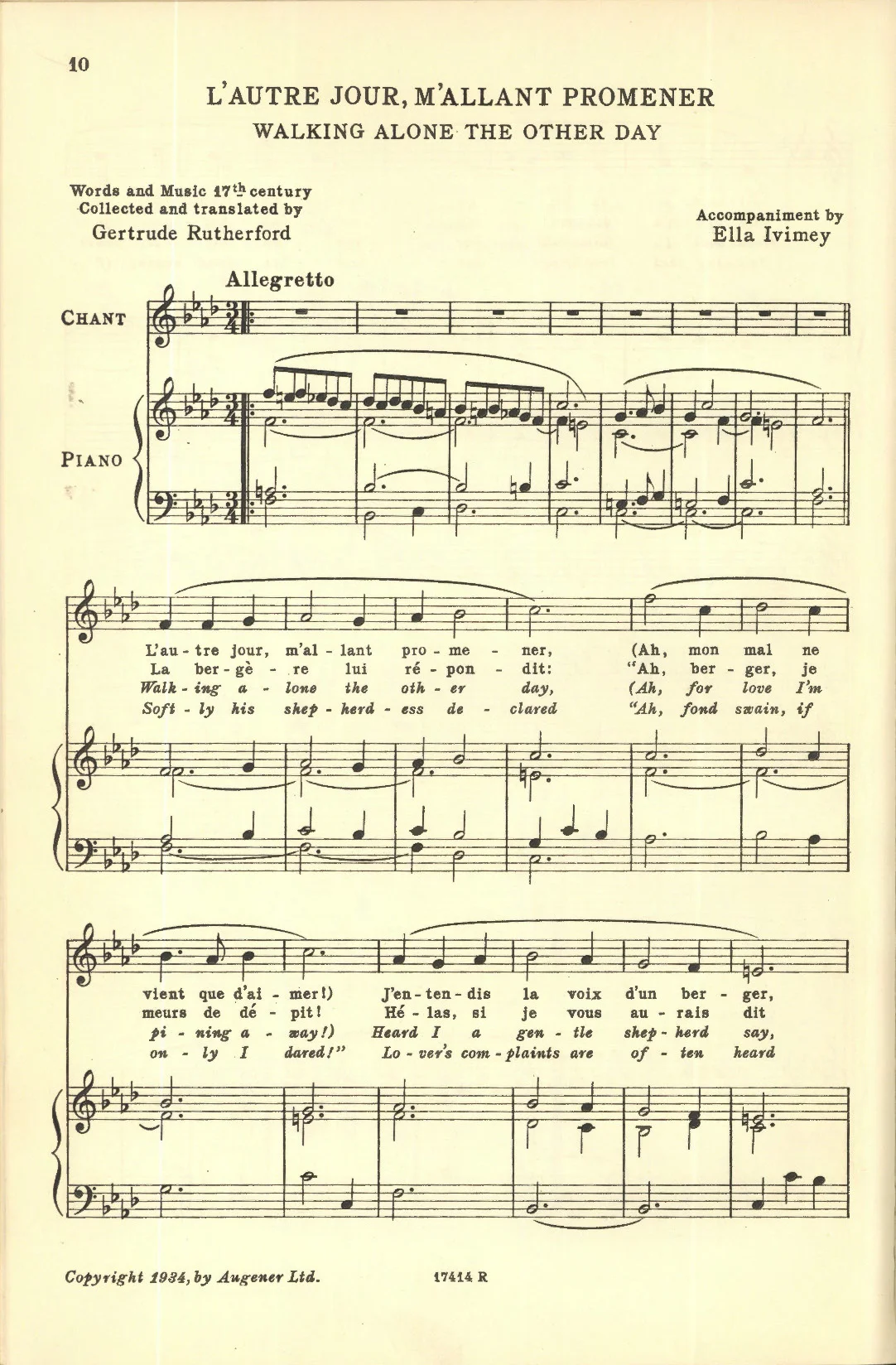
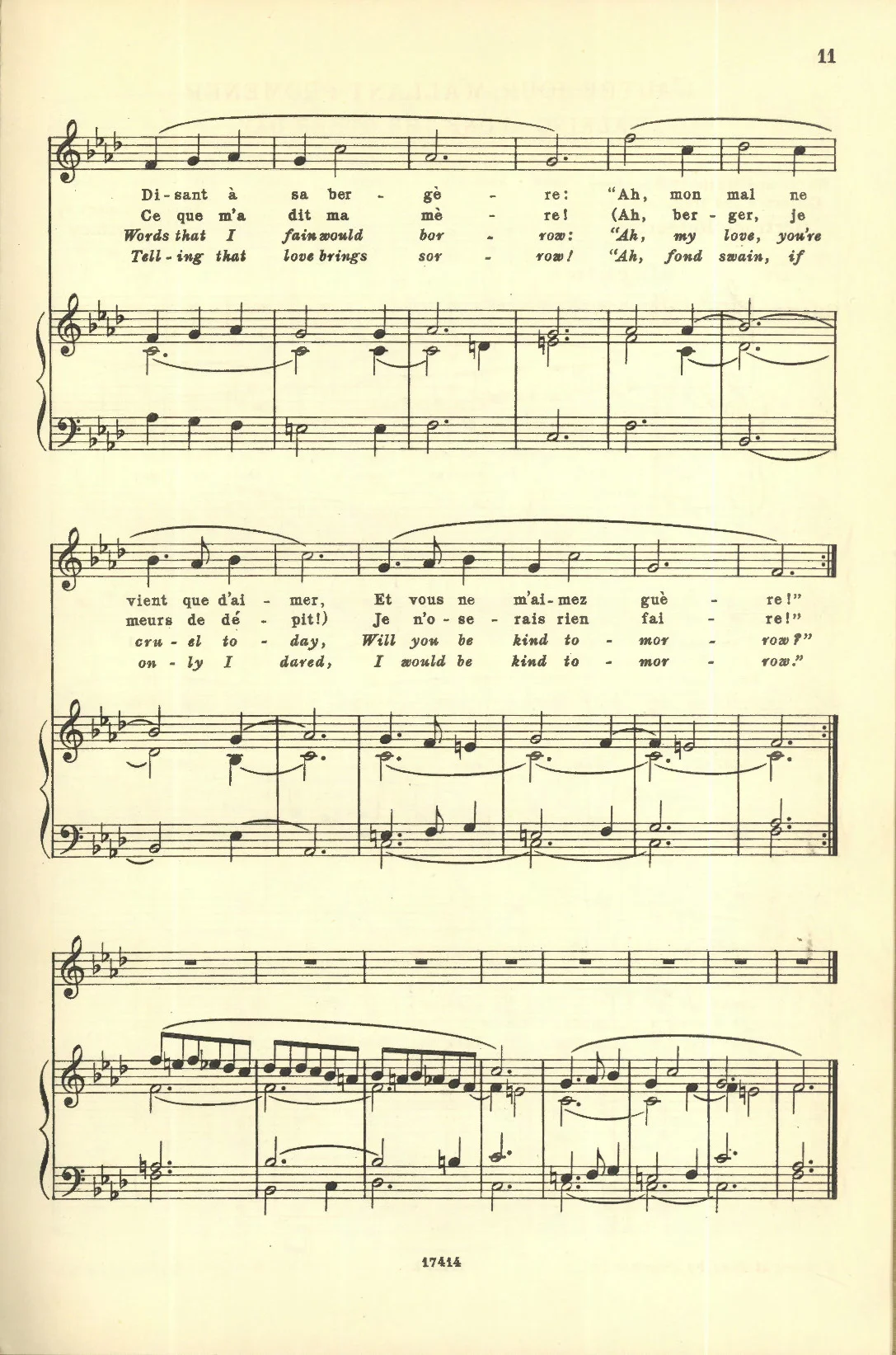
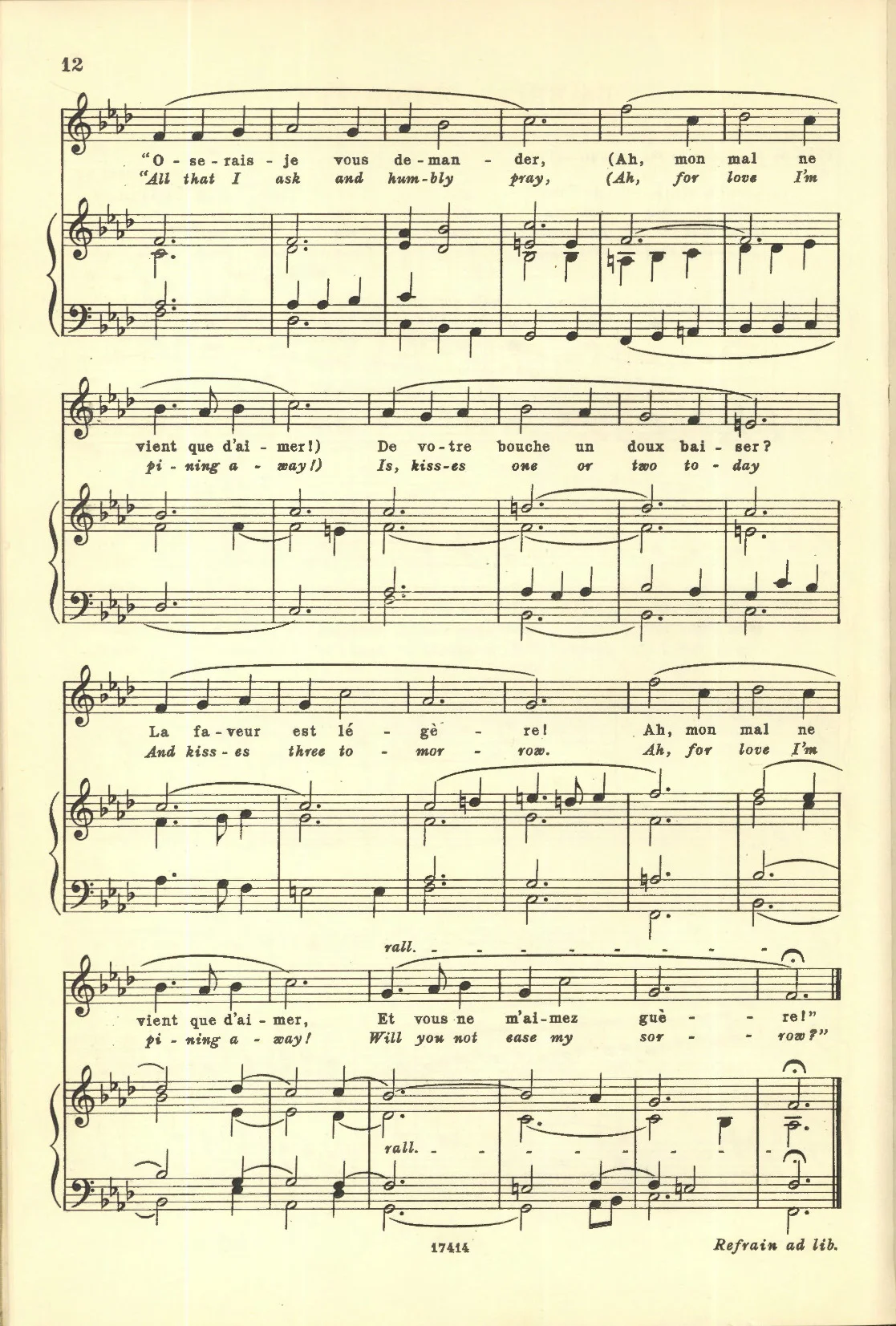
« L’autre jour m’allant promener [Walking Alone the Other Day] », partition pour voix et piano, dans Gertrude Rutherford et Ella Ivimey, 9 French Songs of the 17th & 18th Centuries, Londres, Augener Ltd., 1934, p. 10-12. Reproduit avec l’autorisation de Stainer & Bell Ltd, London, UK, www.stainer.co.uk.


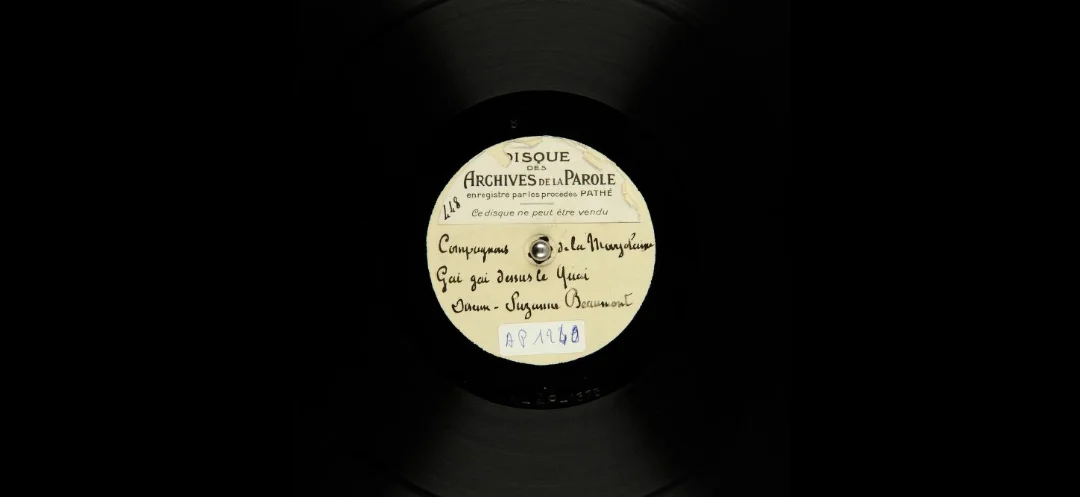
L’autre jour en m’allant me promener, Archives de la parole, 1 disque 78 tours, Pathé, AP1240, 1929. Enregistrement conservé à la Bibliothèque nationale de France.
1944, Cottbus prison
This song is set to a very old melody that has been used for contrafacta – or new lyrics added to an existing tune – since at least the early eighteenth century, as is clear from its inclusion in La clef des chansonniers (1717) by Jean-Baptiste-Christophe Ballard, who was a music printer for many years under Louis XIV. This melody can be found, always with different lyrics, in many opera parodies presented at the Comédie-Italienne during the eighteenth century (for example, Louis Fuzelier”s Arlequin Persée in 1722; Claude Florimond Boizard de Pontau’s Arlequin Atys in 1726; and Les ensorcelés in 1757 by Justine Favart, Jean-Nicolas Guérin de Frémincourt and Harny de Guerville), as well as many other traditional folk songs such as Moi qui suis si jolie [I, Who Am So Pretty) and Vous chiffonnez mon bavolet [You’re Getting On My Nerves]. The original lyrics, as found in La clef des chansonniers, are about a shepherd who begs his beloved for a kiss while lamenting that “[his] pain comes only from being in love.”
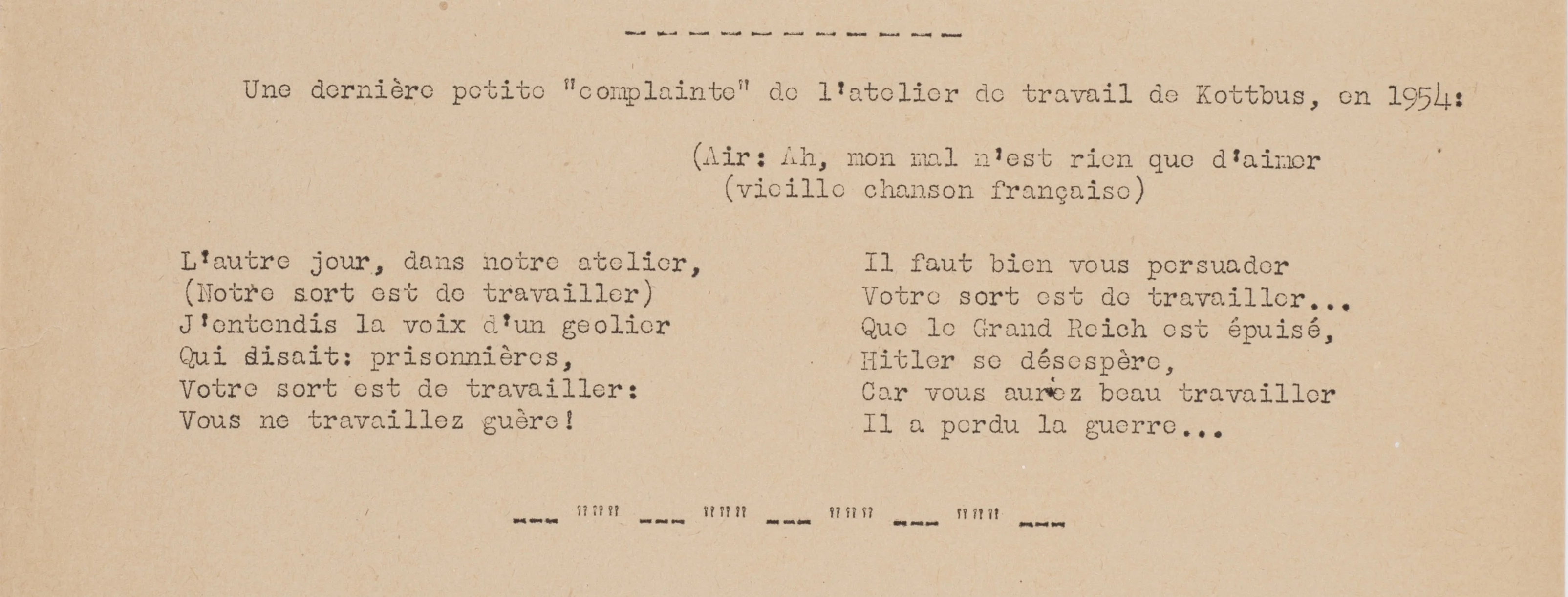
The lyrics are slightly modified in the score reproduced here, which is the only 1930s edition we could track down (as the vast majority of published versions of L’autre jour m’allant promener predate the nineteenth century). In this score, from a 1934 British collection, the addition of a second verse gives a voice to the shepherdess in question, introducing a sense of agency for a woman that is entirely absent both from the version notated by Ballard in 1717 and from the recording documented here.
This recording attests to the widespread oral mode of transmission of the song in France, well beyond the eighteenth century. Collected by Hubert Pernot for the Archives of the Spoken Word (an institute at the Sorbonne founded in 1911 by Ferdinand Bunot), it is performed by one of the Archives frequent collaborators, Suzanne Beaumont. The album’s centre label only mentions the title of the first song on the A side, hence the seeming discrepancy between the audio and the image that accompanies it.
Described as a “little lament,” the transformed version by Oddon and her companions speaks to a refusal to work for the Nazis, a key stance for women of the Resistance. This theme takes on special significance within Cottbus prison, for as Oddon wrote in a talk given on June 28, 1945 at the Muséum national d’Histoire naturelle in Paris, “when, in the fall of 1944, the SS set up a gas mask factory [there] […], the French and Belgian political prisoners refused to work in it and were sent to Ravensbrück.” In the song transcribed by Oddon before that ill-fated transfer, the original refrain “Oh, my pain comes only from being in love, And you hardly love me” is transformed and assigned to a prison guard pointing out the prisoners’ lack of cooperation: “Your lot is to work: you’re hardly working!”. The guard thus takes on the role of the shepherd, whose lament is no longer about a rebellious heart but about uncooperative prisoners. The second verse expresses anticipation of the long-awaited victory: “For however hard you’ve worked, He [Hitler] has lost the war…”.
[Sources: references 10, 15, 28, 29, 50, 53, 65, 86, 88, 117 in the bibliography]
L’autre jour, m’allant promener
The Other Day, Out Walking
(oral tradition)
L’autre jour, m’allant promener,
The other day, out walking
(Ah, mon mal ne vient que d’aimer!)
(Oh, my pain comes only from being in love!)
J’entendis la voix d’un berger,
I heard the voice of a shepherd,
Disant à sa bergère :
Saying to his shepherdess:
« Ah, mon mal ne vient que d’aimer,
“Oh, my pain comes only from being in love,
Et vous ne m’aimez guère! »
And you hardly love me!”
La bergère lui répondit :
The shepherdess replied:
« Ah, berger, je meurs de dépit!
“Oh shepherd, I’m dying of chagrin!
Hélas, si je vous a[v]ais dit
Alas, if I told you
Ce que m’a dit ma mère!
What my mother said to me!
(Ah, berger, je meurs de dépit!)
(Oh shepherd, I’m dying of chagrin!)
Je n’oserais rien faire! »
I’d dare not do a thing!”
« Oserais-je vous demander,
“Dare I ask you,
(Ah, mon mal ne vient que d’aimer!)
(Oh, my pain comes only from being in love!)
De votre bouche un doux baiser?
From your lips a sweet kiss
La faveur est légère!
It is but a small kindness!
Ah, mon mal ne vient que d’aimer,
Oh, my pain comes only from being in love,
Et vous ne m’aimez guère! »
And you hardly love me!”
L’autre jour, dans notre atelier
The Other Day, In Our Sweatshop
[untitled song]
(ms p. 14)
L’autre jour, dans notre atelier,
The other day, in our sweatshop,
(Notre sort est de travailler)
(Our lot is to work)
J’entendis la voix d’un ge[ô]lier
I heard the voice of a prison guard
Qui disait : prisonnières,
Saying: Prisoners,
Votre sort est de travailler :
Your lot is to work:
Vous ne travaillez guère!
You’re hardly working!
Il faut bien vous persuader
Someone must convince you
Votre sort est de travailler…
That your lot is to work…
Que le Grand Reich est épuisé,
That the Greater Reich is overcome,
Hitler se désespère,
Hitler is in despair,
Car vous aurez beau travailler
For however hard you’ve worked
Il a perdu la guerre…
He has lost the war…