
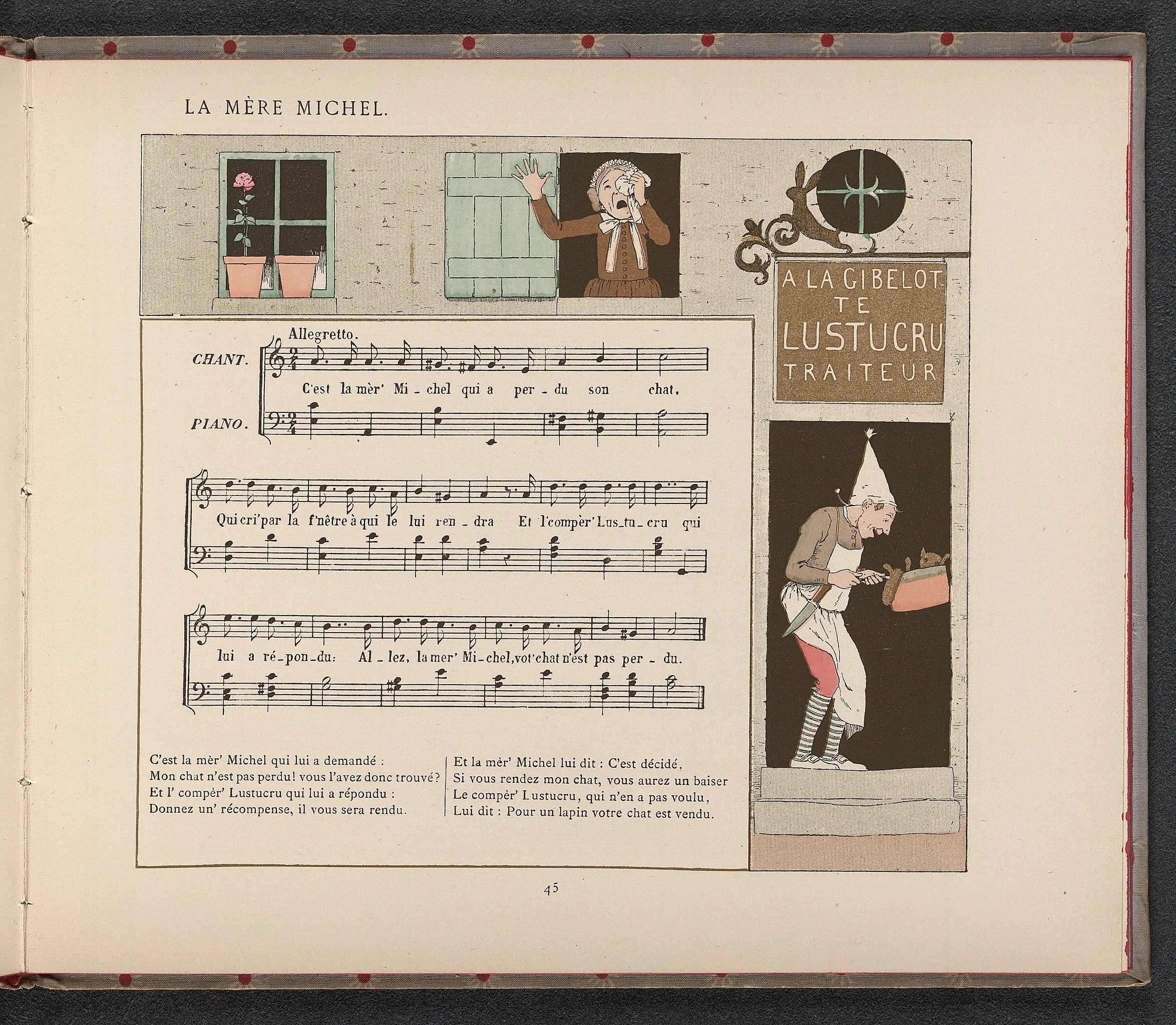
« La mère Michel », partition pour chant et piano, dans Vieilles chansons et rondes pour les petits enfants avec accompagnements de Ch. M. Widor, Paris, Plon-Nourrit et Cie, [v. 1910], p. 45.


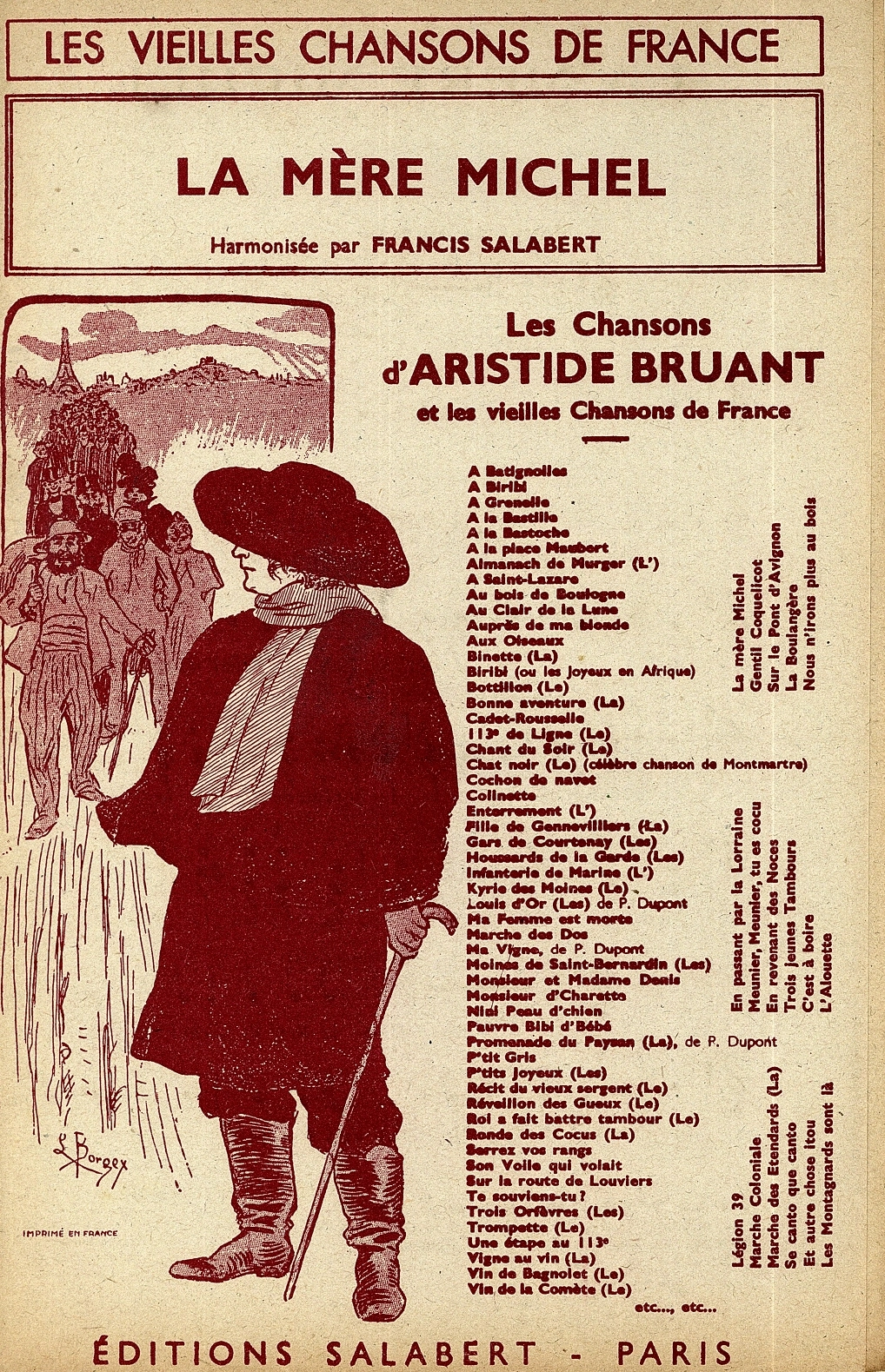
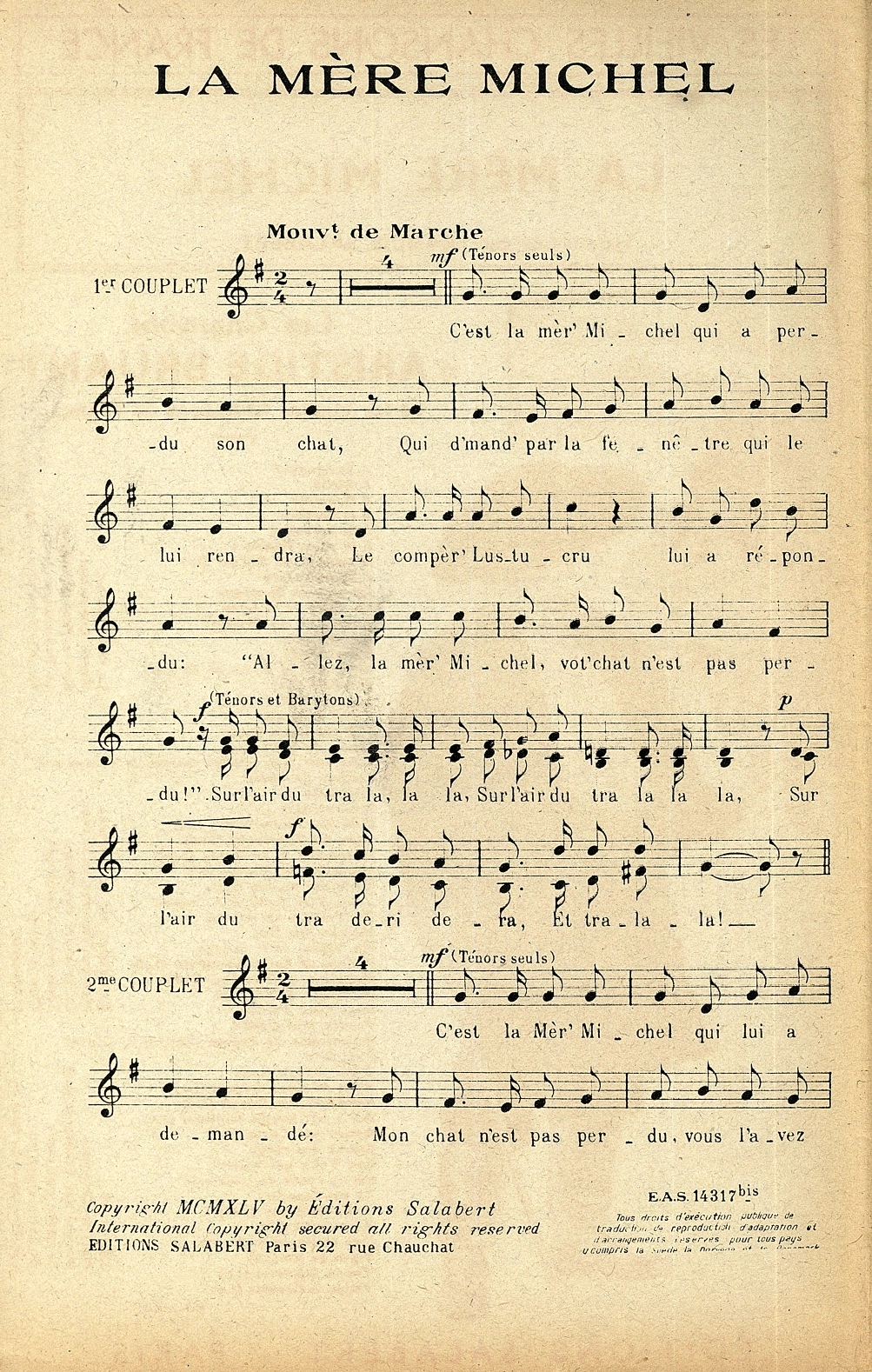
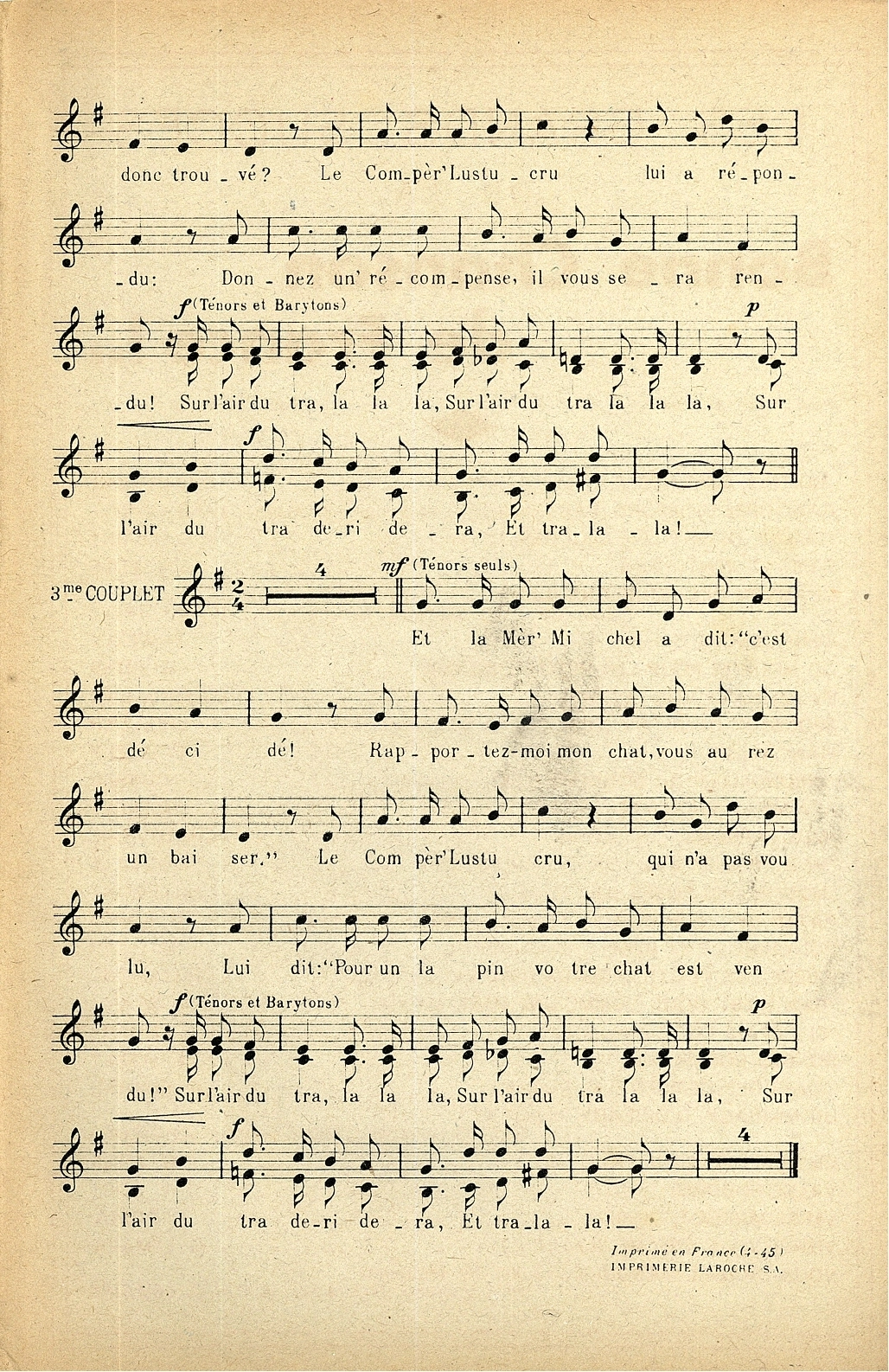
La mère Michel, chanson de tradition orale harmonisée par Francis Salabert, Paris, Salabert, E.A.S. 14317bis, 1945.
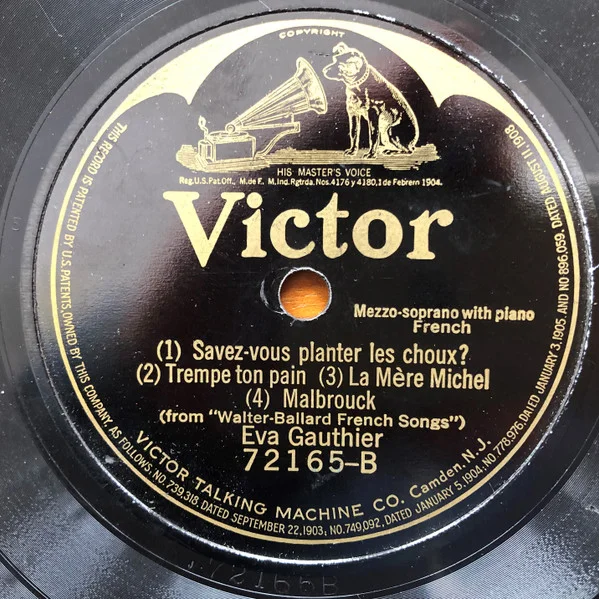
La mère Michel, Éva Gauthier (chant), 1 disque 78 tours, Camden (NJ), Victor’s Talking Machine, Co., 72165-B, 1919.
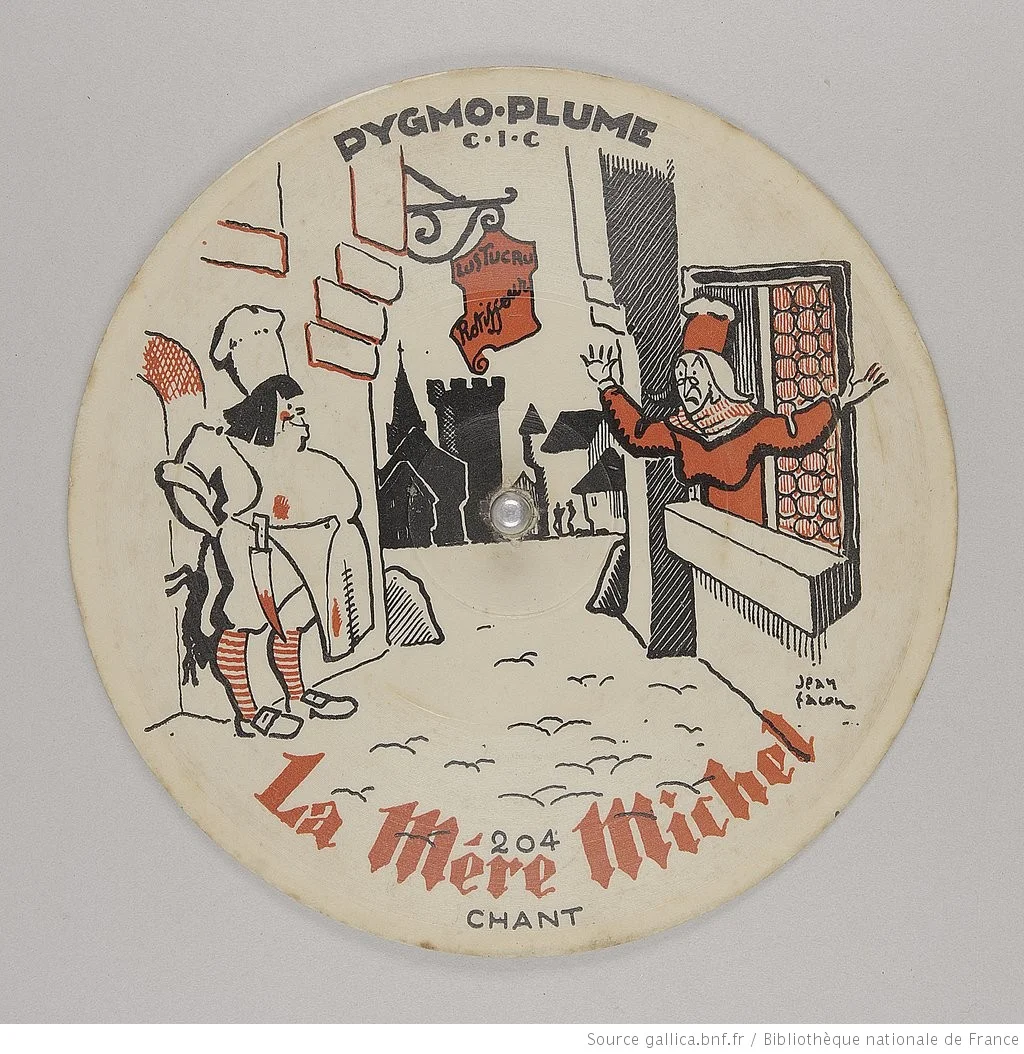
La mère Michel, Mad Rainvyl (chant), 1 disque 78 tours, Pygmo-Plume, n° 204, 1930.
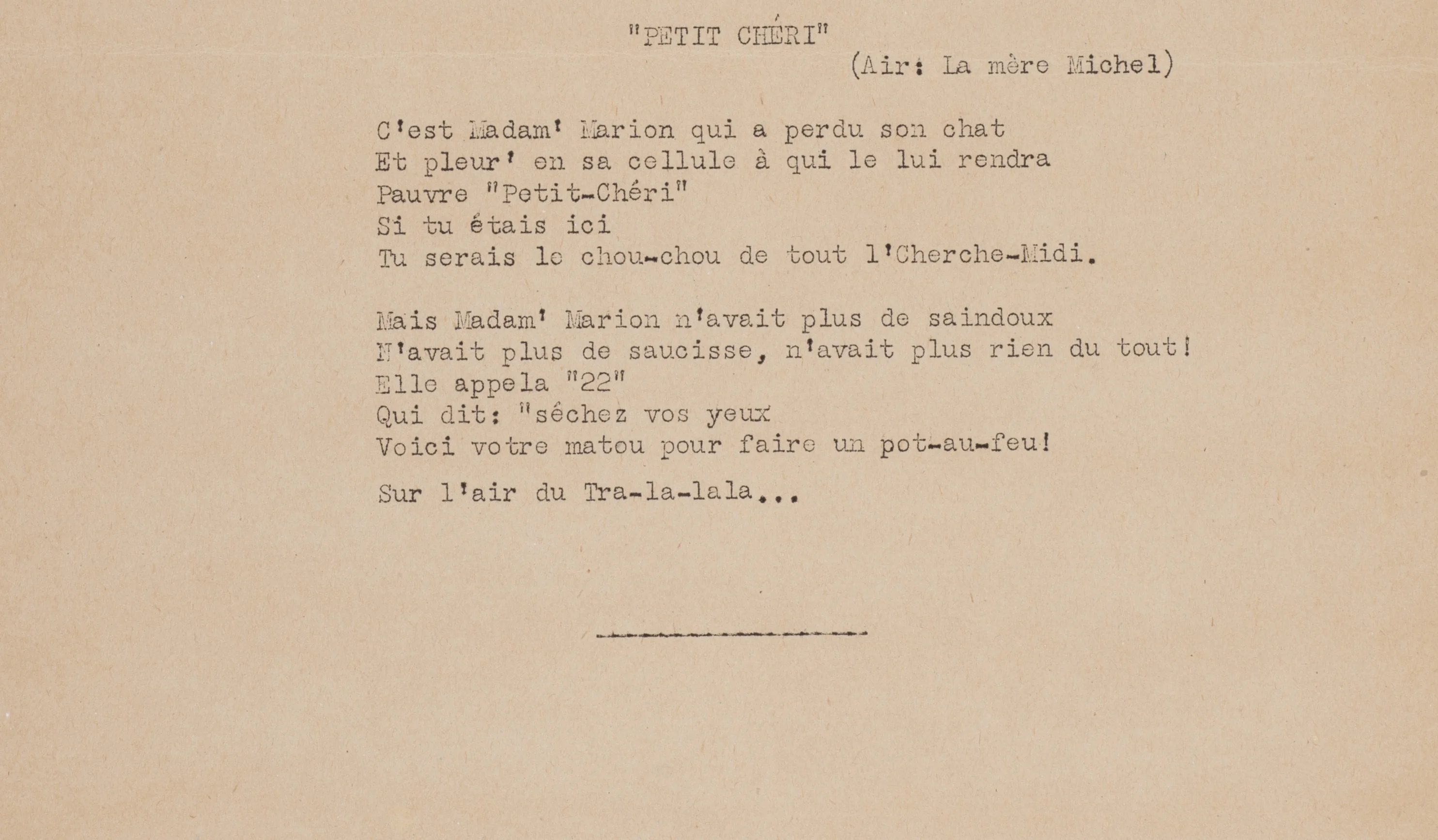
1941, Cherche-Midi prison
Based on the famous folksong La mère Michel, this tune presents a remarkably complex case. There are, in fact, two distinct versions of the source song, which explains the split into multiple tabs (and three columns of side-by-side transcription) on this page of our virtual exhibition.
Initially sung in a minor key with a mostly stepwise melody, La mère Michel is now known as a melody in a major key, characterized by interval leaps of fourths and fifths. The shift between the two versions seems to have happened around the 1920s to 1930s, right at the time Yvonne Oddon and her companions would have learned these songs that they later reworked from memory while imprisoned. It is thus difficult to say with certainty which of the two melodies was the basis for the adaptation documented here.
The older version of La mère Michel, which likely dates back to the eighteenth century, is itself a contrafactum, meaning a pre-existing melody that’s been given new lyrics. Many other songs use this same melody, such as Grand Duc de Savoie, à quoi penses-tu? [Grand Duke of Savoie, What Are You Thinking?] and Malgré la bataille [In Spite of the Battle].
As for the modern version still known today, it was also rewritten with other lyrics, as can be seen in the Canadian version of Claude Augé’s Le livre de musique, where the melody accompanies a text inspired by La Fontaine’s fable The Raven and the Fox (p. 71). It can also be heard in the Belgian song Saint-Nicolas, patron des écoliers. Beyond the changes to the melody, the song known today also differs from its older version by the addition of a refrain “to the tune of the tra la la”, which itself is borrowed, as evidenced by the refrain’s presence on its own in the Anthologie hospitalière et latinesque where the song “Sur l’air du tra la la” appears twice, including once using the title “Tchot Ite”, a Picardian song set to the same melody.
The story of La mère Michel is therefore an interlocking sequence of contrafacta in the manner of nesting dolls, and the song’s adaptation by Yvonne Oddon and her fellow detainees is simply one more chapter.
Apart from the chorus added in the modern version, the lyrics remain largely the same across the different melodies. It tells the story of Mother Michel, who lost her cat, and of her neighbour Compère Lustucru, a meat roaster by trade, who decides to prepare the cat like rabbit – a cruel act frequently depicted in the illustrations accompanying the song. The very dark humour in the adapted version transcribed by Oddon makes perfect sense here; the idea of cooking the cat that a recently arrived prisoner weeps for is directly inspired by the original text. In the rewritten version, the interlocutor is no longer Compère Lustucru, but one of the prison guards (the signal “twenty-two” warned of their arrival in the slang used by French women detainees); the nastiness of the character transfers easily from the original text to its adaptation.
While it remains challenging to establish beyond the shadow of a doubt whether Oddon had the major or minor version in mind when referencing “the tune [of] La mère Michel,” the presence of the refrain “to the tune of the tra la la” in her text points to the modern melody in the major key. What’s more, the song La mère Michel had already been parodied at the start of the Occupation by author and illustrator Maurice Van Moppès, for the show Les Français parlent aux Français [The French Speak to the French] on BBC radio. Broadcast as independent verses in no less than five different programs between November 1940 and April 1941, the various versions by Van Moppès mercilessly mocked the misfortunes of “Père Musso” – that being, of course, Benito Mussolini. The music for the reworked song that parachuted into France with the Royal Air Force around 1943 (before being officially published in 1944) uses the melody in a major key, showing that the modern version of La mère Michel was already in circulation at that time. Given the overlap between the musical sources of the songs adapted by the detainees and those broadcast on Radio Londres (see also Moi j’en ai marre and Hitler), we can safely assume that the detainees were singing the modern version of La mère Michel, as repeatedly heard in the program Les Français parlent aux Français.
Being unable to completely discard the possibility that Oddon and her fellow prisoners were singing the older version of La mère Michel, we offer two potential musical reconstructions here, which both remain as close as possible to the text transcribed by Oddon. In addition to the version of the melody still known today (and whose use with the transformed text by Oddon and her fellow detainees poses no problem), we present a hybrid version that combines the older melody in a minor key with the refrain “to the tune of the tra la la” in major. Although this interpretation matches none of the versions of La mère Michel that have survived to the present day, it does allow us to incorporate the entirety of Oddon’s text while exploring the possibility of a hybrid recollection of the song.
Despite La mère Michel having been passed down mainly through oral tradition, many scores have been published, especially of the minor-key version. The modern version has been recorded much more often than the older one, which mostly circulated before the widespread adoption of sound recording technology. The recording of the older version included here was released in 1919 by Canadian songstress Éva Gauthier (1885-1958), based on a collection of traditional French songs published in the United States in 1916 – evidence of the song’s widespread geographical circulation. It is worth noting that Yvonne Oddon received part of her training in the United States in the 1920s, and that Éva Gauthier went to Paris early in her career (1902–1905), while her sister, ethnomusicologist Juliette Gaultier de la Vérendrye, gave a talk on Canadian folk music at the Musée de l’Homme in July 1938, by which time Oddon was already working there. Although indirect, there are many points of contact, and they seem to converge in this manifestation of the early interest in music shown by members of the Musée de l’Homme.
[Sources: references 8, 23, 27, 36, 74, 97, 122, 123, 124, 126 in the bibliography]
La mère Michel
Mother Michel
Older version
(oral tradition)
C’est la mèr’ Michel qui a perdu son chat,
It’s Mother Michel who lost her cat,
Qui cri’ par la f’nêtre à qui le lui rendra.
Who called out the window to whoever would bring him back to her.
Et l’compèr’ Lustucru
And Compère Lustucru
Qui lui a répondu :
Who replied to her:
Allez, la mèr’ Michel, vot’ chat n’est pas perdu.
Come now, Mother Michel, your cat isn’t lost.
C’est la mèr’ Michel qui lui a demandé :
It’s Mother Michel who asked him:
Mon chat n’est pas perdu! vous l’avez donc trouvé?
My cat’s not lost! So you found him?
Et l’compèr’ Lustucru qui lui a répondu :
And Compère Lustucru who answered:
Donnez un’ récompense, il vous sera rendu.
Offer a reward, he’ll be given back to you.
Et la mèr’ Michel lui dit : C’est décidé,
And Mother Michel said to him: It’s settled,
Si vous rendez mon chat, vous aurez un baiser.
If you return my cat, you’ll get a kiss.
Le compèr’ Lustucru,
Compère Lustucru,
Qui n’en a pas voulu,
Who didn’t want one,
Lui dit : Pour un lapin votre chat est vendu.
Said to her: Your cat’s been sold as a rabbit.
La mère Michel
Mother Michel
Modern version
(oral tradition)
FIRST VERSE
C’est la mèr’ Michel qui a perdu son chat,
It’s Mother Michel who lost her cat,
Qui d’mand’ par la fenêtre qui le lui rendra,
Who asked out the window who would bring him back to her.
Le compèr’ Lustucru
And Compère Lustucru
Lui a répondu :
Replied to her:
« Allez, la mèr’ Michel, vot’ chat n’est pas perdu! »
“Come now, Mother Michel, your cat isn’t lost.”
Sur l’air du tra la, la la,
To the tune of the tra la, la la,
Sur l’air du tra la la la,
To the tune of the tra la la la,
Sur l’air du tra de ri de ra,
To the tune of the tra de ri de ra,
Et tra la la !
And tra la la !
SECOND VERSE
C’est la Mèr’ Michel qui lui a demandé :
It’s Mother Michel who asked him:
Mon chat n’est pas perdu, vous l’avez donc trouvé?
My cat’s not lost! So you found him?
Le Compèr’ Lustucru
Compère Lustucru
Lui a répondu :
Replied to her:
Donnez un’ récompense, il vous sera rendu!
Offer a reward, he’ll be given back to you!
Sur l’air du tra la, la la,
To the tune of the tra la, la la,
Sur l’air du tra la la la,
To the tune of the tra la la la,
Sur l’air du tra de ri de ra,
To the tune of the tra de ri de ra,
Et tra la la!
And tra la la !
THIRD VERSE
Et la Mèr’ Michel a dit : « c’est décidé!
And Mother Michel said to him: “It’s settled!
Rapportez-moi mon chat, vous aurez un baiser. »
Bring back my cat, you’ll get a kiss.”
Le Compèr’ Lustucru,
Compère Lustucru,
Qui n’a pas voulu,
Who didn’t want one,
Lui dit : « Pour un lapin votre chat est vendu! »
Said to her: Your cat’s been sold as a rabbit.
Sur l’air du tra la, la la,
To the tune of the tra la, la la,
Sur l’air du tra la la la,
To the tune of the tra la la la,
Sur l’air du tra de ri de ra,
To the tune of the tra de ri de ra,
Et tra la la!
And tra la la !
Petit chéri
Little Darling
(ms p. 2)
C’est Madam’ Marion qui a perdu son chat
It’s Madam Marion who lost her cat
Et pleur’ en sa cellule à qui le lui rendra
Who cried in her cell to whoever would bring him back to her.
Pauvre « Petit-Chéri »
Poor “Little Darling”
Si tu étais ici
If you were here
Tu serais le chou-chou de tout l’Cherche-Midi.
You’d be the sweetie of the whole Cherche-Midi.
Mais Madam’ Marion n’avait plus de saindoux
But Madam Marion had run out of lard
N’avait plus de saucisse, n’avait plus rien du tout!
Had no more sausages, had nothing at all!
Elle appela « 22 »
She called out to a “22”
Qui dit : « séchez vos yeux
Who said: “Dry your eyes
Voici votre matou pour faire un pot-au-feu! [»]
Here’s your kitty to make a stew! [”]
Sur l’air du Tra-la-lala…
To the tune of the Tra-la-la…