
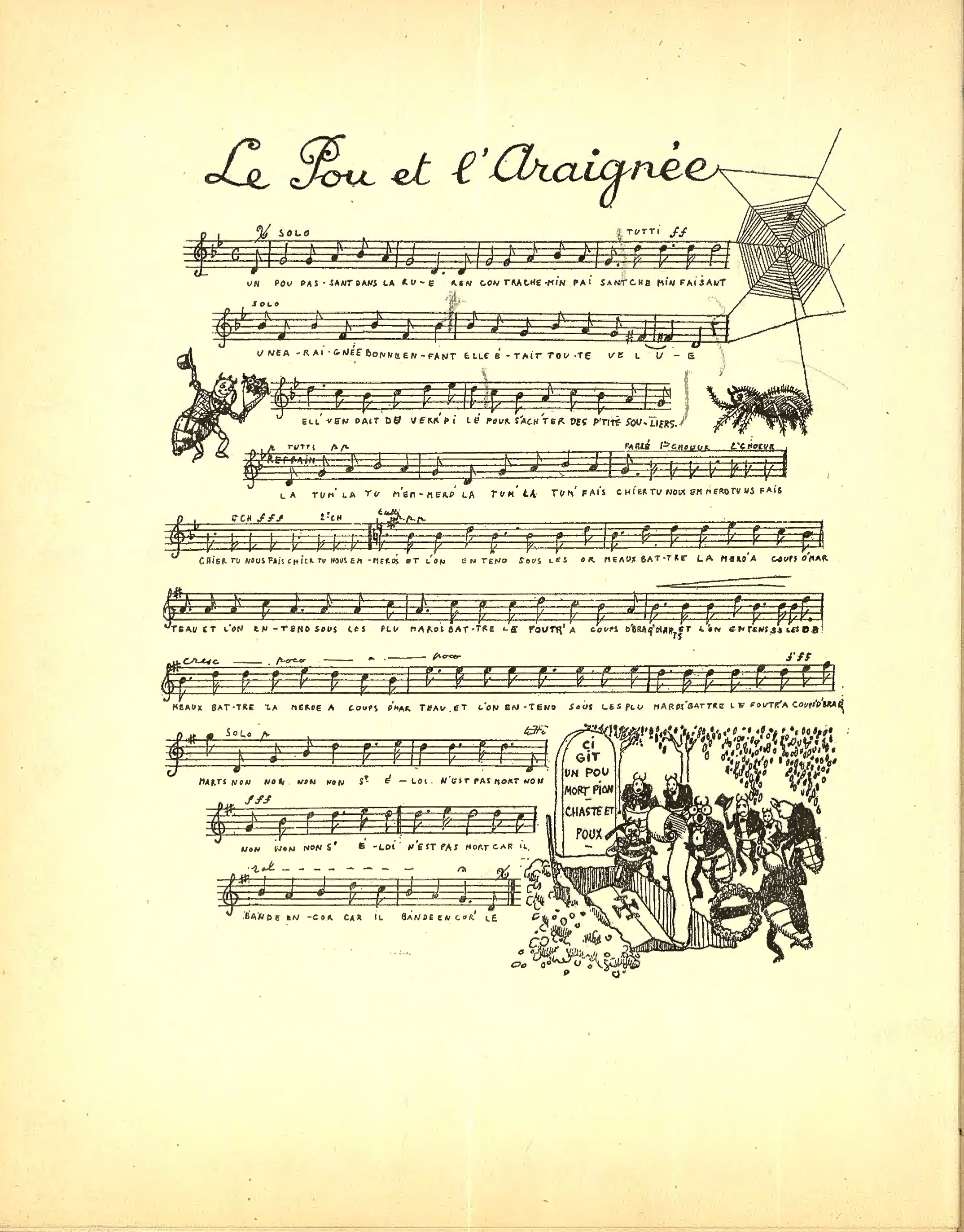
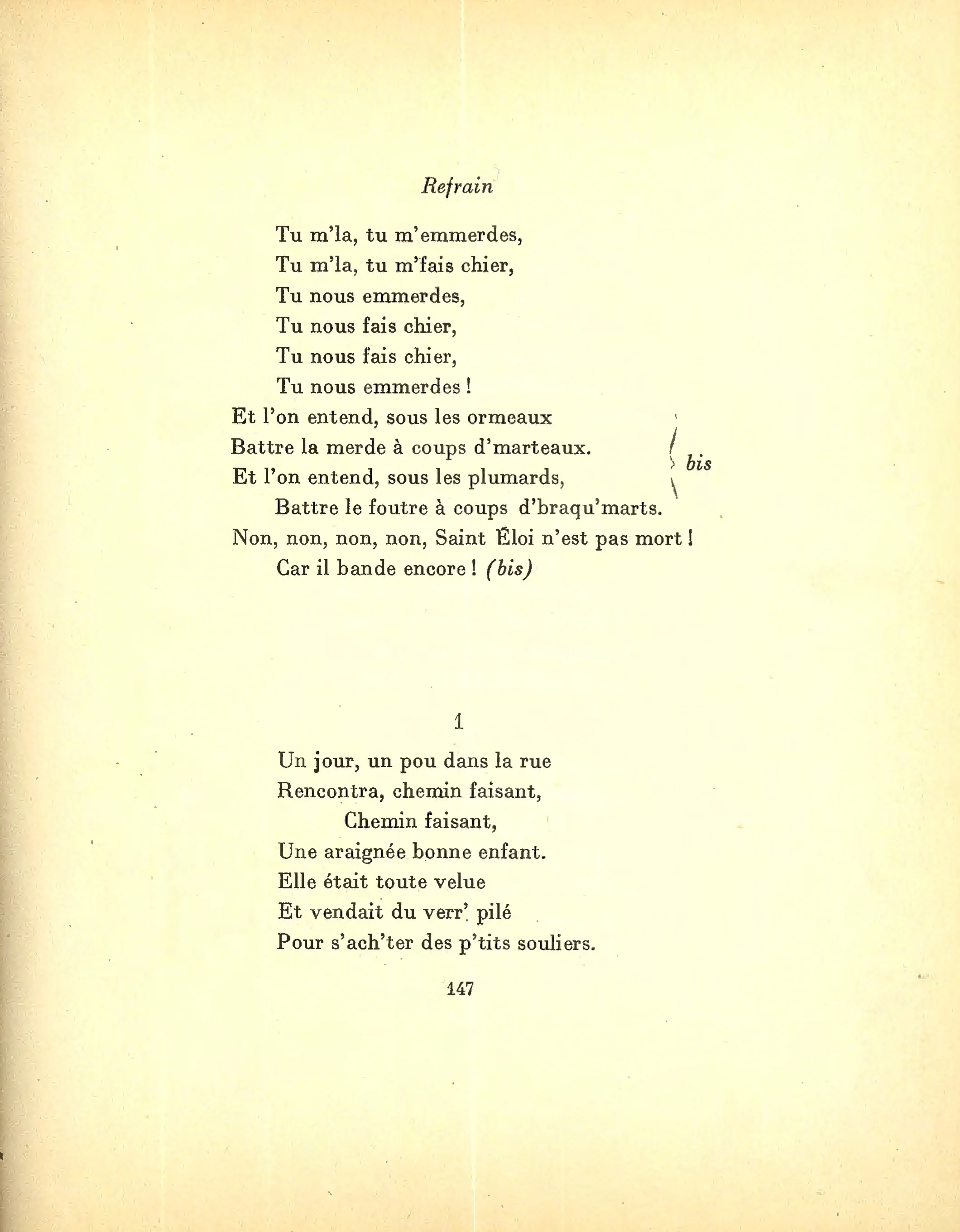
« Le pou et l’araignée », partition pour chant seul, dans Marcel Prangey, Chansons de salles de garde, Amsterdam, Éditions du Scorpion, 1931, p. 145-150.


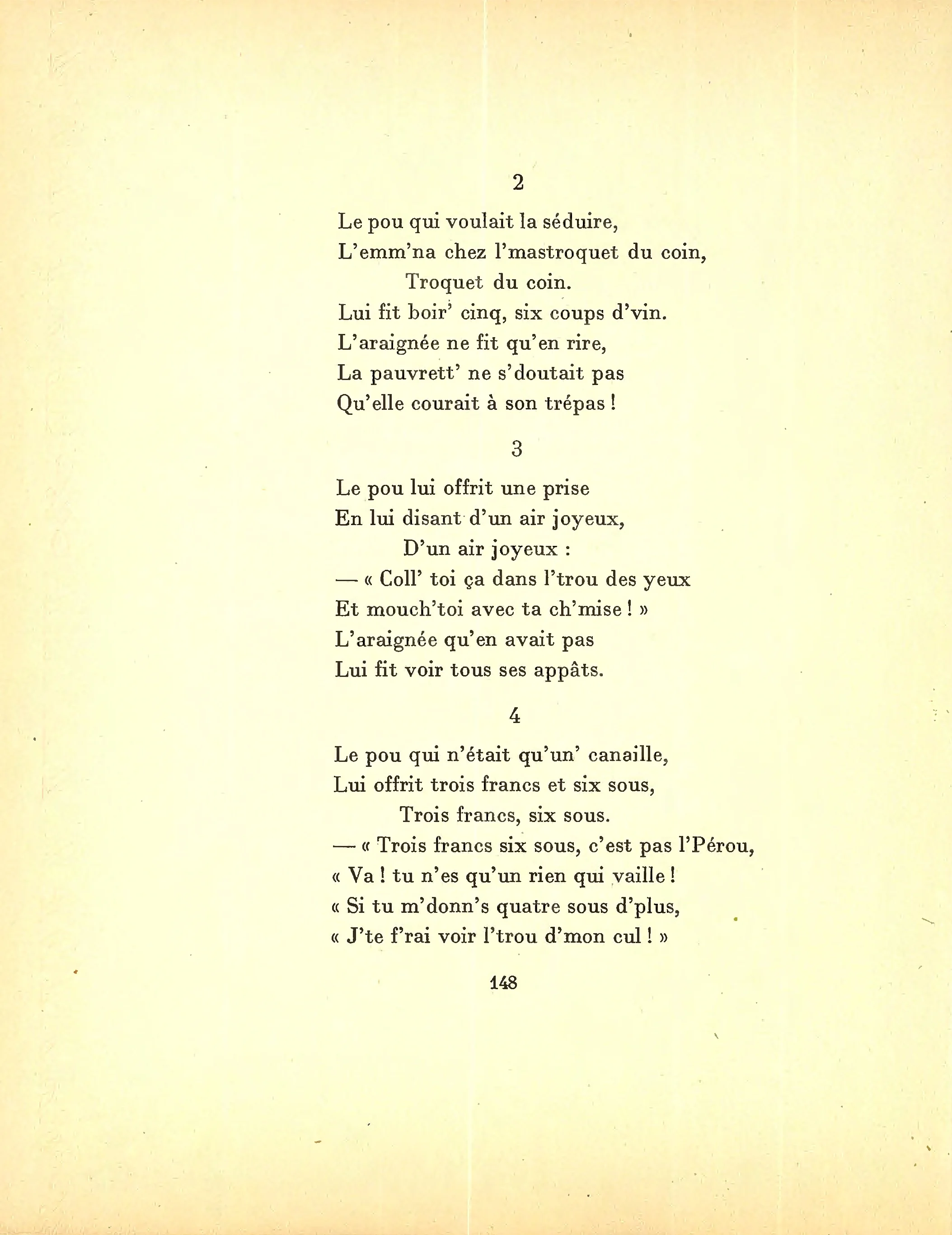
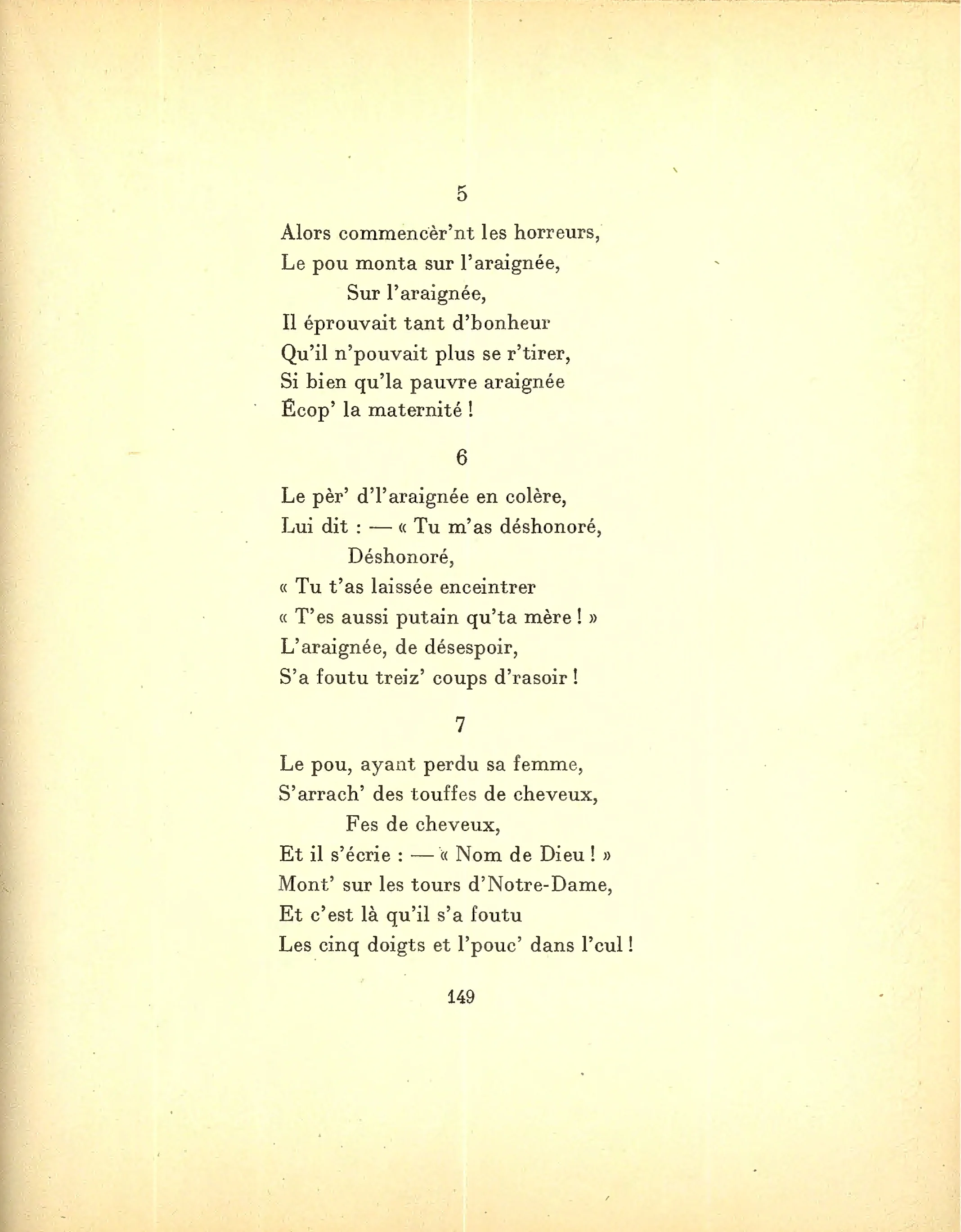
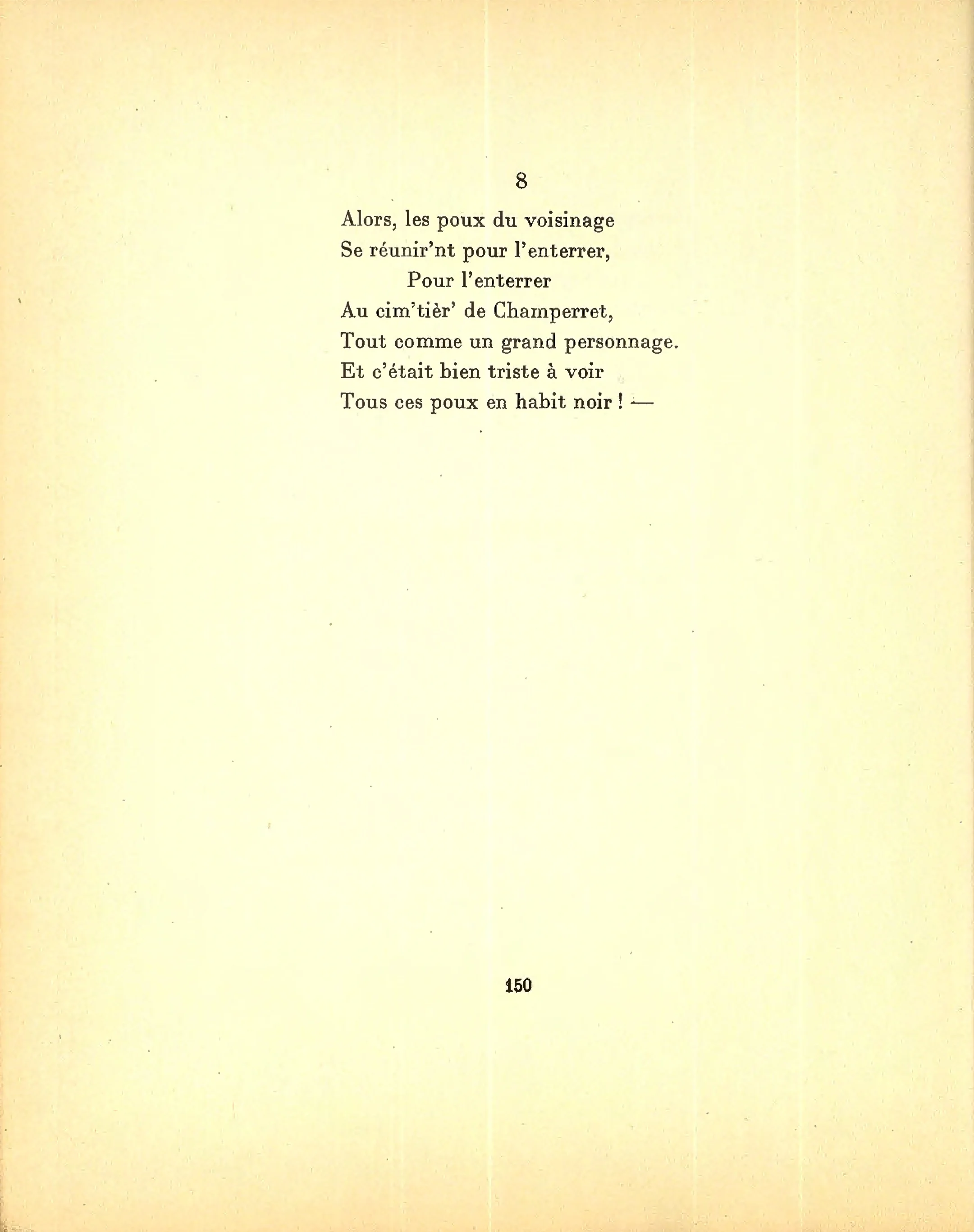
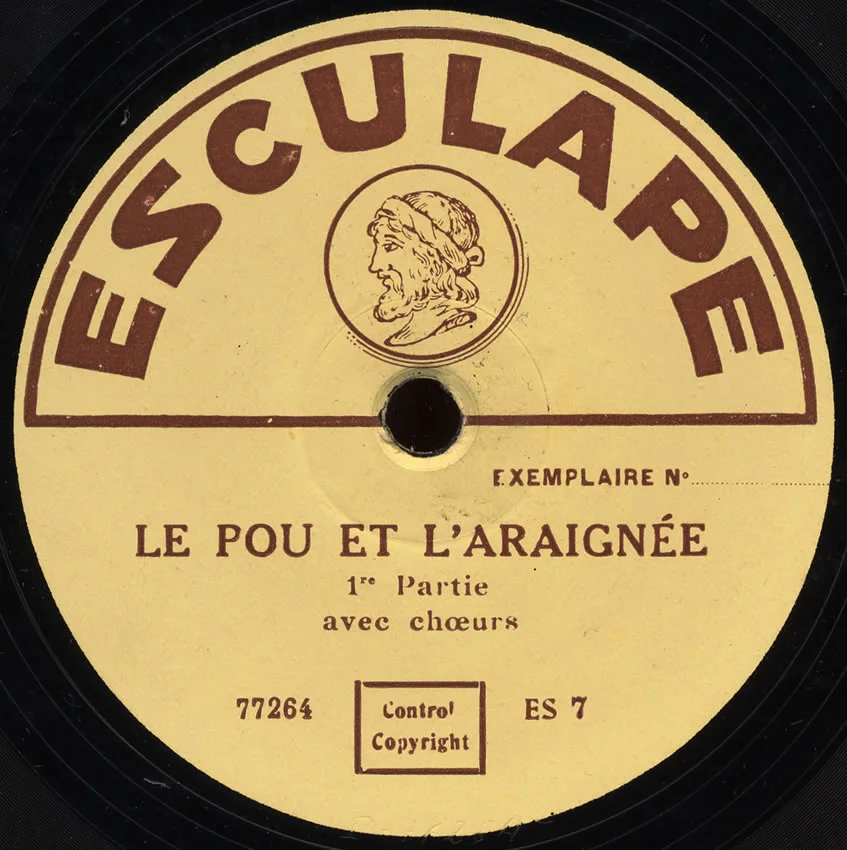
Le pou et l’araignée, chanson de salle de garde, chant et chœurs, 1 disque 78 tours, Esculape, ES 7, v. 1935.
1941, Cherche-Midi prison
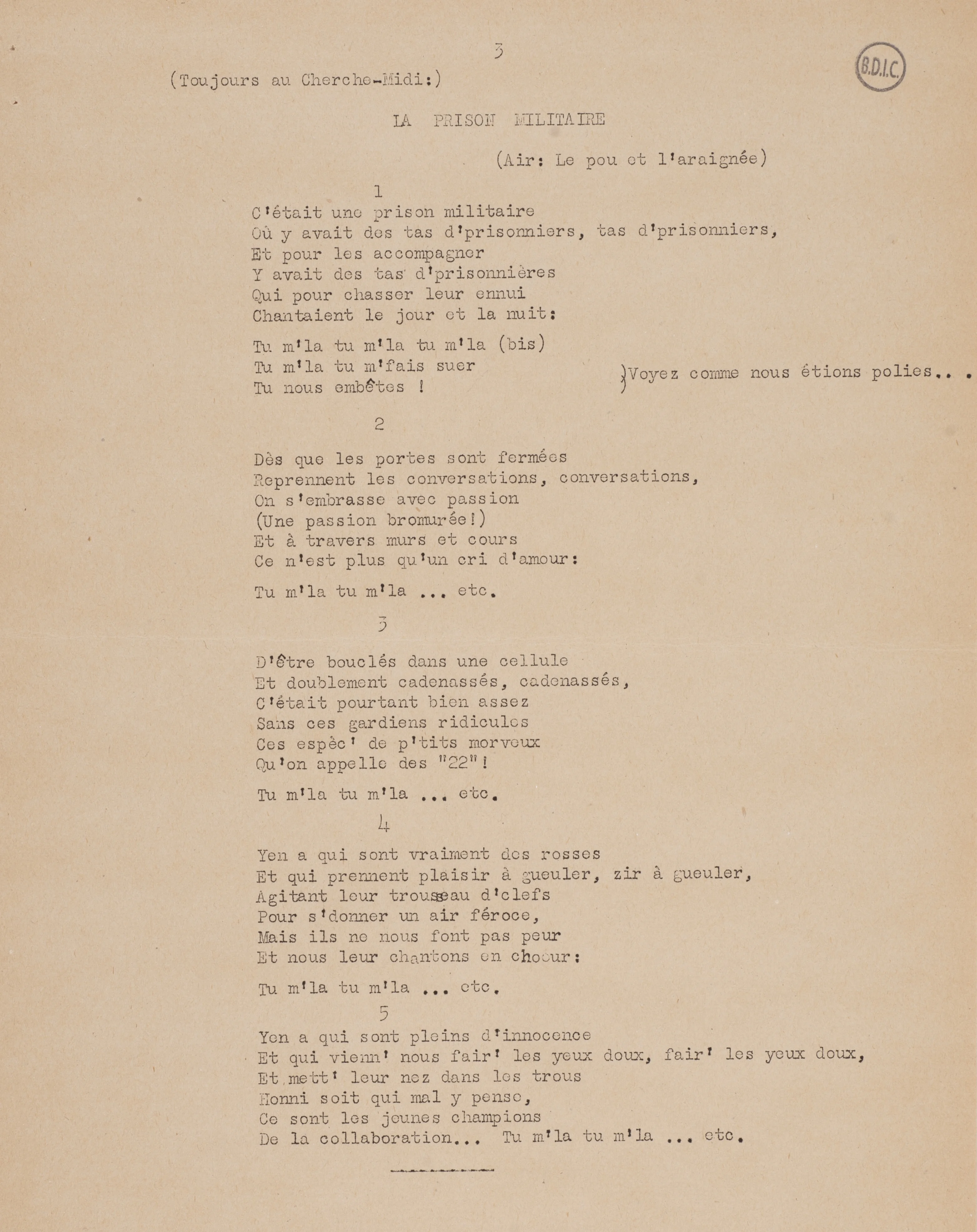
La prison militaire was written to the tune of an on-call room song called Le pou et l’araignée. Also known as a “chanson de carabins”, this oral-tradition musical genre of off-colour songs was created and sung by medical students and characterized by the (often very explicit) lewdness of its subject matter. Two authors are often credited with this unattributed song: Hector Berlioz for the music and Alfred de Musset for the text. While these unverifiable claims may raise eyebrows, they are based on solid facts: Berlioz, who studied medicine, was no stranger to musical jokes; and Musset, a notorious alcoholic, was a fan of well-lubricated events where it was not uncommon to break into songs from the on-call room. In the absence of concrete evidence, it is fair to assume that the students who helped to disseminate this song chose to credit these leading figures with its authorship to ironically reinforce its irreverence. The recording presented here, which likely dates from 1935, comes from an album on the Esculape label (named after Aesculapius, the Greco-Roman god of medicine), a trademark registered in November 1934. Since the album does not mention the names of the performers, it is very likely they were in fact amateurs – probably medical students, interns, or doctors, as tradition would have it.
The verses of Le pou et l’araignée tell the tale, in rather risqué terms, of a young spider who takes her own life after being seduced and impregnated by a flea, then disowned by her father. The song goes on to describe the heartbreak her death causes the flea, who kills himself in quite an unusual way, and concludes with the flea’s solemn burial. The three-part refrain serves to interrupt the narrative with a long string of expressions blending religious, sexual, and scatological themes.
In its transformed version, La prison militaire, the song openly mocks the guards (“Those pesky little brats / We call ’22s’”), and, in a pseudo-salacious tone, describes the passion at the heart of the relationships between the women prisoners – which they call a “bromide-ified” passion, in reference to the rumour that the authorities were adding a chemical (often called bromide) to prisoners’ food to keep them calm. Oddon and her companions’ version uses the complete melody of the original verses (five times instead of eight), and only the first part of the refrain (with “You bug me you make me sweat / You pester us” replacing “You bug me, you piss me off / You’re annoying as shit”). In the margin beside these few lines of the refrain in the song transcribed by Oddon, she wrote “See how polite we were…” – a paratextual comment hinting that the members of the Resistance, even while imprisoned, preferred a sanitized version to the racier original. To avoid any confusion in our side-by-side transcription, we have chosen not to include this note, which is not part of the lyrics.
[Sources: references 23, 55, 59, 109, 113 in the bibliography]
Le pou et l’araignée
The Louse and the Spider
(oral tradition)
1
Un jour, un pou dans la rue
One day, a louse in the street
Rencontra, chemin faisant, chemin faisant,
Met, along the way, along the way,
Une araignée bonne enfant.
A friendly spider.
Elle était toute velue
She was covered in hair
Et vendait du verr’ pilé
And selling crushed glass
Pour s’ach’ter des p’tits souliers.
To buy herself some little shoes.
Refrain
Tu m’la, tu m’emmerdes,
You bug me, you annoy me,
Tu m’la, tu m’fais chier,
You bug me, you piss me off,
Tu nous emmerdes,
You’re annoying as shit,
Tu nous fais chier,
You piss us off,
Tu nous fais chier,
You piss us off,
Tu nous emmerdes!
You’re annoying as shit!
Et l’on entend, sous les ormeaux
And we can hear, under the elm trees
Battre la merde à coups d’marteaux.
Crap being pounded by hammers.
Et l’on entend, sous les plumards,
And we can hear, under the beds,
Battre le foutre à coups d’braqu’marts.
Cum being pounded by dicks.
Non, non, non, non, Saint Éloi n’est pas mort!
No, no, no, no, Saint Eligius isn’t dead!
Car il bande encore! (bis)
’Cause he’s still hard! (bis)
2
Le pou qui voulait la séduire,
The louse who wanted to seduce her,
L’emm’na chez l’matroquet du coin, troquet du coin.
Took her to the corner pub, the local joint.
Lui fit boir’ cinq, six coups d’vin.
Had her drink five, six glasses of wine.
L’araignée ne fit qu’en rire,
The spider just laughed,
La pauvrett’ ne s’doutait pas
The poor thing had no idea
Qu’elle courait à son trépas!
She was courting her own demise!
Refrain
3
Le pou lui offrit une prise
The louse offered her a pinch of snuff
En lui disant d’un air joyeux, d’un air joyeux :
Telling her cheerfully, cheerfully:
– « Coll’ toi ça dans l’trou des yeux
– “Stick this in your peepers
Et mouch’toi avec ta ch’mise! »
And wipe your schnoz on your shirt!”
L’araignée qu’en avait pas
The spider, who didn’t have one
Lui fit voir tous ses appâts.
Showed him all her allure.
Refrain
4
Le pou qui n’était qu’un’ canaille,
The louse, who was a scoundrel,
Lui offrit trois francs et six sous, trois francs, six sous.
Offered her three francs and six cents, three francs, six cents.
– « Trois francs six sous, c’est pas l’Pérou,
– “Three francs six cents, is no Eldorado,
« Va! tu n’es qu’un rien qui vaille!
“Go on! You’re not worth a damn!
« Si tu m’donn’s quatre sous d’plus,
“If you give me four cents more,
« J’te f’rai voir l’trou d’mon cul! »
“I’ll show you my arsehole!”
Refrain
5
Alors commencèr’nt les horreurs,
And so began the horrors,
Le pou monta sur l’araignée, sur l’araignée,
The louse mounted the spider, mounted the spider,
Il éprouvait tant d’bonheur
He was feeling so much bliss
Qu’il n’pouvait plus se r’tirer,
He couldn’t pull himself away,
Si bien qu’la pauvre araignée
So the poor spider
Écop’ la maternité!
Found herself knocked up!
Refrain
6
Le pèr’ d’l’araignée en colère,
The spider’s angry father
Lui dit : – « Tu m’as déshonoré,
Said to her: – “You’ve disgraced me,
Déshonoré,
Disgraced,
« Tu t’as laissée enceintrer
“You let yourself get with child
« T’es aussi putain qu’ta mèr! »
“You’re as much a tart as your mother!”
L’araignée, de désespoir,
The spider, in despair,
S’a foutu treiz’ coups d’rasoir!
Slashed herself thirteen times with a razor!
Refrain
7
Le pou, ayant perdu sa femme,
The louse, having lost his wife,
S’arrach’ des touffes de cheveux,
Tore out tufts of his hair
Fes de cheveux,
Tufts of his hair,
Et il s’écrie : – « Nom de Dieux! »
And he cried out: – “God be damned!”
Mont’ sur les tours d’Notre-Dame,
Climbed the towers of Notre-Dame,
Et c’est là qu’il s’a foutu
And it’s there that he shoved
Les cinq doigts et l’pouc’ dans l’cul!
All five fingers and his thumb up his arse!
Refrain
8
Alors, les poux du voisinage
So the neighbourhood lice
Se réunir’nt pour l’enterrer,
Gathered to bury him,
Pour l’enterrer
To bury him
Au cim’tièr’ de Champerret,
In the Champerret cemetery,
Tout comme un grand personnage.
Like a distinguished figure.
Et c’était bien triste à voir
And it was a sorry sight to see
Tous ces poux en habit noir! –
All those lice in black suits! –
La prison militaire
The Military Prison
(ms p. 3)
1
C’était une prison militaire
It was a military prison
Où y avait des tas d’prisonniers, tas d’prisonniers,
Where there were tons of men detained, tons of men detained
Et pour les accompagner
And along with them
Y avait des tas d’prisonnières
Tons of women detained too
Qui pour chasser leur ennui
Who to stave off their boredom
Chantaient le jour et la nuit :
Sang day and night:
[Refrain]
Tu m’la tu m’la tu m’la (bis)
You bug you bug you bug me (bis)
Tu m’la tu m’fais suer
You bug me you make me sweat
Tu nous embêtes!
You pester us!
2
Dès que les portes sont fermées
As soon as the doors are closed
Reprennent les conversations, conversations,
Start up the conversations, conversations,
On s’embrasse avec passion
Passionate embraces
(Une passion bromurée!)
(Bromide-ified passion!)
Et à travers murs et cours
And through the walls and yards
Ce n’est plus qu’un cri d’amour :
It’s simply a cry of love:
[Refrain]
Tu m’la tu m’la… etc.
You bug you bug… etc.
3
D’être bouclés dans une cellule
Being locked in a cell
Et doublement cadenassés, cadenassés,
And double chained, chained,
C’était pourtant bien assez
It’s well enough
Sans ces gardiens ridicules
Without these ridiculous guards
Ces espèc’ de p’tits morveux
Those pesky little brats
Qu’on appelle des « 22 »!
We call “22s”!
[Refrain]
Tu m’la tu m’la… etc.
You bug you bug… etc.
4
Yen a qui sont vraiment des rosses
Some are a real pain
Et qui prennent plaisir à gueuler, zir à gueuler,
And enjoy hollering, ’njoy hollering
Agitant leur trousseau d’clefs
Rattling their keychains
Pour s’donner un air féroce,
To make themselves look fierce,
Mais ils ne nous font pas peur
But they don’t scare us
Et nous leur chantons en chœur :
And we sing them a chorus of:
[Refrain]
Tu m’la tu m’la… etc.
You bug you bug… etc.
5
Yen a qui sont pleins d’innocence
Some are quite innocent
Et qui vienn’ nous fair’ les yeux doux, fair’ les yeux doux,
And come make eyes at us,
Et mett’ leur nez dans les trous
And poke their noses in the holes
Honni soit qui mal y pense,
Shame on anyone who thinks ill,
Ce sont les jeunes champions
They are the young champions
De la collaboration…
Of collaboration…
[Refrain]
Tu m’la tu m’la… etc.
You bug you bug… etc.