
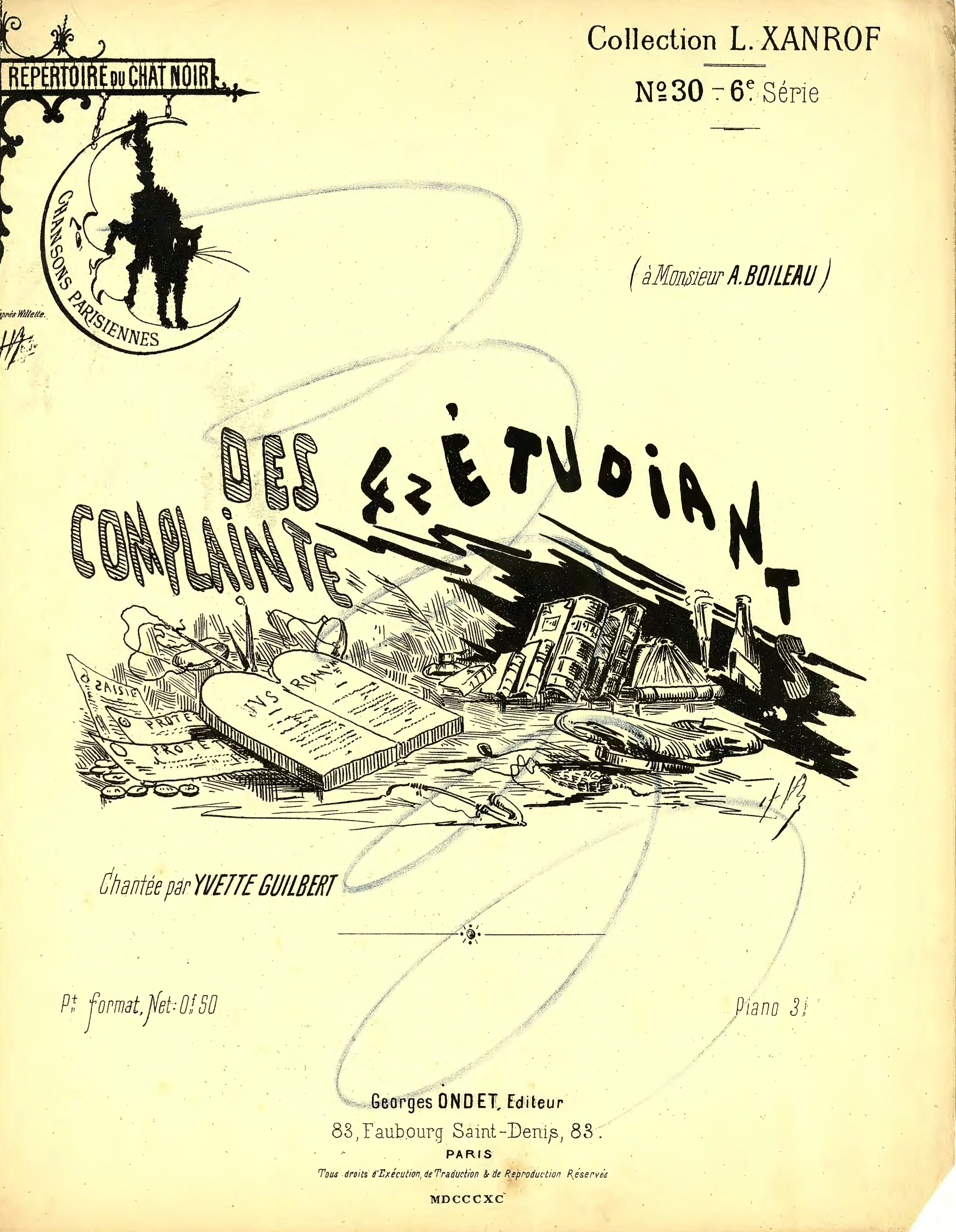
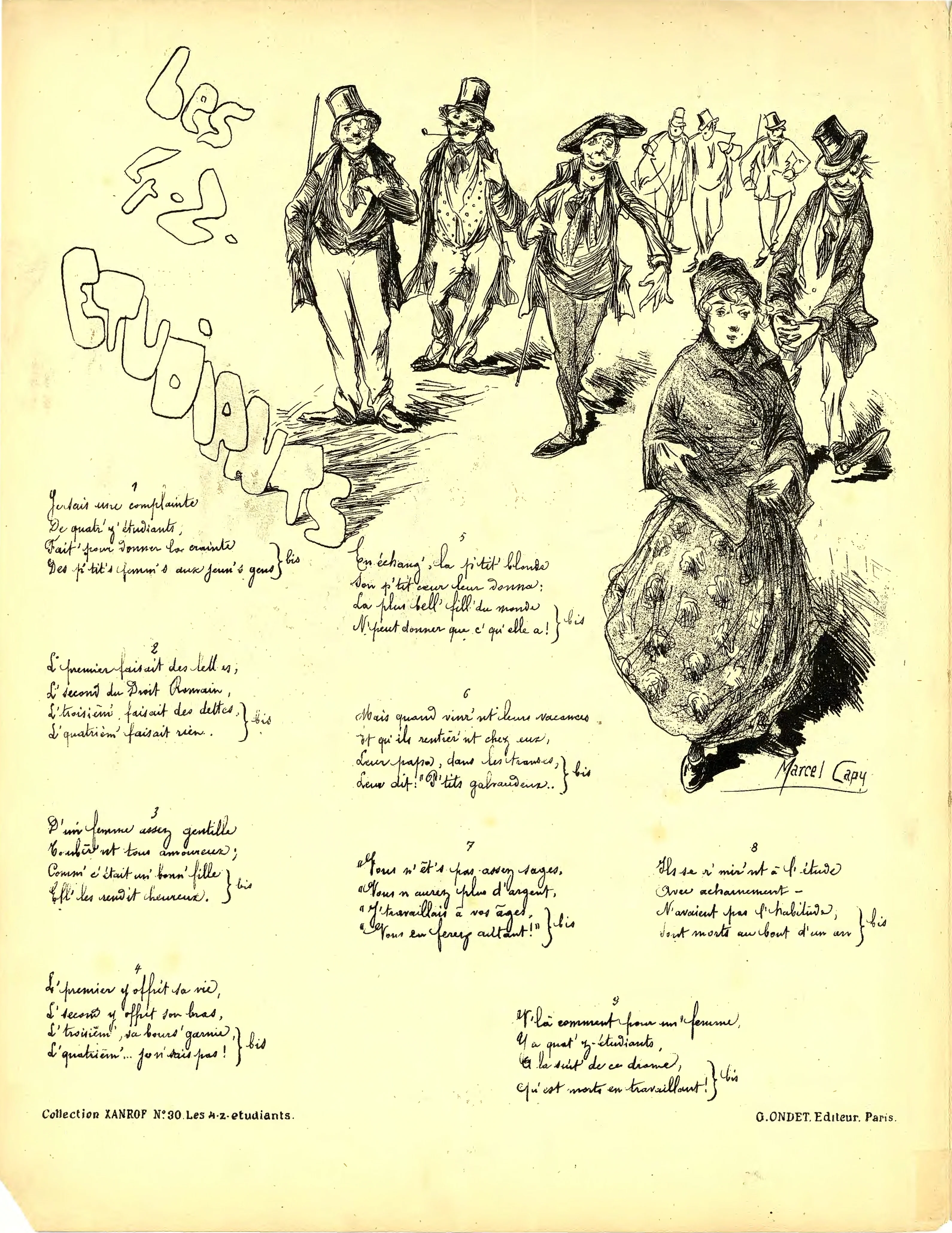
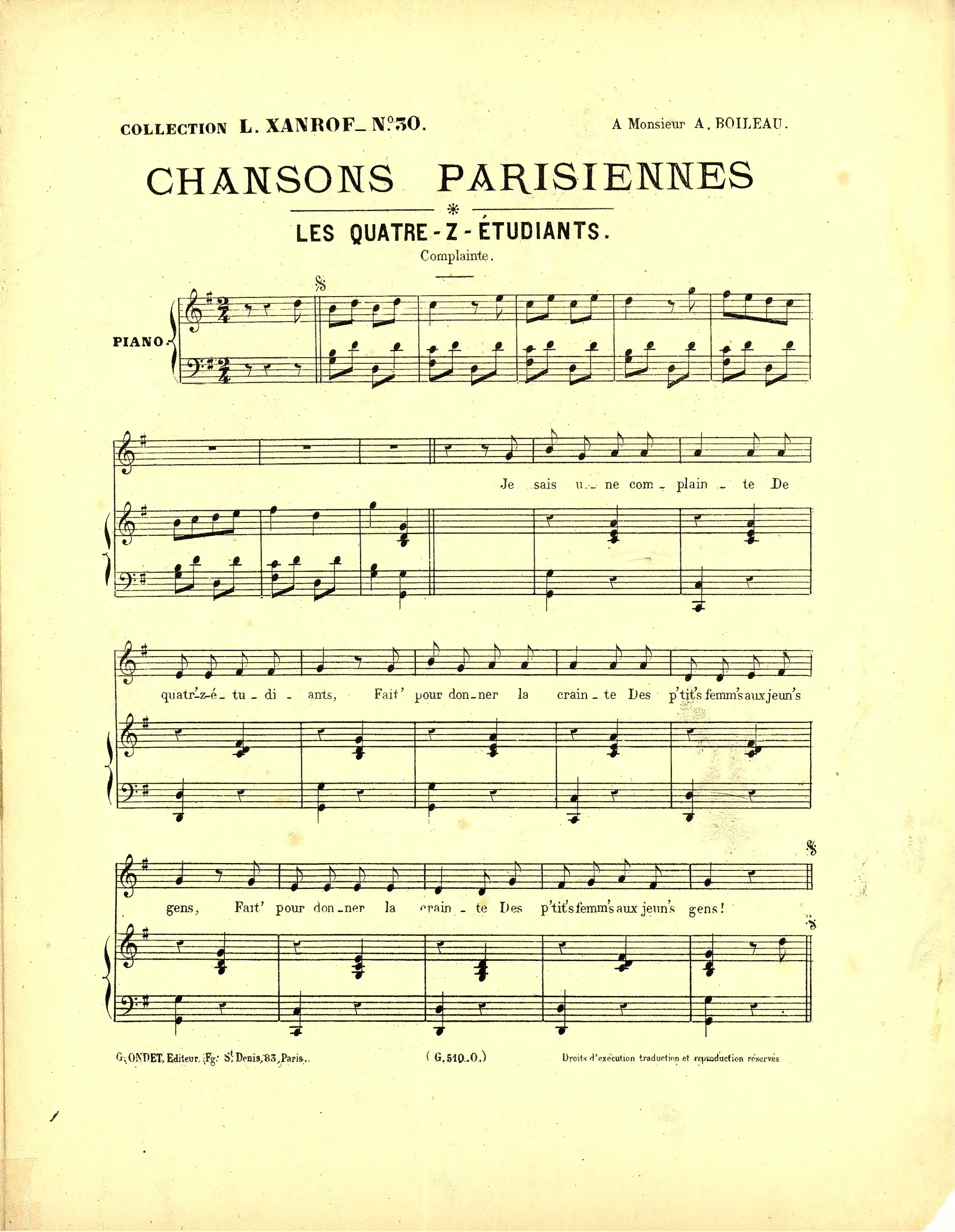
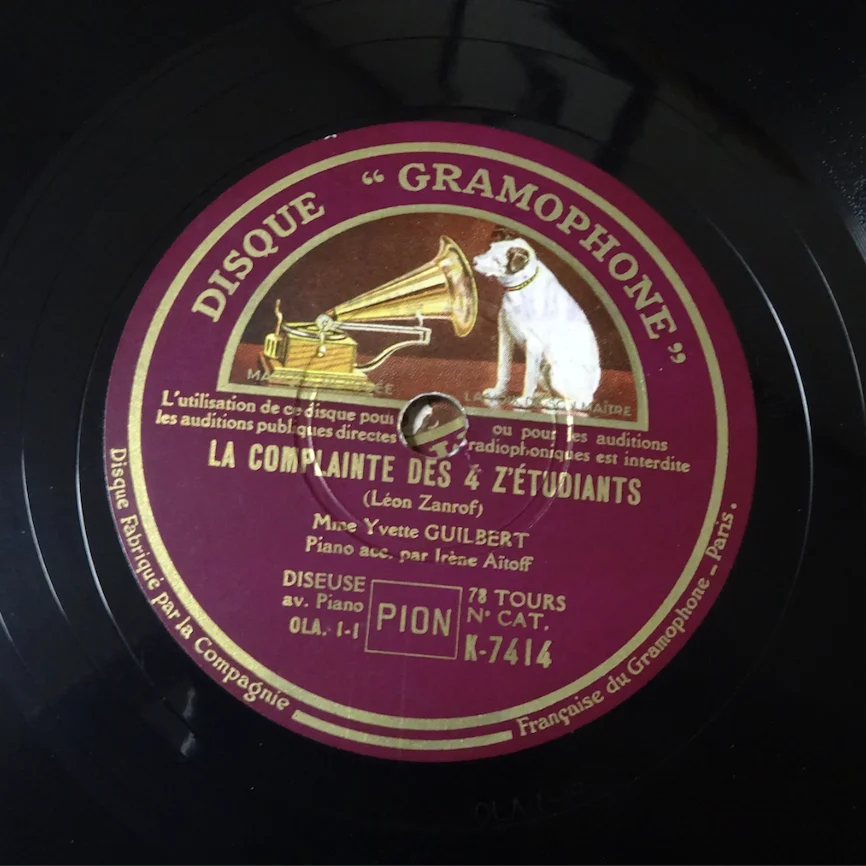
Léon Xanrof (paroles et musique), Complainte des 4 z’étudiants, partition pour chant et piano, Paris, Georges Ondet, 1890.


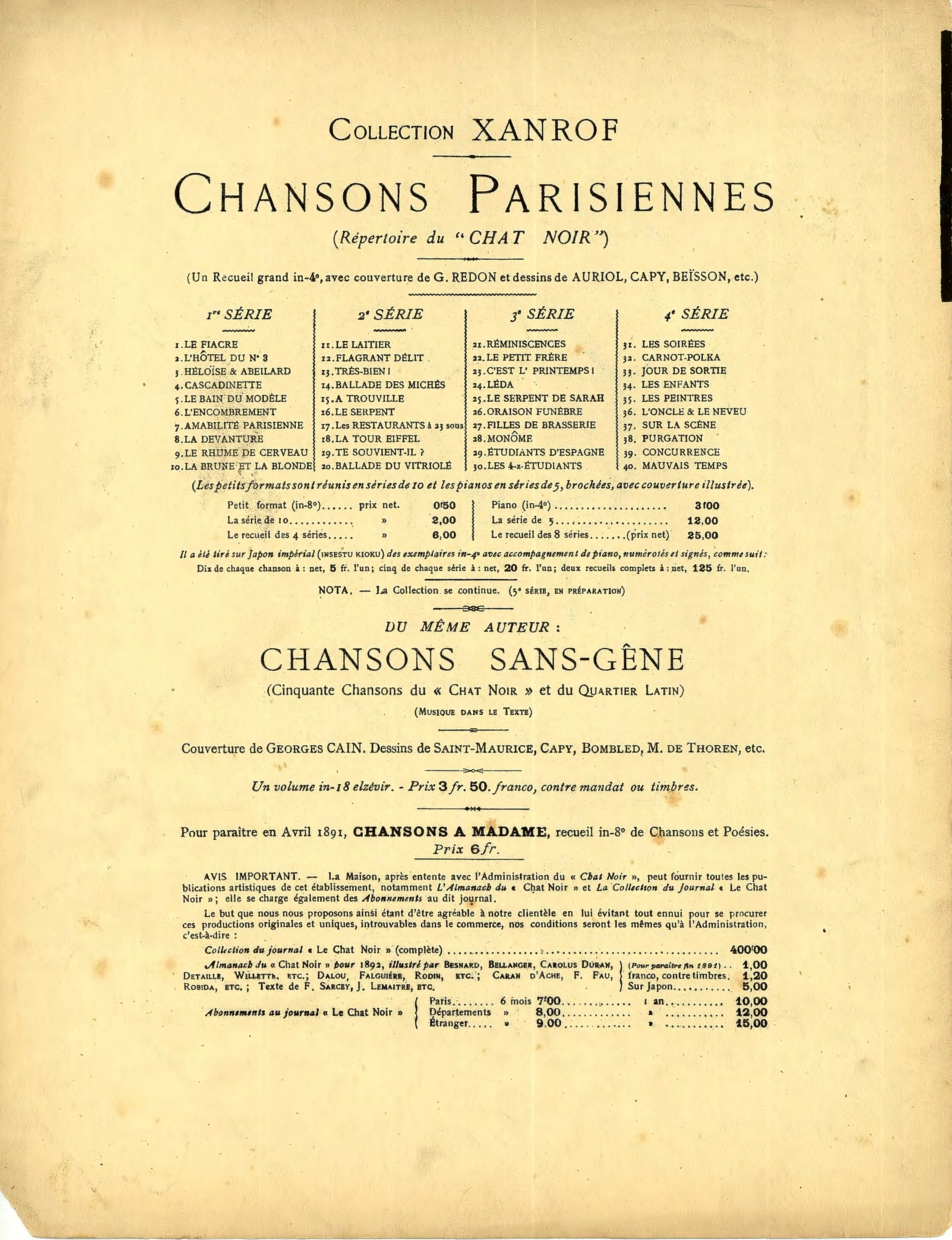
Léon Xanrof (paroles et musique), La complainte des 4 z’étudiants, Yvette Guilbert (chant), Irène Aïtoff (piano), 1 disque 78 tours, Gramophone, K-7414, 1934.
1941, Cherche-Midi prison
This song is a transformed version of La complainte des quatre z’étudiants written by Monmartre singer-songwriter Léon Xanrof (the stage name of Léon Alfred Fourneau, 1867-1953), whose career was closely linked to that of cabaret singer Yvette Guilbert (1865-1944). The recording presented here is, in fact, one of hers, made in 1934 for the Gramophone label. Known for her half-recited half-sung style that closely followed the text and – at that point in her career – for her explicit stage act (hip swaying, winking, expressive gesturing, and exaggerated miming), Guilbert also made quite a few recordings. Her discography spans several decades – from the late nineteenth century to just years before her death – and provides valuable insight into the evolution both of her voice and of recording techniques.
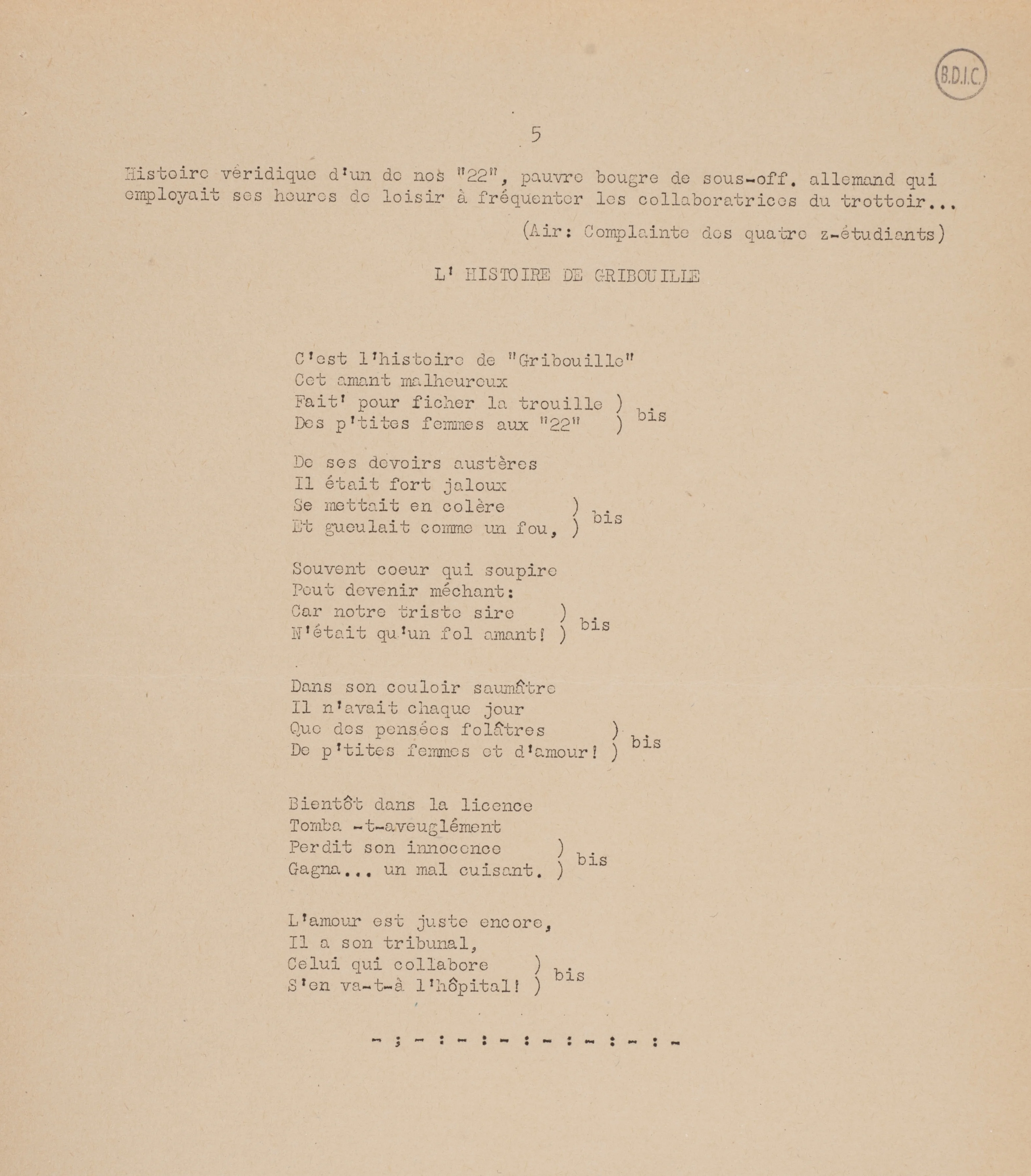
The original text tells the story of four students and is “meant to scare young men away from painted ladies.” The version by Oddon skillfully parodies the original lyrics to reference the guards of the Cherche-Midi prison who consorted with French prostitutes and contracted venereal diseases. In her commentary that accompanies the typewritten transcription of this song, the Resistance fighter makes clear that it is a “true story of one of our ‘22s’ [term used by women detainees to refer to the guards], a poor old German non-com who spent his free time visiting streetwalkers…”. Like its source, Oddon’s song concludes with a “moral” adapted to the context of the Occupation: “The collaborator ends up in the hospital.”
[Sources: references 9, 43, 83, 125 in the bibliography]
La complainte des quatre z’étudiants
The Lament of the Four Students
(1890)
1
Je sais une complainte
I know a sad song
De quatr’ z’étudiants,
About four students
Fait’ pour donner la crainte
Meant to scare young men
Des p’tit’s femm’s aux jeun’s gens!
Away from painted ladies!
2
L’premier faisait des lettres,
The first studied literature,
L’second du Droit Romain,
The second Roman law,
L’troisièm’ faisait des dettes,
The third racked up debts,
L’quatrièm’ faisait rien.
The fourth did nothing at all.
3
D’un’ femme assez gentille
With a rather kind woman
Tombèrent tous amoureux;
Everyone fell in love;
Comm’ c’était un’ bonn’ fille
Since she was such a good girl
Ell’ les rendit heureux.
She made them all very happy.
4
L’premier y offrit sa vie,
The first laid down his life
L’second y offrit son bras,
The second gave his arm
L’troisièm’, sa bours’ garnie,
The third, a bulging sack of coin
L’quatrièm’... je n’sais pas!
The fourth… I don’t know!
5
En échang’, la p’tit’ blonde
In return the little blond
Son p’tit cœur leur donna :
Gave them her little heart:
La plus bell’ fill’ du monde
The prettiest girl in the world
N’peut donner que c’qu’elle a!
Can only give what she has!
6
Mais quand vinr’nt leurs vacances
But when came their holidays
Et qu’ils rentrèr’nt chez eux,
And they went back home,
Leur papa, dans les transes,
Their father, in a fit of terror
Leur dit : « P’tits galvaudeux…
Said to them: “Little wastrels…
7
« Vous n’êt’s pas assez sages,
“You’re not well-behaved enough,
« Vous n’aurez plus d’argent,
“You’ll get no more pocket money,
« J’travaillais à vos âges,
“I had a job at your age,
« Vous en ferez autant! »
“You’ll do the same!”
8
Ils se r’mir’nt à l’étude
They dove into their studies
Avec acharnement –
With frenzied resolve –
N’avaient pas l’habitude,
Weren’t used to it,
Sont morts au bout d’un an
And died within the year.
9
V’là comment pour une femme,
That’s how for one woman,
Y a quat’ z-étudiants,
There were four students who,
À la suit’ de ce drame,
After this tragedy,
Qu’est morts en travaillant!
Died for her while on the job!
L’histoire de Gribouille
The Story of Gribouille the Simpleton
(ms p. 5)
C’est l’histoire de « Gribouille »
Here’s the story of “Gribouille”
Cet amant malheureux
The ill-fated lover
Fait’ pour ficher la trouille
Designed to scare the wits out of
Des p’tites femmes aux « 22 »
The young women of the “22s.”
De ses devoirs austères
To his austere duties
Il était fort jaloux
He was fiercely devoted
Se mettait en colère
He’d lose his temper
Et gueulait comme un fou,
And bellow like a madman,
Souvent cœur qui soupire
Often a heart that yearns
Peut devenir méchant :
Can become cruel:
Car notre triste sire
For our wretched sort
N’était qu’un fol amant!
Was just a lovestruck fool!
Dans son couloir saumâtre
In his putrid hallway
Il n’avait chaque jour
All he had each day
Que des pensées folâtres
Were fanciful thoughts
De p’tites femmes et d’amour!
Of painted ladies and love!
Bientôt dans la licence
Soon into licentiousness
Tomba-t-aveuglément
He unwittingly fell
Perdit son innocence
Lost his innocence
Gagna… un mal cuisant.
Gained… a burning pain.
L’amour est juste encore,
Love is still righteous,
Il a son tribunal,
It has its own court,
Celui qui collabore
The collaborator
S’en va-t-à l’hôpital!
Ends up in the hospital!