

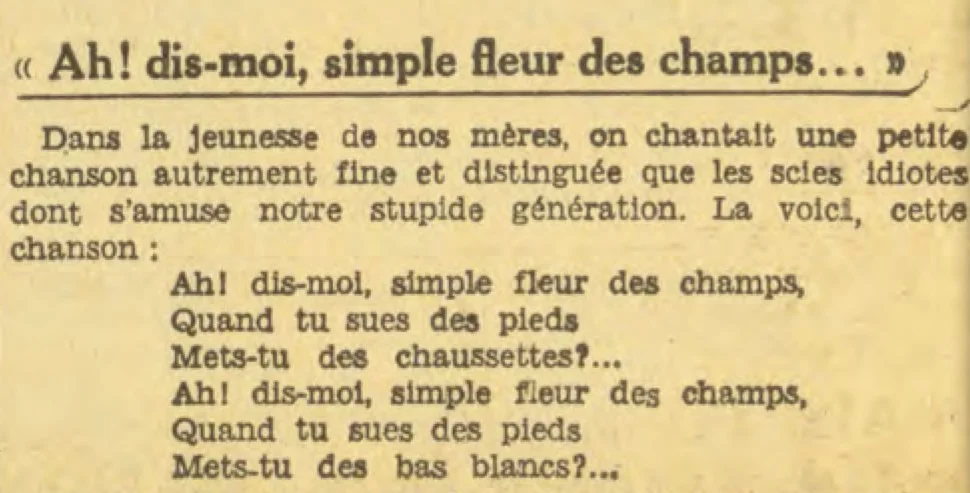
« Les propos d’Eve. Ah ! Dis-moi simple fleur des champs », Pourquoi pas?, n°1024, 16 mars 1934, p. 612-613.


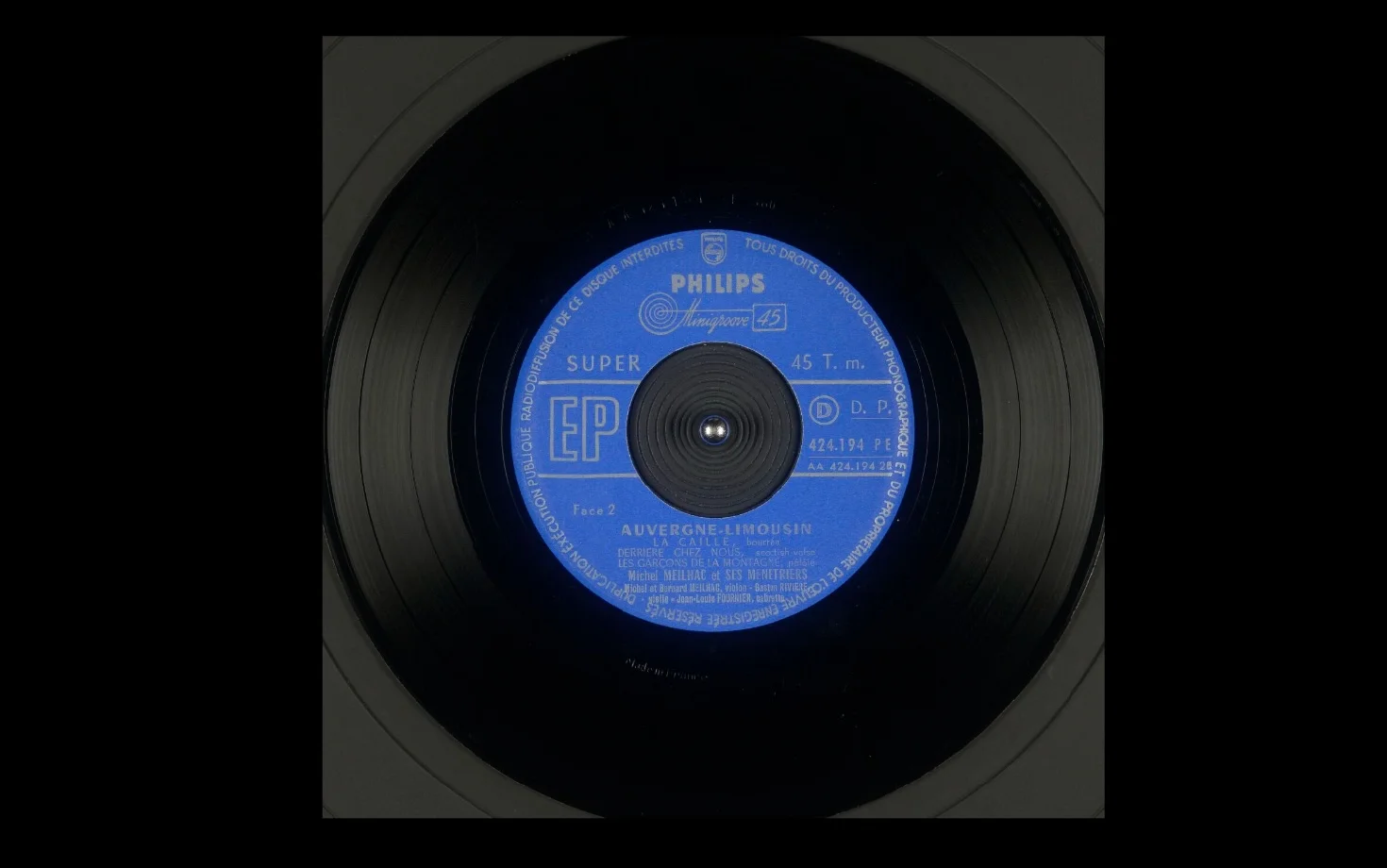
« Mazurka des grands-mères », Michel Meilhac et ses ménétriers, Auvergne-Limousin, 1 disque 45 tours, Philips, Le tour du monde en 45 tours, 424.194 PE, 1960. Enregistrement conservé à la Bibliothèque nationale de France.
1941, Cherche-Midi prison
This song reimagines six lines of a traditional folk song known by many names, all of them mazurkas: Mazurka de Lapleau [of Lapleau], Mazurka fleur des champs [of the Wildflowers], Mazurka petite fleur des champs [of the Little Wildflowers], Mazurka des grands-mères [of the Grandmothers], or even Mazurka des Loges-Marchis (named after a community in the Manche department of Normandy). A mazurka is a traditional Polish dance that made its way into French folklore during the nineteenth century. A ballroom dance and traditional folk song known in many regions, this mazurka does not seem to have been published as either a score or recording before the Second World War; its melody is presented here in an instrumental version by Michel Meilhac et ses ménétriers [minstrels], released by Philips in 1960 in the collection Le tour du monde en 45 tours [Around the world in 45 rpm], which documented folk music of France and Europe.
In the Belgian satirical weekly Pourquoi pas? [Why Not?] of March 16, 1934, the song is said to belong to “our mothers’ youth” and functions as a pretext for an exploration – using a comical contrast with sweaty feet – of the overused image of the flower as a symbol of feminine purity and elegance.
It is precisely the text quoted in this brief article that found its way into Oddon’s memory, to then be taken and transformed with her fellow prisoners. The song’s matter-of-fact humour and informal tone allow it to simultaneously refer to the guards’ rounds (the “22s”) and the unpleasant odour of their feet, which still doesn’t manage to kill the bedbugs infesting the prisoners’ cells.
As with the previous song, this one is presented in the collection as a refrain “sung as ‘warnings’ before and after the 22’s rounds”. Thus, it is a practical song, meant to alert the women in nearby cells to the arrival of a guard.
Of this dance in triple meter with many variations, Oddon only reworked the first part: an antecedent-consequent phrase characterized by a trochaic rhythm (long-short). This rhythm, along with the repeated cells of the melody, contribute to the song’s light, dance-like qualities, which undoubtedly helped the prisoners mask its use as a warning.
[Sources: references 35, 57, 62, 72, 75 in the bibliography]
Ah! dis-moi, simple fleur des champs…
Oh! Tell Me, Simple Wildflower…
(oral tradition)
Ah! dis-moi, simple fleur des champs,
Oh! Tell me simple wildflower,
Quand tu sues des pieds, mets-tu des chaussettes?...
When your feet sweat, do you put on socks?...
Ah! dis-moi, simple fleur des champs,
Oh! Tell me simple wildflower,
Quand tu sues des pieds, mets-tu des bas blancs?...
When your feet sweat, do you put on white socks?...
Vingt-Deux, quand tu pues des pieds
Twenty-Two, When Your Feet Stink
[untitled fragment]
(ms p. 6)
Vingt-Deux, quand tu pues des pieds
Twenty-Two, when your feet stink
Tu pourrais au moins tuer les punaises!
You could at least kill the bedbugs!
Vingt-deux, quand tu pues des pieds
Twenty-Two, when your feet stink
Tu pourrais au moins les asphyxier!
You could at least suffocate them!