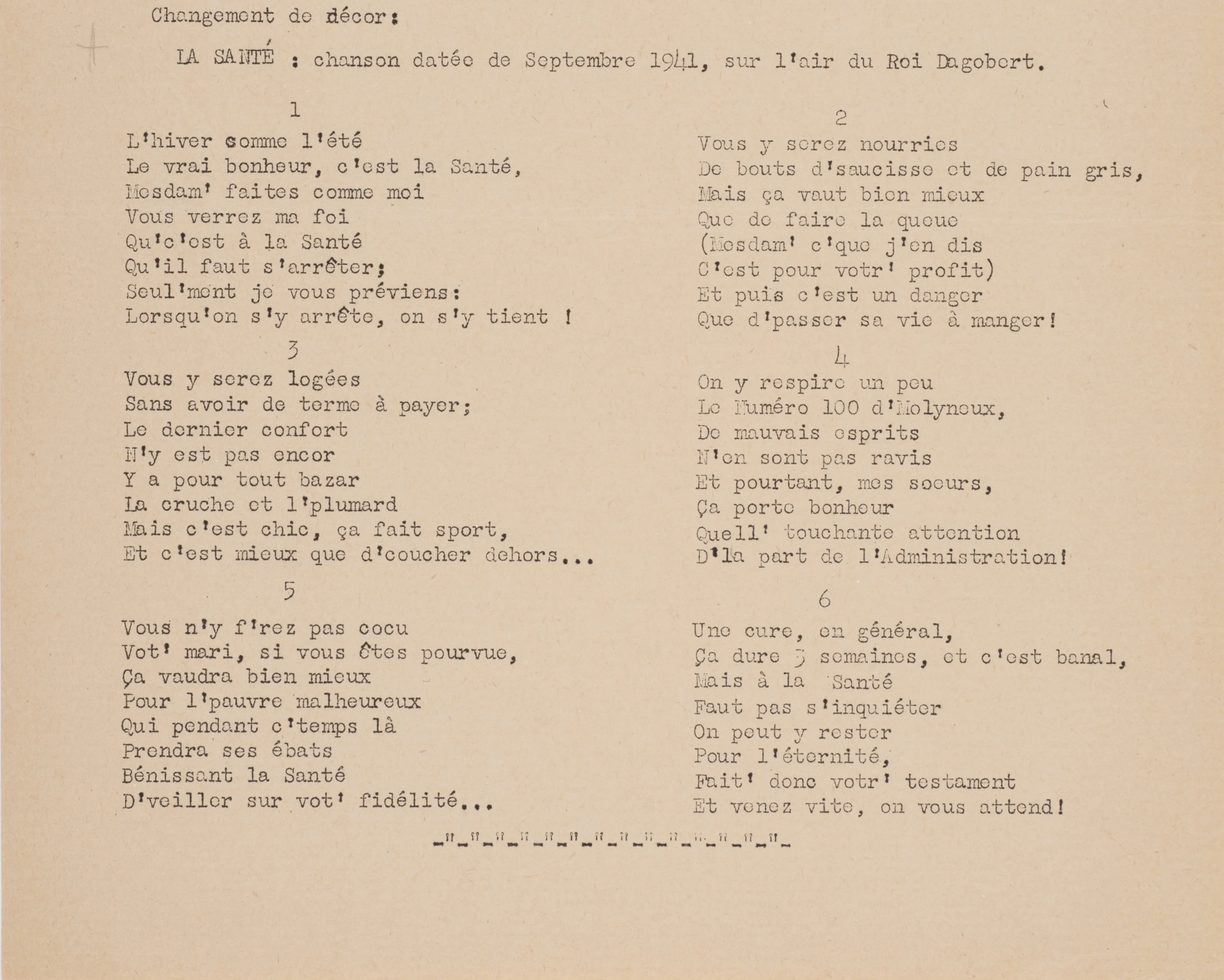

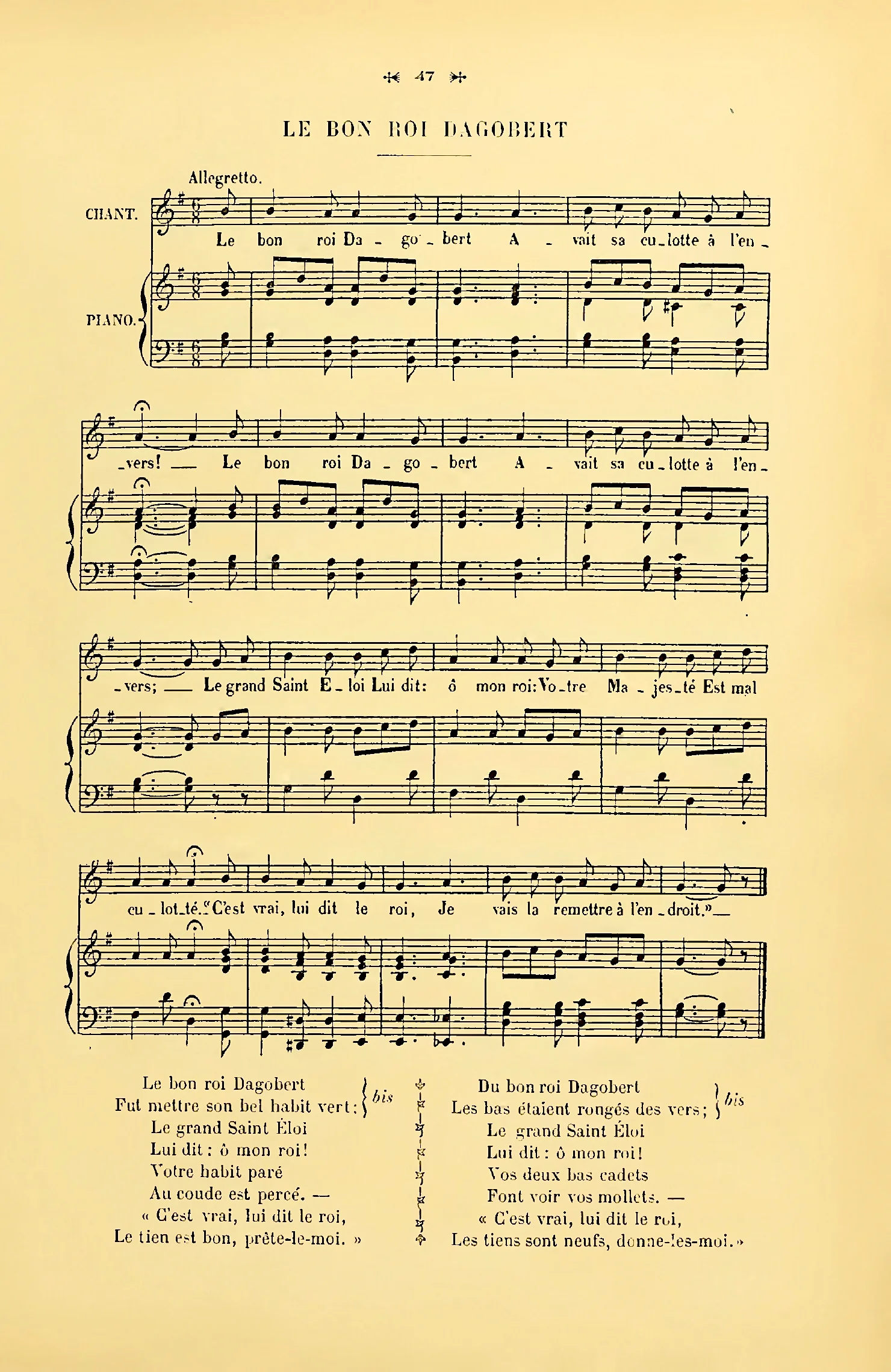
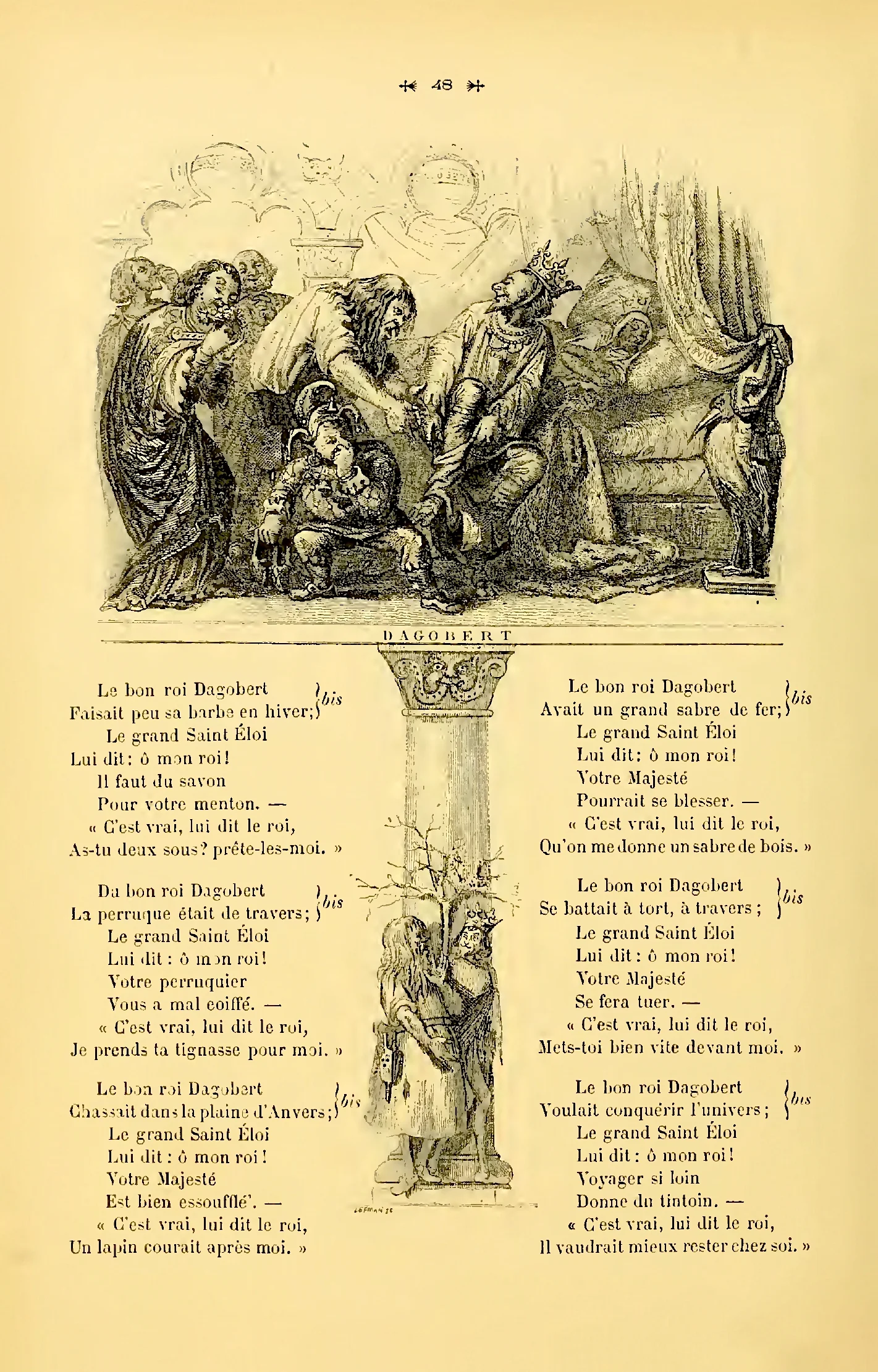
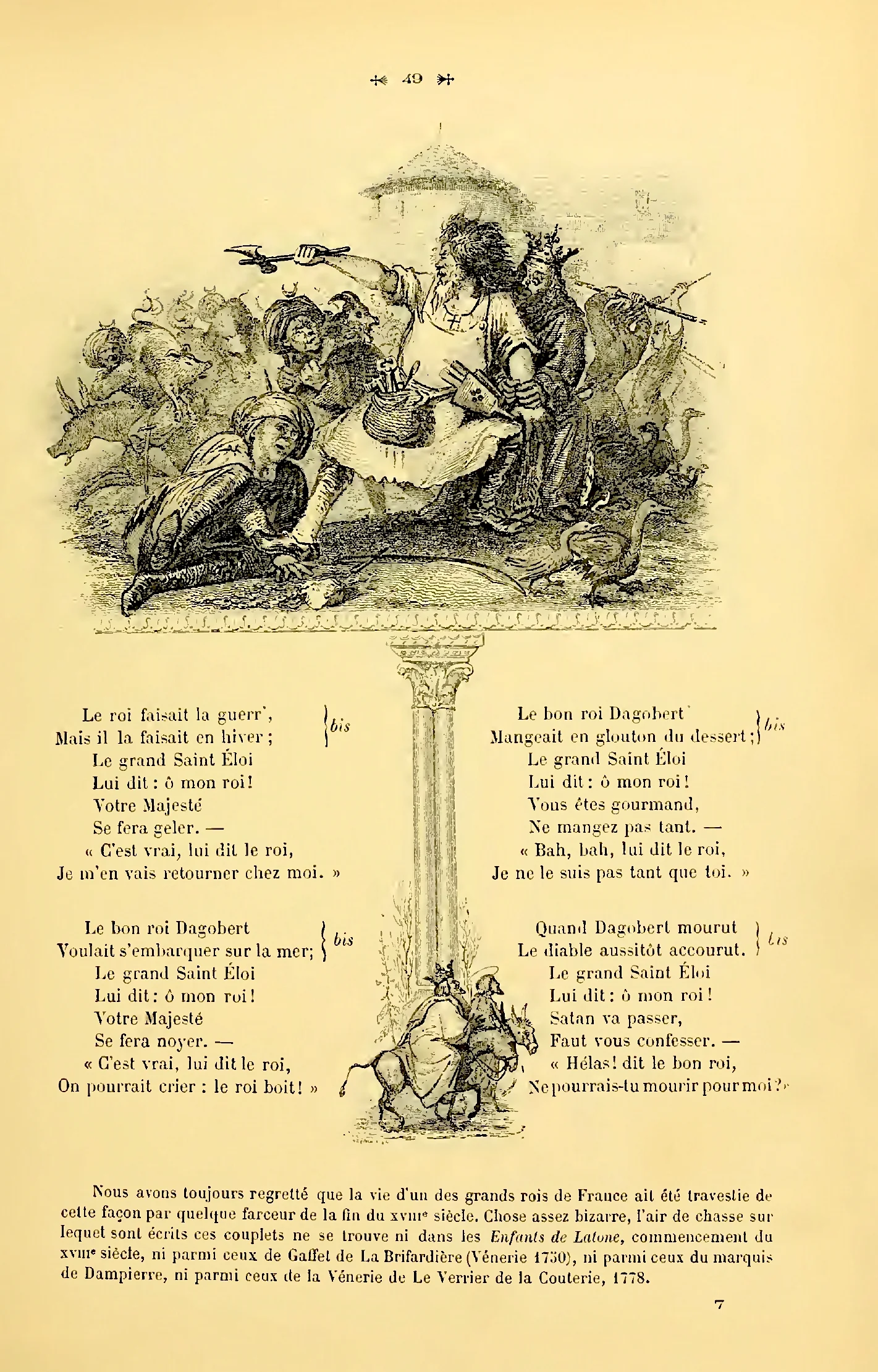
« Le bon roi Dagobert », partition pour chant et piano, dans Jean-Baptiste Weckerlin, Chansons et rondes enfantines avec notices et accompagnement de piano, Paris, Garnier Frères, 1870, p. 47-49.


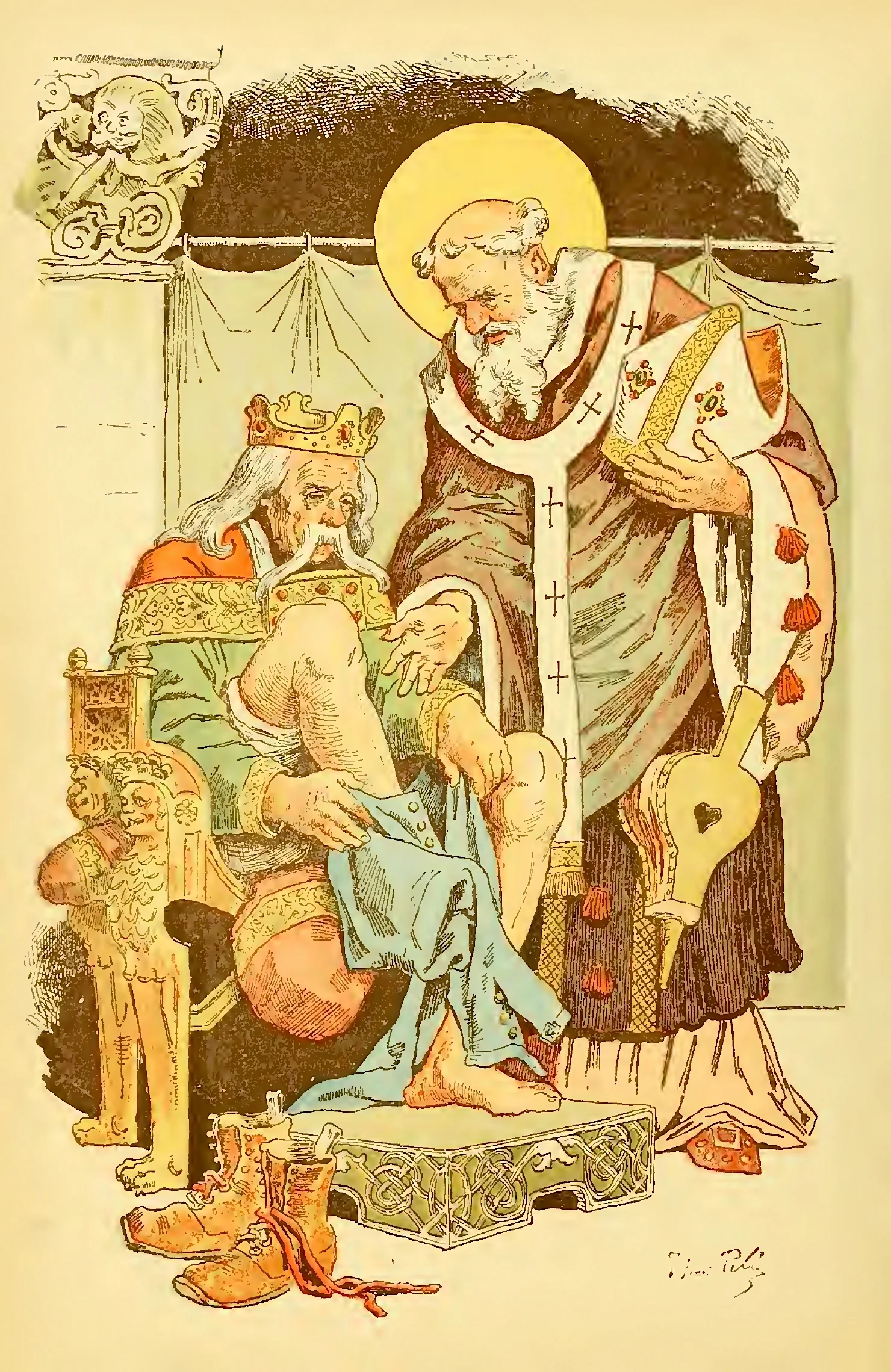
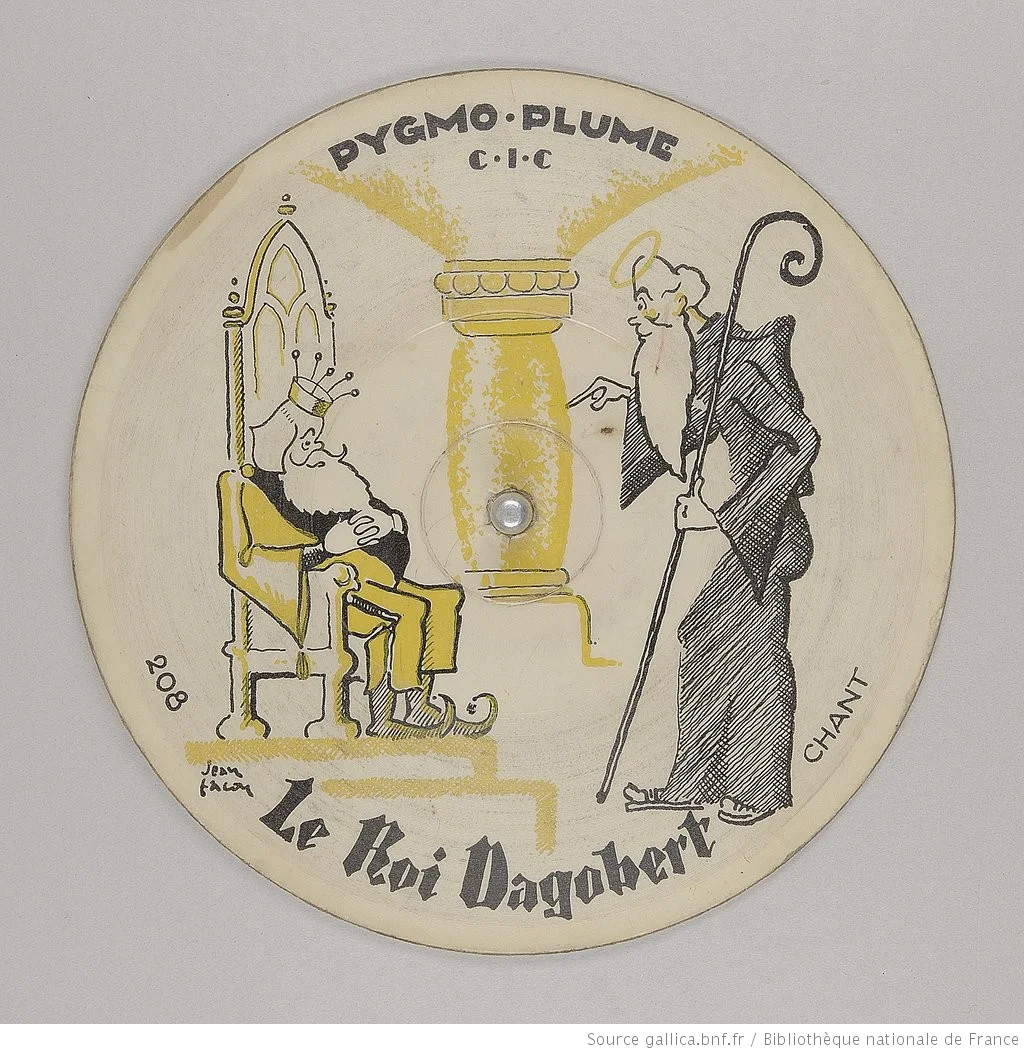
Le roi Dagobert, Mad Rainvyl (chant), 1 disque 78 tours, Pygmo-Plume, n° 208, 1931.
September 1941, La Santé prison
Inspiration in this case is taken from the famous folk song Le bon roi Dagobert, which dates back to the second half of the eighteenth century. According to researchers Jean-Claude Klein, Martine David, and Anne-Marie Delrieu (among others), its melody is based on the hunting call Fanfare du cerf [Deer’s Fanfare]. The song features the very inept Dagobert I (king of the Franks born c. 602/605, died c. 638/639) and one of his chief advisors, St. Eligius (also known as Saint Eloi), who always manages to get him out of trouble with his keen observations and clever turns of phrase. However, this song written in the pre-revolutionary period uses the historical figure of the Merovingian king to mock royal authority in general and King Louis XVI in particular, all while evading censorship. As events unfolded, many verses describing the foibles of King Dagobert/Louis XVI were added; this explains wide-ranging versions of Bon roi Dagobert, including Charles Péguy's novel as its literary extension.
The transcription of the lyrics presented here is based on a score from the volume Rondes et chansons enfantines (Garnier Frères, 1870) compiled by French composer, librarian, and musicographer Jean-Baptiste Weckerlin (1821-1910), with chromotypographic illustrations by French painter Henri Pille (1844-1897). The recording presented here is taken from the collection of illustrated albums produced by the German label Pygmo-Plume, which released numerous vinyl records in France, a considerable proportion of which featured music for children. The song is sung by French music-hall singer Mad Rainvyl (stage name of Madeleine Suzanne Raige, 1886-1953), who was the exclusive performer for this series of children’s albums.
In their reworked version, Yvonne Oddon and her companions transformed Le bon roi Dagobert into a mock advertisement for La Santé Prison, ironically describing the fabulous life to be led there (potentially indefinitely: “You can stay here / For eternity / […] hurry over, we’re expecting you!”). There is a pun in French here, and the double meaning is exploited throughout the reworked lyrics; “la santé” translates to “health” in English, as well as being the name of the prison. With six verses that perfectly follow the prosody of the original melody, the rewritten song is quite long, which further enhances the effectiveness of its comedic effect. It is worth noting the feminist undertones of this reimagined song that uses an entire verse to draw a parallel between the consequences of the Occupation and the motivations of patriarchy (“your husband […] / Will have a romp / Giving thanks that la Santé / Is keeping you faithful”).
[Sources: references 38, 55, 61, 93, 128 in the bibliography]
Le bon roi Dagobert
Good King Dagobert
(oral tradition)
Le bon roi Dagobert,
Good King Dagobert
Avait sa culotte à l’envers!
Had his pants on backwards!
Le grand Saint Éloi
The great St. Eligius
Lui dit : ô mon Roi!
Said to him: Oh my King!
Votre Majesté
Your Majesty’s
Est mal culotté…
Pants are back to front…
« C’est vrai, lui dit le roi,
“It’s true,” said the King,
Je vais la remettre à l’endroit. »
I will put them right way round.”
Le bon roi Dagobert
Good King Dagobert
Fut mettre son bel habit vert :
Went to put on his fine green garment:
Le grand Saint Éloi
The great St. Eligius
Lui dit : ô mon roi!
Said to him: Oh my King!
Votre habit paré
Your exquisite garment
Au coude est percé.
Is torn at the elbow.
« C’est vrai, lui dit le roi,
“It’s true,” said the King,
Le tien est bon, prête-le-moi. »
“Yours is nice, lend it to me.”
Du bon roi Dagobert
Good King Dagobert’s
Les bas étaient rongés des vers;
Stockings were eaten by worms;
Le grand Saint Éloi
The great St. Eligius
Lui dit : ô mon roi!
Said to him: Oh my King!
Vos deux bas cadets
Your two sagging stockings
Font voir vos mollets.
Show your calves.
« C’est vrai, lui dit le roi,
“It’s true,” said the King,
Les tiens sont neufs, donne-les-moi. »
Yours are new, give them to me.”
Le bon roi Dagobert
Good King Dagobert
Faisait peu sa barbe en hiver;
Rarely shaved in winter
Le grand Saint Éloi
The great St. Eligius
Lui dit : ô mon roi!
Said to him: Oh my King!
Il faut du savon
You need soap
Pour votre menton.
For your chin
« C’est vrai, lui dit le roi,
“It’s true,” said the King,
As-tu deux sous? prête-les-moi. »
Have you two cents? Give them to me.”
Du bon roi Dagobert
Good King Dagobert’s
La perruque était de travers;
Wig was lopsided;
Le grand Saint Éloi
The great St. Eligius
Lui dit : ô mon roi!
Said to him: Oh my King!
Votre perruquier
Your wigmaker
Vous a mal coiffé.
Has styled you badly.
« C’est vrai, lui dit le roi,
“It’s true,” said the King,
Je prends ta tignasse pour moi. »
I’m taking your locks for myself.”
Le bon roi Dagobert
Good King Dagobert
Chassait dans la plaine d’Anvers;
Was hunting on the plains of Antwerp;
Le grand Saint Éloi
The great St. Eligius
Lui dit : ô mon roi!
Said to him: Oh my King!
Votre Majesté
Your Majesty
Est bien essoufflé.
Is out of breath.
« C’est vrai, lui dit le roi,
“It’s true,” said the King,
Un lapin courait après moi. »
A rabbit was chasing me.”
Le bon roi Dagobert
Good King Dagobert
Avait un grand sabre de fer;
Had a big iron sword
Le grand Saint Éloi
The great St. Eligius
Lui dit : ô mon roi!
Said to him: Oh my King!
Votre Majesté
Your Majesty
Pourrait se blesser.
Could injure himself.
« C’est vrai, lui dit le roi,
“It’s true,” said the King,
Qu’on me donne un sabre de bois. »
Give me a wooden sword.”
Le bon roi Dagobert
Good King Dagobert
Se battait à tort, à travers;
Was fighting erratically
Le grand Saint Éloi
The great St. Eligius
Lui dit : ô mon roi!
Said to him: Oh my King!
Votre Majesté
Your Majesty
Se fera tuer.
Will get himself killed.
« C’est vrai, lui dit le roi,
“It’s true,” said the King,
Mets-toi bien vite devant moi. »
Hurry, stand in front of me.”
Le bon roi Dagobert
Good King Dagobert
Voulait conquérir l’univers;
Wanted to conquer the universe;
Le grand Saint Éloi
The great St. Eligius
Lui dit : ô mon roi!
Said to him: Oh my King!
Voyager si loin Donne du tintoin.
Travelling so far will make a commotion.
« C’est vrai, lui dit le roi,
“It’s true,” said the King,
Il vaudrait mieux rester chez soi. »
Better off staying at home.”
Le roi faisait la guerr’,
The King was waging war,
Mais il la faisait en hiver;
But waging it in winter;
Le grand Saint Éloi
The great St. Eligius
Lui dit : ô mon roi!
Said to him: Oh my King!
Votre Majesté
Your Majesty
Se fera geler.
Will freeze.
« C’est vrai, lui dit le roi,
“It’s true,” said the King,
Je m’en vais retourner chez moi. »
I’ll head back home.”
Le bon roi Dagobert
Good King Dagobert
Voulait s’embarquer sur la mer;
Wanted to go to sea;
Le grand Saint Éloi
The great St. Eligius
Lui dit : ô mon roi!
Said to him: Oh my King!
Votre Majesté
Your Majesty
Se fera noyer.
Will drown.
« C’est vrai, lui dit le roi,
“It’s true,” said the King,
On pourrait crier : le roi boit! »
“People could say: ‘The King drinks!’”
Le bon roi Dagobert
Good King Dagobert
Mangeait en glouton du dessert;
Ate dessert like a glutton
Le grand Saint Éloi
The great St. Eligius
Lui dit : ô mon roi!
Said to him: Oh my King!
Vous êtes gourmand,
You have a sweet tooth,
Ne mangez pas tant.
Do not eat so much.
« Bah, bah, lui dit le roi,
“Well now,” said the King,
Je ne le suis pas tant que toi. »
“I’m not as bad as you.”
Quand Dagobert mourut
When Dagobert died
Le diable aussitôt accourut.
The devil rushed right in.
Le grand Saint Éloi
The great St. Eligius
Lui dit : ô mon roi!
Said to him: Oh my King!
Satan va passer,
Satan is coming,
Faut vous confesser.
You must make your confession.
« Hélas ! dit le bon roi,
“Alas!” said the good King,
Ne pourrais-tu mourir pour moi? »
Could you not die for me?”
La Santé
La Santé (Good Health)
(ms p. 6)
1
L’hiver comme l’été
In winter as in summer
Le vrai bonheur, c’est la Santé,
True happiness, is la Santé,
Mesdam’ faites comme moi
Ladies follow my lead
Vous verrez ma foi
You’ll see, I’m telling you
Qu’c’est à la Santé
That it’s la Santé
Qu’il faut s’arrêter;
We should focus on;
Seul’ment je vous préviens :
But I warn you:
Lorsqu’on s’y arrête, on s’y tient!
Once you are focussed, you’re committed!
2
Vous y serez nourries
Here you’ll be fed
De bouts d’saucisse et de pain gris,
Bits of sausage and dry bread
Mais ça vaut bien mieux
But better that
Que de faire la queue
Than standing in line
(Mesdam’ c’que j’en dis
(Ladies what I’m saying
C’est pour votr’ profit)
Is for your own good)
Et puis c’est un danger
And anyway it’s not safe
Que d’passer sa vie à manger!
To spend your life eating!
3
Vous y serez logées
You’ll be housed here
Sans avoir de terme à payer;
Without paying a cent;
Le dernier confort
The latest comforts
N’y est pas encor
Haven’t arrived yet
Y a pour tout bazar
And as for the rest
La cruche et l’plumard
A jug and a bed
Mais c’est chic, ça fait sport,
But it’s stylish and sporty,
Et c’est mieux que d’coucher dehors…
And it’s better than sleeping outdoors…
4
On y respire un peu
There’s more than a mild whiff here
Le Numéro 100 d’Molyneux,
Of Molyneux No. 100 (our literal eau de toilet),
De mauvais esprits
The mean-spirited
N’en sont pas ravis
Are not thrilled
Et pourtant, mes sœurs,
And yet my sisters,
Ça porte bonheur
It’s a good omen
Quell’ touchante attention
What touching consideration
D’la part de l’Administration!
From the Administration!
5
Vous n’y f’rez pas cocu
You’ll not be cheating here
Vot’ mari, si vous êtes pourvue,
On your husband, if you have one,
Ça vaudra bien mieux
It’ll go much better
Pour l’pauvre malheureux
For the poor wretch
Qui pendant c’temps là
Who, meanwhile,
Prendra ses ébats
Will have a romp
Bénissant la Santé
Giving thanks that la Santé
D’veiller sur vot’ fidélité…
Is keeping you faithful…
6
Une cure, en général,
A treatment, in general
Ça dure 3 semaines, et c’est banal,
Lasts 3 weeks, and that’s standard,
Mais à la Santé
But with la Santé
Faut pas s’inquiéter
No need to worry
On peut y rester
You can stay here
Pour l’éternité,
For eternity,
Fait’ donc votr’ testament
So write up your will
Et venez vite, on vous attend!
And hurry over, we’re expecting you!