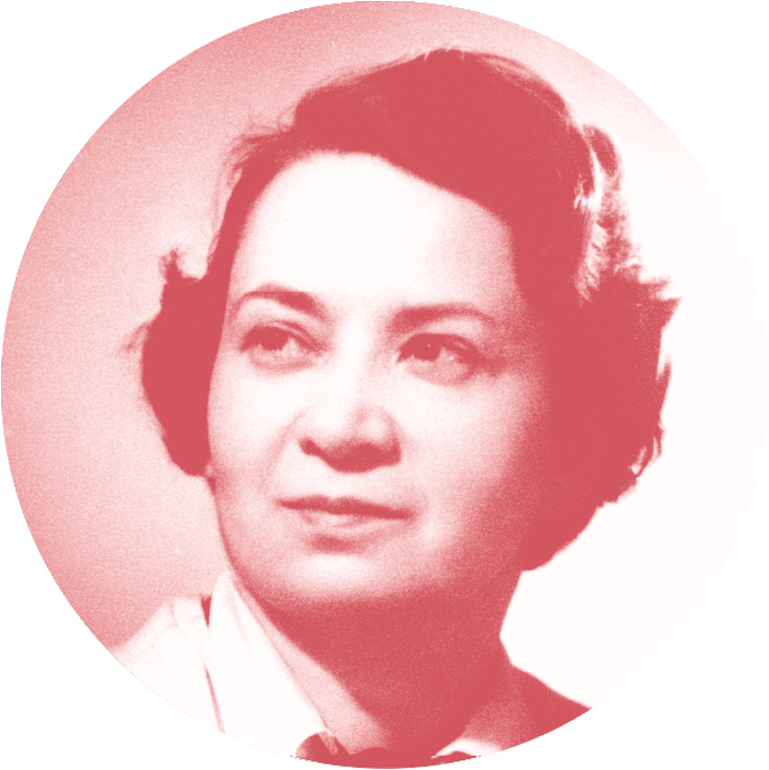
In the gloom of Nazi prisons, women of the Resistance had the brilliant audacity to sing about the reality of their incarceration. Using melodies of well-known songs of the time, they transformed the lyrics, with caustic wit, to tailor them to their wretched conditions and give themselves the collective courage to continue the fight. All this is brought to light by this virtual exhibition based on a collection of songs typed up after the war by French Resistance fighter Yvonne Oddon (1902-1982) upon her return from more than four years of deportation and internment in several Nazi prisons and concentration camps.
In addition to tracing the original musical sources of these songs, the exhibition helps bring them (back) to life through performances by Catherine Harrison-Boisvert (voice) and Monica Han (piano). It opens a fascinating window on the practice of singing “to the tune of” as a resistance strategy in the context of detention – when musical memory constituted one of the rare lifelines connecting detainees to the world beyond the prison.
The map opposite traces the route of Yvonne Oddon’s deportation. The prison names in black denote sites where the songs she catalogued upon her return to France were created; the names of Nazi prisons and camps in grey show deportation sites that are not associated with any of the songs documented here.


Cherche-Midi (1941)
Built between 1847 and 1851 at the heart of Paris’s 6th arrondissement, the Cherche-Midi military prison was the first detention facility in Paris to combine individual cells with group workshops, based on the model used in the United States at the time. It held many famous prisoners, including Alfred Dreyfus, who was incarcerated there after his arrest and during his trial in 1894-1895. Requisitioned by the Gestapo in June 1940, the Cherche-Midi prison was the only Parisian prison to remain entirely under German control throughout the Occupation. It was mainly used as a transit point for political prisoners, notably members of the Musée de l’Homme resistance network, to which Yvonne Oddon belonged. To break the physical isolation in which the “political prisoners” were held, a culture of solidarity quickly developed, with prisoners talking and singing through the gaps in their cell doors, as evidenced by the large number of songs Oddon collected there. The Cherche-Midi prison was demolished in the early 1960s; the Fondation Maison des sciences de l’homme was built on the site and still stands there today.
La Santé (1941-1942)
In the 14th arrondissement of Paris, on Rue de la Santé, the men’s prison of the same name was built between 1863 and 1868. While the prison was initially a model of modernity and hygiene, its detention conditions deteriorated over time. Overcrowding became particularly acute during the Occupation, when La Santé, partly controlled by the Nazi authorities until the end of 1942, held a large number of political prisoners (which, for the first time, included women). Several members of the Musée de l’Homme network passed through this prison in 1941-1942, before and after the mass trial held at Fresnes prison in early 1942. While the women were subsequently deported, several men (including Anatole Lewitsky, Oddon’s fiancé) were transferred from there to the Mont-Valérien fortress, where they were executed by firing squad. At La Santé, it was very difficult to communicate by sound with neighbouring cells, which probably explains why Oddon wrote only one song related to this place. The La Santé prison still exists today: it is the only prison building still in operation within Paris city limits.
Anrath (1942)
Built at the turn of the twentieth century, the co-ed Anrath prison near Dusseldorf was put to use for the Nazi regime when Hitler came to power in 1933. After the outbreak of the Second World War, many of its prisoners were Resistance fighters who were sentenced by the German military tribunals in France, Belgium, and the Netherlands, then deported to Germany to serve their sentence. The conditions of their detention were extremely harsh: crammed into an overcrowded prison and starved by rations so small that it was not uncommon for prisoners to literally die from hunger, the detainees were also subjected to the arbitrary whims of a sadistic director, Bodo Combrinck, who engaged in physical and psychological torture. Yvonne Oddon arrived at Anrath in March 1942 after several weeks of detention at Karlsruhe prison, and was assigned to manual labour (sewing, embroidery, basketry) in her cell, which allowed her to avoid the work details in factories in the nearby town of Krefeld, where conditions were atrocious. Liberated by the US Army in March 1945, Anrath prison was replaced in 1985 by two separate penitentiaries, one for men (Willich I) and one for women (Willich II).
Lübeck (1942-1943)
Also known as Lauerhof (named after the land on which it stands, three kilometers east of the city), Lübeck Prison was inaugurated in April 1909, responding, at the time, to a significant need to modernize the region’s prison facilities. When it opened, it had a capacity for 512 men and 46 women, housed in two separate buildings. After the Nazi Party came to power in 1933, the prison population grew exponentially, grouping together prisoners of war, victims of oppression (Jewish men and women, Jehovah’s Witnesses, homosexuals, etc.) and many political prisoners. Despite this overcrowding, conditions in Lübeck were less harsh than in Anrath, at least in terms of food and discipline. Yvonne Oddon, who notated five songs collected in Lübeck prison between the end of 1942 and the end of 1943, recounted in a lecture in June 1945 that she worked there 10 to 12 hours a day in “sweatshops, sewing on machines, weaving rushes or corn leaves, etc.” The prison is still in operation today.
Cottbus (1944)
The co-ed prison in Cottbus was inaugurated in 1860. Between January 1939 and April 1945, it became a women’s prison, holding a large number of political prisoners. German Resistance fighters were imprisoned there, as well as many French and Belgian prisoners who, like Yvonne Oddon, belonged to the “Nacht und Nebel” (“N.N.” or “night and fog”) category, an expression used to refer to political deportees who were held in secret by Nazis. In a lecture given in June 1945, Oddon recounted how the spirit of solidarity made the prisoners “strong enough to defy [their] Nazi guards and organize certain national demonstrations, such as the famous one on July 14, 1944, at Cottbus prison.” Like many “N.N.” prisoners in Cottbus, Oddon refused to work in a gas mask factory, which led to her transfer to Ravensbrück in November 1944. Partially destroyed by bombing on February 15, 1945, Cottbus prison was abandoned by the Nazi authorities in April 1945, then reopened by the city of Cottbus in July 1945. In 2012, it was converted into a memorial by the Cottbus Human Rights Centre.
Cover photo: Yvonne Oddon and Paule Barret-Reichlen at the library of the Musée de l’Homme in Paris, December 1929. © Musée du quai Branly – Jacques Chirac, Dist. GrandPalaisRmn/Art Resource, NY.
Cherche-Midi (1941)
La Santé (1941-1942)
Anrath (1942)
Lübeck (1942-1943)